The Digital Economy
Introducido| English | Significado |
|---|---|
| service sector | The part of the economy that provides services, such as health care, retail, finance and teaching. |
| deindustrialization/ˌdeɪndəˌstrɪəlaɪˈzeɪʃn/ | The decline of manufacturing industry in a country or region, with the loss of factory jobs. |
A computer in every home
- When IBM launched its personal computer in 1981, few families owned one. By 2000, about half of American households had a computer, and many were connecting to the World Wide Web, which had opened to the public in 1991. Work, shopping and communication were changing fast.
- From the 1980s, technology and globalization reshaped the American economy.
New technologies
- Personal computers, the internet and mobile phones raised productivity in offices, banks and shops.
- New firms such as Microsoft, Apple and Amazon grew into some of the world's largest companies.
Who worked
- More women worked outside the home: about 43% of women were in the labour force in 1970, and about 60% by 2000.
- Jobs moved from factories to the service sector 服务业 — health care, retail, finance and information.
Women's labour-force participation rose from about 43% in 1970 to about 60% in 2000. By how many percentage points did it rise?
Dificultad 2/5 · 140 monedas + un pequeño bono en el primer intento de hoy
60 − 43.
Which job is in the service sector?
Dificultad 1/5 · 100 monedas + un pequeño bono en el primer intento de hoy
Services, not manufacturing.
Worked example: why manufacturing jobs fell
US manufacturing employment peaked at about 19.5 million in 1979; by 2010 it was about 11.5 million.
- Technology: automation let factories make more with fewer workers.
- Globalization: free-trade agreements such as NAFTA (1994) and China's entry into the WTO (2001) moved production to lower-wage countries.
- Effect: deindustrialization 去工业化 hit the "Rust Belt" — Detroit, Cleveland, Pittsburgh — where well-paid union jobs disappeared.
Follow the forces behind rising inequality
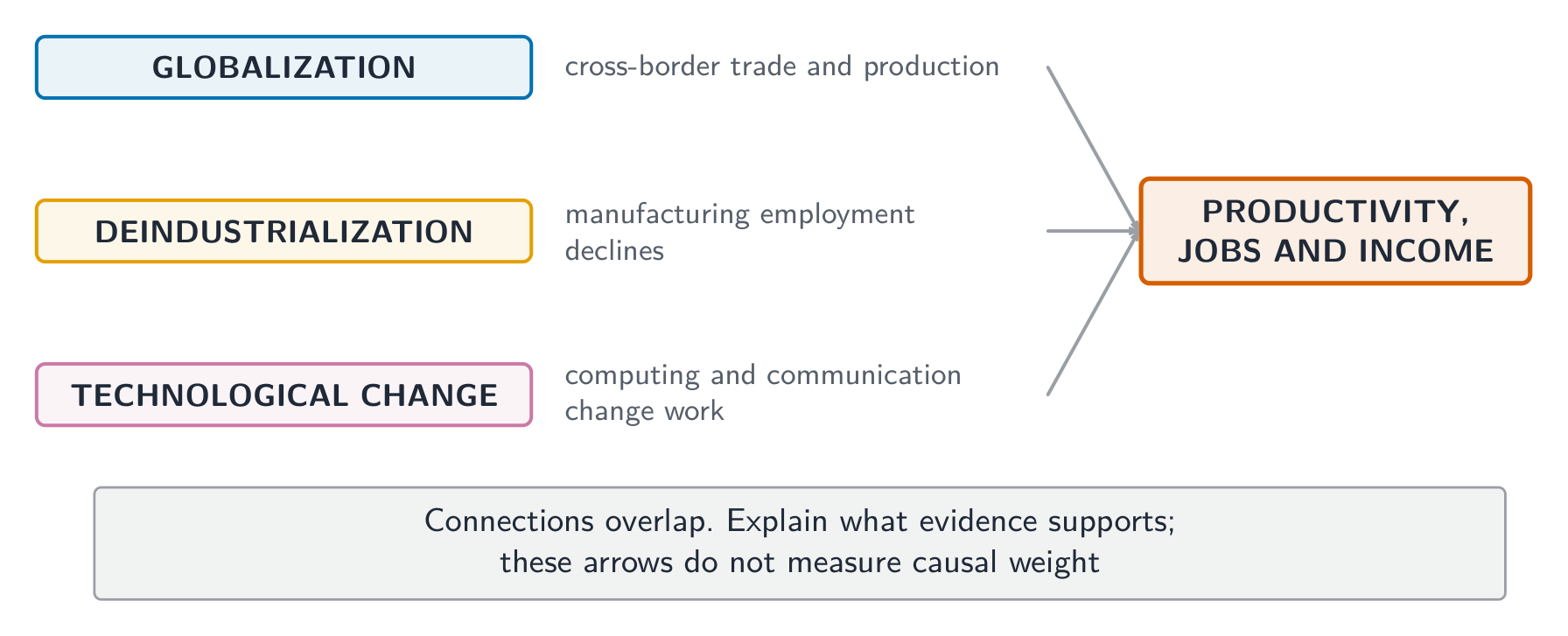
Globalization, deindustrialization and technological change overlap, so the argument is about weight.
Which contributed to the fall in US manufacturing jobs?
Dificultad 2/5 · 140 monedas + un pequeño bono en el primer intento de hoy
Union membership fell.
Deindustrialization hit cities such as Detroit and Pittsburgh hard.
Dificultad 1/5 · 100 monedas + un pequeño bono en el primer intento de hoy
The Rust Belt.
Unions shrink
- About 20% of American workers belonged to unions in 1983; by the 2020s it was about 10%.
- Reagan's firing of 11 000 striking air-traffic controllers in 1981 signalled tougher treatment of unions.
What happened to union membership after 1983?
Dificultad 1/5 · 100 monedas + un pequeño bono en el primer intento de hoy
Unions shrank.
Wages and inequality
- Productivity grew, but wages for many middle- and lower-income workers barely rose after inflation from the 1970s on.
- Highly educated workers in technology and finance gained most, and income inequality widened.

Do not blame one cause alone. Technology, trade, weaker unions and tax policy all contributed to the loss of factory jobs and to rising inequality. Historians and economists weigh them differently.
Historians agree that one single cause explains rising inequality.
Dificultad 1/5 · 100 monedas + un pequeño bono en el primer intento de hoy
Several causes are weighed.
Computers and the internet raised productivity and created new industries, while more women joined the workforce. Automation and globalization cut manufacturing jobs, union membership fell, and wages stagnated for many, widening inequality.
Explain the effects of technological change and globalization on American workers after 1980.
Causation.