The Conservative Turn
Introducido| English | Significado |
|---|---|
| stagflation/stæɡˈfleɪʃn/ | A combination of inflation with stagnant economic activity and high unemployment. |
| Religious Right | Conservative Christian voters and groups, such as the Moral Majority, active in politics from the late 1970s. |
| New Right | The conservative movement of the 1970s and 1980s that wanted lower taxes, smaller government and traditional social values. |
A tax revolt in California, June 1978
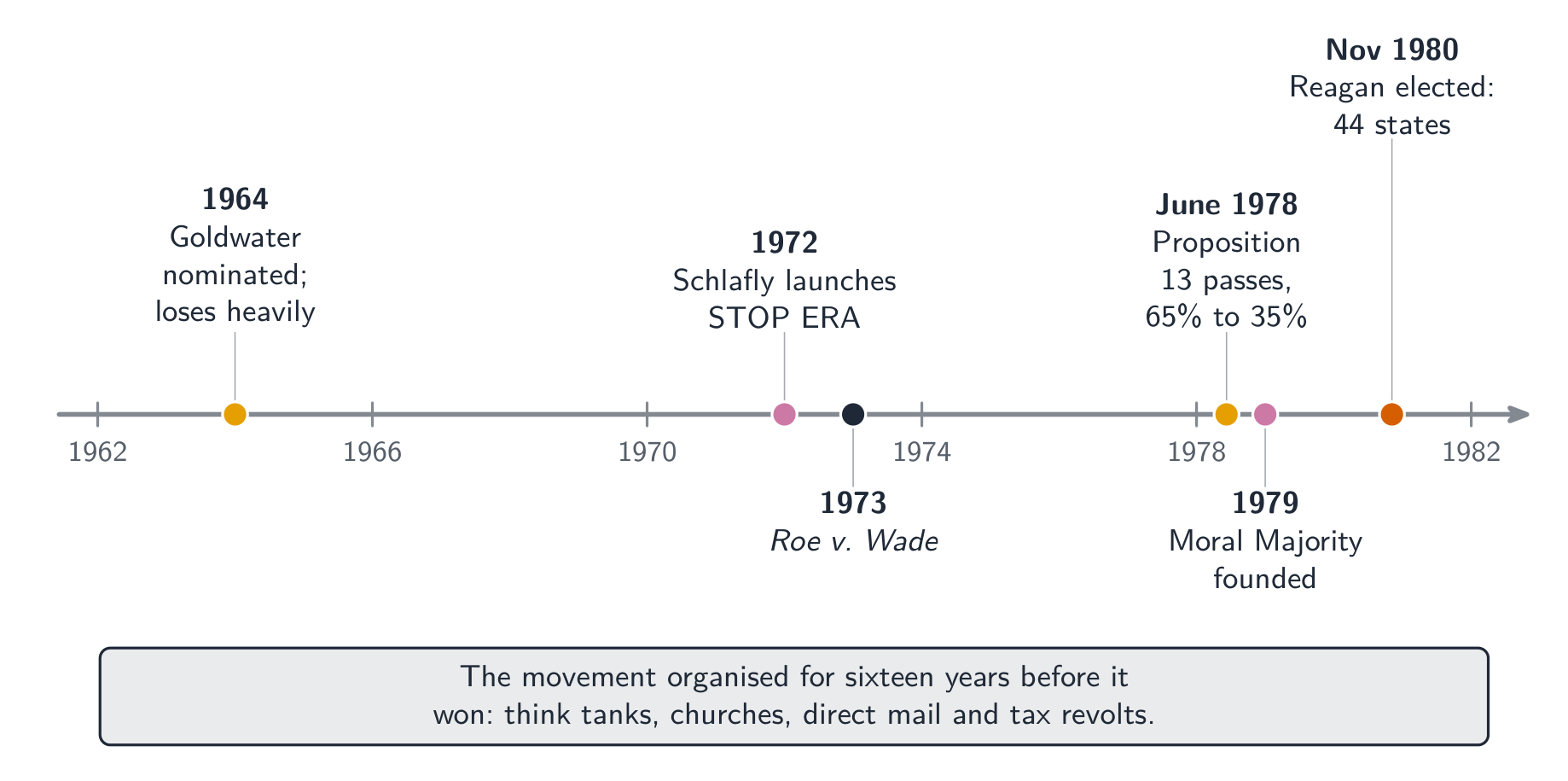
- On 6 June 1978, California voters approved Proposition 13 by about 65% to 35%. It cut property taxes by more than half and limited future increases. Its leader, Howard Jarvis, said ordinary homeowners were tired of a government that took too much. Tax revolts spread to other states, and two years later Ronald Reagan won the presidency.
- In the 1970s and 1980s, a conservative movement grew in politics, religion and the economy.
Proposition 13 won about 65% of the vote. What percentage voted against?
Dificultad 2/5 · 140 monedas + un pequeño bono en el primer intento de hoy
100 − 65.
Confidence in government fell
- Vietnam, the Watergate scandal and Nixon's resignation (August 1974) made many Americans distrust government.
- In the 1970s, stagflation 滞胀 — high inflation and high unemployment together — weakened faith in liberal economic policy.
What is stagflation?
Dificultad 1/5 · 100 monedas + un pequeño bono en el primer intento de hoy
The 1970s.
Conservatives challenged on four fronts
- Taxes and government: they wanted lower taxes, less regulation and smaller welfare programs.
- Social issues: they opposed the Court's abortion ruling Roe v. Wade (1973), busing to integrate schools and the Equal Rights Amendment, which Phyllis Schlafly helped defeat.
What did conservatives oppose in the 1970s?
Dificultad 2/5 · 140 monedas + un pequeño bono en el primer intento de hoy
Fronts of the conservative challenge.
Worked example: religion and political activism
- Growth: evangelical churches grew quickly in the 1970s.
- Organisation: in 1979, the preacher Jerry Falwell founded the Moral Majority to bring religious voters into politics.
- Result: the Religious Right 宗教右派 became a strong part of the Republican coalition and helped elect Reagan in 1980.
Assemble the conservative turn
Three policies rest on one economic claim, and two of them pull against each other on the deficit.
Match each person to their role.
Dificultad 2/5 · 140 monedas + un pequeño bono en el primer intento de hoy
Leaders of the New Right.
New voters
- Many white Southern voters left the Democratic Party for the Republicans after the civil rights laws.
- Sun Belt suburbs, with their homeowners and taxpayers, became strongholds of the New Right 新右派.
Reagan's election
- In 1980, Reagan won 44 states. He promised lower taxes, less government and a stronger stand against the Soviet Union.
- He cut the top income tax rate from 70% to 28% by 1988.
Reagan cut the top income tax rate from 70% to 28%. By how many percentage points?
Dificultad 2/5 · 140 monedas + un pequeño bono en el primer intento de hoy
70 − 28.
The conservative turn did not undo the New Deal. Social Security and Medicare stayed; Reagan cut some programs but government spending still grew.
Reagan abolished Social Security.
Dificultad 1/5 · 100 monedas + un pequeño bono en el primer intento de hoy
The New Deal core stayed.
After Vietnam, Watergate and stagflation lowered trust in government, conservatives challenged high taxes, welfare and changes in social values. Proposition 13, the Religious Right and the move of Southern and Sun Belt voters built the coalition that elected Reagan in 1980.
Explain the causes of the conservative turn of the 1970s and 1980s.
Causation.