The Nation by 1980
Introducido| English | Significado |
|---|---|
| credibility gap/ˌkredɪˈbɪlɪti ɡæp/ | The gap between what the government said about the Vietnam War and what Americans came to believe was true. |
Footprints on the Moon, July 1969
- On 20 July 1969 Neil Armstrong stepped onto the Moon, and hundreds of millions of people watched on television. The Apollo programme had cost about 25 billion dollars and employed about 400 000 people. It was a Cold War victory and a moment of national pride.
- Between 1945 and 1980 the United States led the world, widened rights at home and grew rich — and argued about all three.
The Moon landing of 1969 was also a Cold War victory.
Dificultad 1/5 · 100 monedas + un pequeño bono en el primer intento de hoy
The space race with the Soviet Union.
Global leadership, argued over
- The US built alliances (NATO, 1949), fought in Korea and Vietnam, and spent heavily on defence. Containment had wide support until Vietnam: by 1971 most Americans told pollsters the war had been a mistake.
- After Watergate, Congress passed the War Powers Resolution (1973) to limit a president's power to send troops abroad.
What was the War Powers Resolution (1973) meant to do?
Dificultad 1/5 · 100 monedas + un pequeño bono en el primer intento de hoy
A reaction to Vietnam.
Rights, expanded and contested
- The Brown decision (1954), the Civil Rights Act (1964) and the Voting Rights Act (1965) ended legal segregation; women, Latinos, Native Americans and gay Americans organised for their own rights.
- Each gain met resistance: from "massive resistance" in the South to the campaign against the Equal Rights Amendment, which fell three states short in 1982.
Put these in order.
Dificultad 3/5 · 200 monedas + un pequeño bono en el primer intento de hoy
1954, 1964, 1965, 1982.
Affluence, and its limits
- Median family income roughly doubled between 1947 and 1973, and suburbs, cars and television spread. Johnson's Great Society added Medicare and Medicaid (1965).
- Poverty remained in cities, the rural South and on reservations, and the oil shocks of 1973 and 1979 ended the long boom.
What happened to median family income between 1947 and 1973?
Dificultad 1/5 · 100 monedas + un pequeño bono en el primer intento de hoy
The long postwar boom.
Worked example: two changes at once. In 1964, 77% of Americans told the American National Election Studies that they trusted the federal government to do the right thing most of the time. By 1980 only 25% did. Over the same years that government had passed the Civil Rights and Voting Rights Acts. So the period ended with more people included by the government and fewer trusting it. A strong answer reports both.
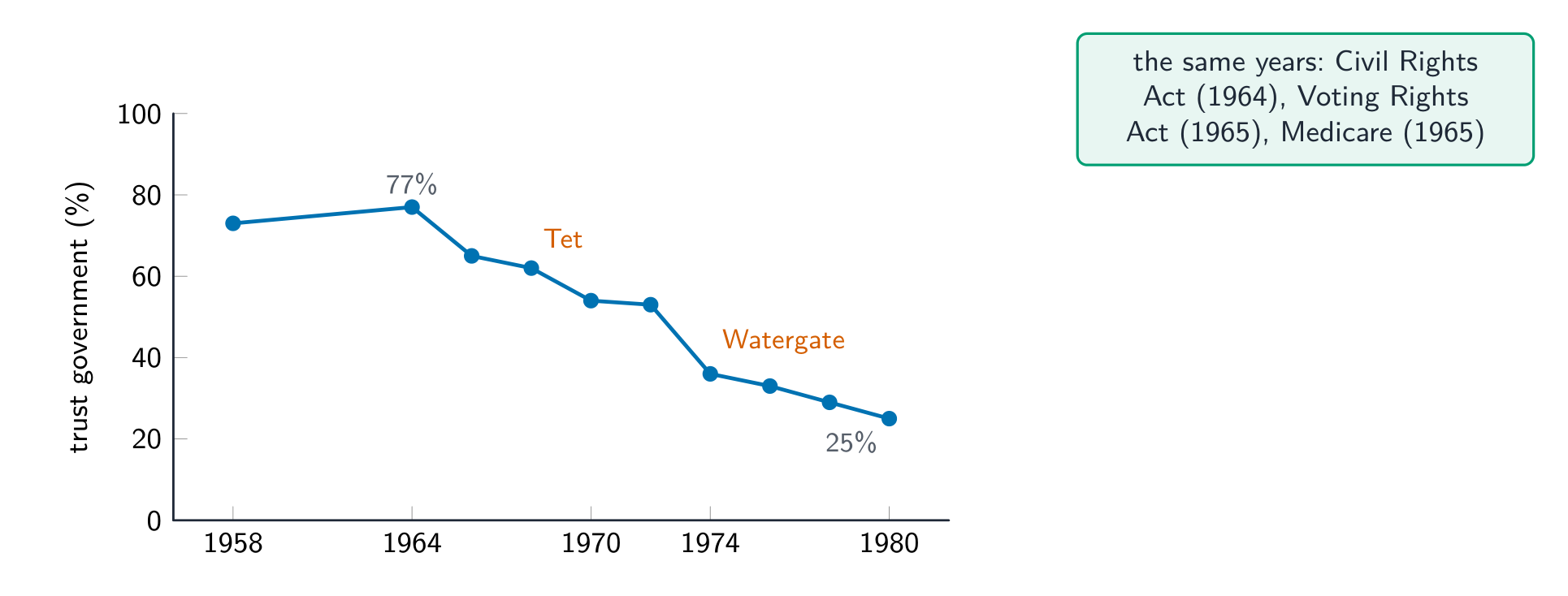
Trust in the federal government fell from 77% in 1964 to ____% in 1980.
Dificultad 1/5 · 100 monedas + un pequeño bono en el primer intento de hoy
American National Election Studies.
Why trust fell
- Vietnam opened a credibility gap 信任差距: official claims of progress were contradicted by the Tet Offensive (1968) and the Pentagon Papers (1971).
- Watergate led to Nixon's resignation in 1974, and inflation above 13% in 1979 made government look unable to fix the economy.
Gain or loss?
Sort each development of 1945-1980.
Which helped cause the fall in trust?
Dificultad 2/5 · 140 monedas + un pequeño bono en el primer intento de hoy
The GI Bill was popular.
Do not describe the period as only progress or only decline. Rights and incomes grew while trust collapsed. Name both trends and give a number or case for each.
From 1945 to 1980 the US led the Western alliance, but Vietnam turned most Americans against that war by 1971. Civil rights laws widened legal equality, and incomes doubled to 1973. Yet trust in the federal government fell from 77% (1964) to 25% (1980) after Vietnam, Watergate and inflation.
To what extent did the United States change between 1945 and 1980?
Report both changes.