Oil and the Environment
Introducido| English | Significado |
|---|---|
| embargo/emˈbɑːɡəʊ/ | An official ban on trade with a country, or on a particular good. |
| Environmental Protection Agency | The US federal agency, created in 1970, that enforces laws against pollution. |
A river on fire, 1969
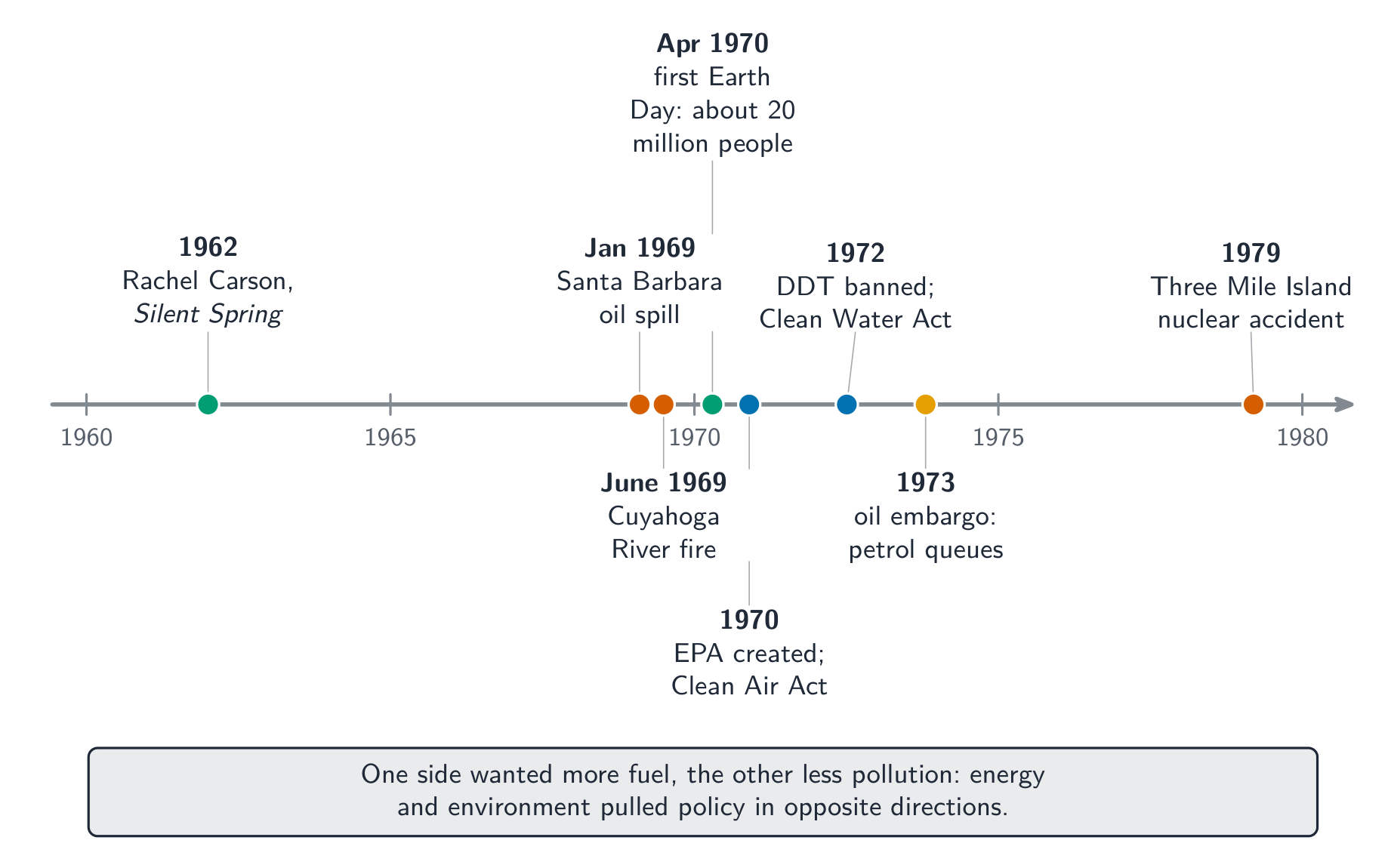
- In June 1969, oil and chemical waste floating on the Cuyahoga River in Cleveland, Ohio, caught fire. It was not the first time — the river had burned at least a dozen times since 1868 — but a Time magazine story made it a national symbol of pollution. That same year, an oil-well blowout off Santa Barbara, California, coated beaches in crude oil.
- Americans began to demand action on the environment, while depending more than ever on oil.
Which events in 1969 raised concern about pollution?
Dificultad 2/5 · 140 monedas + un pequeño bono en el primer intento de hoy
Earth Day was 1970; Three Mile Island 1979.
Oil and the Middle East
- US policy in the Middle East mixed ideological goals (containing Soviet influence), economic goals (oil) and military commitments, including support for Israel and for the Shah of Iran.
- In 1973, after the US supported Israel in the Yom Kippur War, Arab members of OPEC imposed an oil embargo 禁运. Oil prices roughly quadrupled, and drivers queued for petrol.
Why did Arab OPEC members impose an oil embargo in 1973?
Dificultad 1/5 · 100 monedas + un pequeño bono en el primer intento de hoy
The embargo followed US support for Israel.
An environmental movement
- Rachel Carson's Silent Spring (1962) showed how the pesticide DDT killed birds and moved through food chains.
- On 22 April 1970, about 20 million Americans took part in the first Earth Day.
What did Silent Spring (1962) warn about?
Dificultad 1/5 · 100 monedas + un pequeño bono en el primer intento de hoy
Rachel Carson's book.
Worked example: the federal response
- Agency: in December 1970, President Nixon created the Environmental Protection Agency 环境保护署 to enforce pollution laws.
- Laws: the Clean Air Act (1970), Clean Water Act (1972) and Endangered Species Act (1973); DDT was banned in 1972.
- Why so fast: visible disasters, a mass movement and support from both parties made the environment a rare area of agreement.
A Middle East concern, the movement, or the federal response?
Sort each element of environmental and energy policy.
Match each measure to its year.
Dificultad 2/5 · 140 monedas + un pequeño bono en el primer intento de hoy
The federal response.
Energy against environment
- The 1973 crisis led Congress to approve the Trans-Alaska oil pipeline, despite environmental objections.
- In 1979 the Iranian revolution caused a second oil shock, and an accident at the Three Mile Island nuclear plant raised fears about nuclear power.
The 1973 oil crisis helped win approval for the Trans-Alaska pipeline.
Dificultad 1/5 · 100 monedas + un pequeño bono en el primer intento de hoy
Energy over environmental objections.
Two policies pulling apart
- Presidents tried to cut dependence on foreign oil: a 55-mile-per-hour speed limit (1974), fuel-economy standards (1975) and Carter's Department of Energy (1977).
- The Carter Doctrine (1980) declared that the US would use force to protect the Persian Gulf.
Energy policy and environmental policy often clashed. More drilling and pipelines meant more oil but more risk to land and water. Explain the tension rather than treating them as one policy.
Energy policy and environmental policy always pointed in the same direction.
Dificultad 1/5 · 100 monedas + un pequeño bono en el primer intento de hoy
They often clashed.
Oil, the Cold War and support for Israel shaped Middle East policy, and the 1973 embargo exposed US dependence on imported oil. Pollution disasters, Silent Spring and Earth Day produced the EPA and major environmental laws. Securing energy and protecting the environment often pulled in opposite directions.
Explain why the federal government passed major environmental laws in the early 1970s.
Causation.