Mobilisation at Home
Introducido| English | Significado |
|---|---|
| internment | Holding people in camps without trial, as the US did to about 120 000 Japanese Americans in 1942–45. |
| Bracero Program | A US–Mexico agreement (1942–1964) that brought Mexican workers to American farms and railroads. |
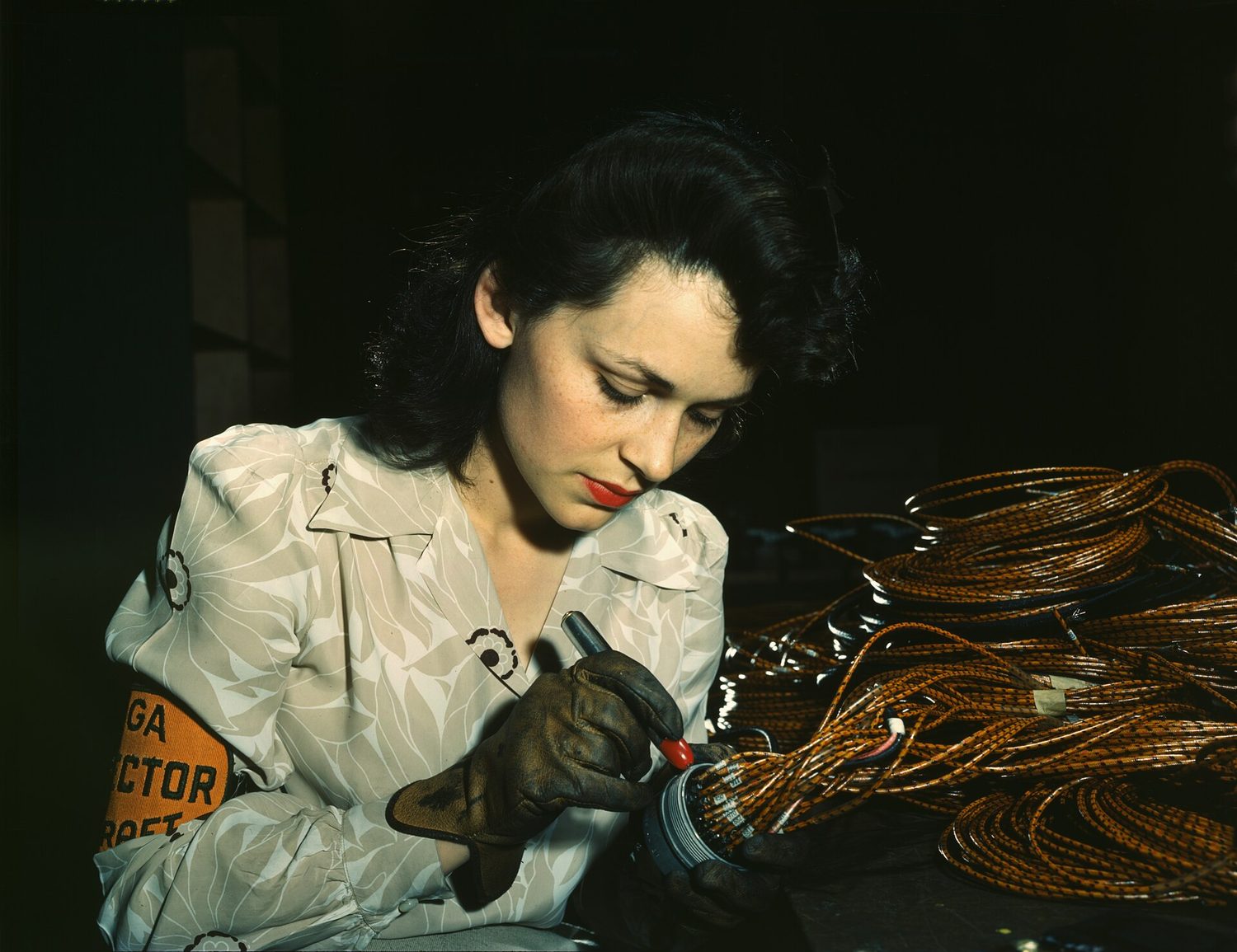
Rosie the Riveter
- Between 1940 and 1945 about 6 million American women joined the workforce, many in shipyards and aircraft factories. "Rosie the Riveter" posters told them "We can do it!". Unemployment fell from about 15% in 1940 to about 1% in 1944.
- The Second World War transformed the American home front.
Unemployment fell from about 15% in 1940 to about 1% in 1944. By how many percentage points did it fall?
Dificultad 2/5 · 140 monedas + un pequeño bono en el primer intento de hoy
15 − 1.
The war economy
- Government orders for planes, tanks and ships ended the Depression. By 1944 the US made about 40% of the world's weapons.
- The government rationed goods such as sugar, meat and petrol, and sold war bonds to pay for the war.
New opportunities
- In 1941 the labour leader A. Philip Randolph threatened a march on Washington. Roosevelt responded with Executive Order 8802, banning discrimination in defence industries.
- Black newspapers ran a "Double V" campaign: victory over fascism abroad and racism at home.
What did Executive Order 8802 (1941) do?
Dificultad 1/5 · 100 monedas + un pequeño bono en el primer intento de hoy
A response to Randolph's threatened march.
What was the "Double V" campaign?
Dificultad 1/5 · 100 monedas + un pequeño bono en el primer intento de hoy
Black newspapers' campaign.
Worked example: opportunity and its limits
- Opportunity: women and Black Americans got skilled, well-paid factory jobs; about 1.5 million Black Southerners moved to Northern and Western cities in the 1940s.
- Limit: many women were pushed out of factory jobs when soldiers returned in 1945; Black workers met hostility, as in the Detroit race riot of 1943.
- Conclusion: the war opened doors that peace partly closed — but the experience fed later movements for civil rights and women's rights.
An economic effect, a social opportunity, or a challenge to rights?
Sort each element of wartime mobilisation.
Civil liberties challenged
- After Pearl Harbor, Executive Order 9066 (February 1942) led to the internment 拘禁 of about 120 000 Japanese Americans, two-thirds of them US citizens, in camps.
- In Korematsu v. United States (1944), the Supreme Court upheld the policy. In 1988 Congress apologized and paid compensation to survivors.
Which statements about Japanese American internment are true?
Dificultad 2/5 · 140 monedas + un pequeño bono en el primer intento de hoy
Executive Order 9066, 1942.
Workers from Mexico
- The Bracero Program 布拉塞罗计划 (1942) brought Mexican workers to American farms and railroads to replace drafted men; it lasted until 1964.
- In Los Angeles, the 1943 "Zoot Suit Riots" saw servicemen attack Mexican American youths.
The Bracero Program brought Mexican workers to the US during the war.
Dificultad 1/5 · 100 monedas + un pequeño bono en el primer intento de hoy
1942–1964.
The war did not bring equality. It created jobs for women and minorities, but also segregation in the armed forces, race riots and the internment of Japanese Americans. Present both the opportunity and the injustice.
The Second World War brought full equality for women and minorities at home.
Dificultad 1/5 · 100 monedas + un pequeño bono en el primer intento de hoy
Opportunity came with injustice.
War production ended the Depression and drew women, Black Americans and Mexican workers into new jobs. Executive Order 8802 and the Double V campaign challenged discrimination, while the internment of Japanese Americans showed civil liberties under threat.
To what extent did the Second World War change opportunities for women and minorities in the United States?
Change and continuity.