What Government Should Do
Introducido| English | Significado |
|---|---|
| laissez-faire/ˈleɪsez feə/ | An approach in which government largely leaves economic decisions to individuals and businesses with minimal intervention. |
| protective tariff | A high tax on imported goods meant to shield a country's own industries from foreign competition. |
| Interstate Commerce Act | The 1887 law that created the first federal agency to regulate railroad rates. |
A veto of seed money, 1887
- In 1887, after a terrible drought in Texas, Congress voted 10 000 dollars to buy seed grain for farmers who had lost their crops. President Grover Cleveland vetoed it. He found nothing in the Constitution allowing it, he wrote, and "though the people support the Government, the Government should not support the people". Private charity, he said, should help instead.
- In the Gilded Age, many leaders said government should stay out of the economy — but in practice it helped business in many ways.
Why did Cleveland veto the Texas Seed Bill?
Dificultad 1/5 · 100 monedas + un pequeño bono en el primer intento de hoy
Laissez-faire.
The laissez-faire argument
- Laissez-faire 自由放任 held that the economy worked best without government interference: no regulation, no help for the poor.
- Courts often struck down state laws on working hours and conditions as violating the freedom of contract.
Laissez-faire held that government should not interfere in the economy.
Dificultad 1/5 · 100 monedas + un pequeño bono en el primer intento de hoy
The doctrine.
The awkward fact beside it
- Government gave railroads about 130 million acres of federal land. A high protective tariff 保护性关税 — about 50% on many goods under the McKinley Tariff (1890) — shielded manufacturers from competition.
- In the Pullman strike (1894), federal troops were sent to break a railroad strike.
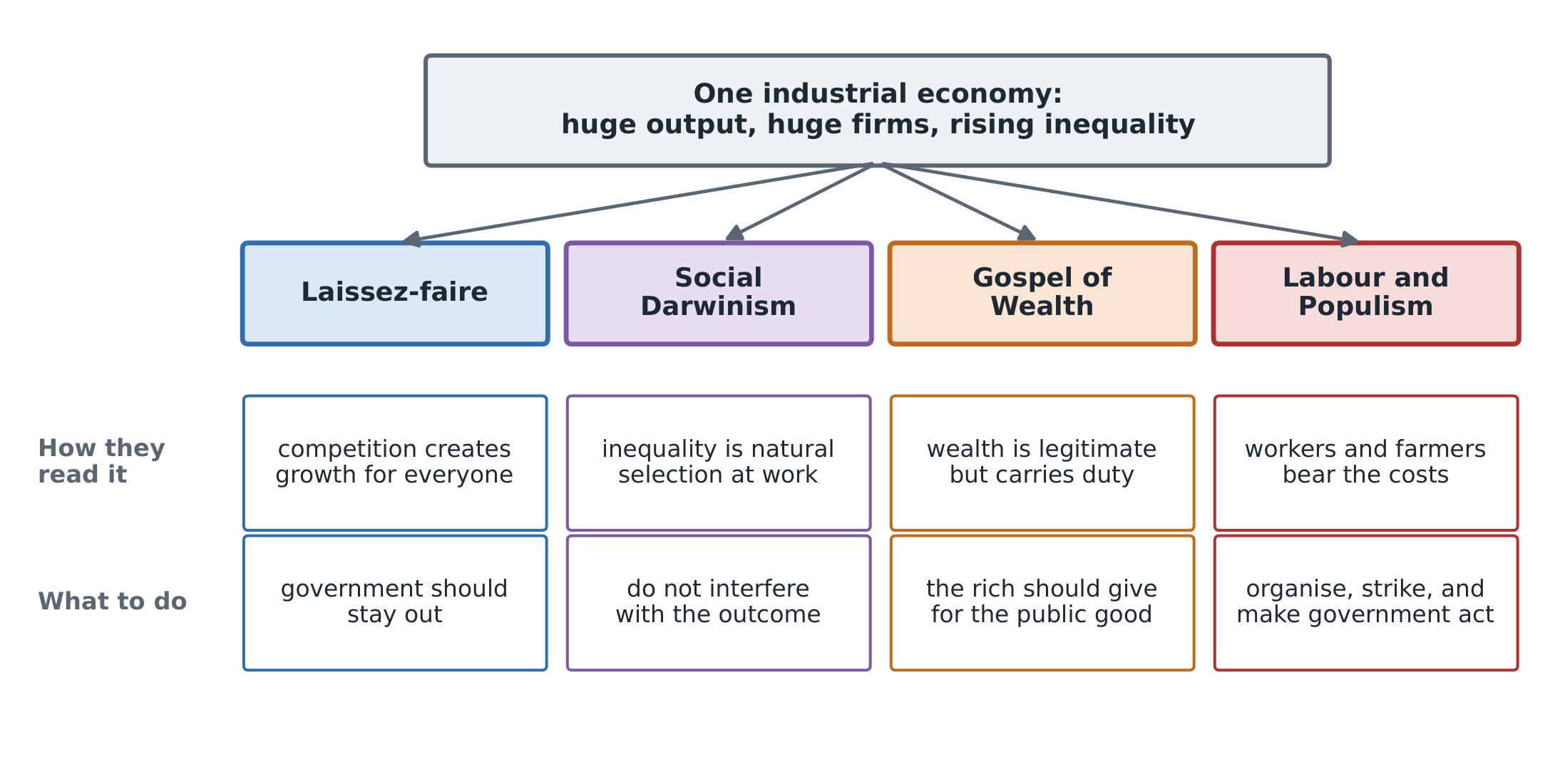
The doctrine, the record, or the outward turn?
Sort each element of government's economic role.
How did government help business in the Gilded Age?
Dificultad 2/5 · 140 monedas + un pequeño bono en el primer intento de hoy
The awkward fact.
About how many million acres of federal land did railroads receive?
Dificultad 2/5 · 140 monedas + un pequeño bono en el primer intento de hoy
Land grants.
Worked example: the first steps to regulation
- Pressure: farmers' groups such as the Grange complained that railroads charged unfair rates. Some states regulated rates in the 1870s.
- Federal laws: the Interstate Commerce Act 州际商务法 (1887) created the first federal regulatory agency; the Sherman Antitrust Act (1890) banned monopolies.
- The limit: courts weakened both laws, and in 1895 the Supreme Court used the Sherman Act against a union instead of a trust.
Match each law to its purpose.
Dificultad 2/5 · 140 monedas + un pequeño bono en el primer intento de hoy
Government's role.
Looking outward
- Policymakers sought foreign markets for American goods, especially in Latin America and Asia.
- Secretary of State James Blaine organized the first Pan-American Conference in 1889.
Continuity and change
- Continuity: government continued to support business through tariffs, land and force against strikes.
- Change: the first federal regulatory laws set a pattern that Progressives would build on after 1900.
Gilded Age government was not purely laissez-faire. It refused help to the poor but gave land, tariffs and troops to business. Describe both the doctrine and the record.
Gilded Age government never helped any economic group.
Dificultad 1/5 · 100 monedas + un pequeño bono en el primer intento de hoy
It helped business.
Gilded Age leaders like Cleveland preached laissez-faire and refused relief to the poor, but government gave railroads land, protected industry with high tariffs and broke strikes with troops. Pressure from farmers produced the first regulation — the Interstate Commerce Act and the Sherman Act — though courts limited them.
To what extent did Gilded Age governments follow laissez-faire?
Extent.