Responses to Newcomers
Introducido| English | Significado |
|---|---|
| nativism | Favouring native-born people over immigrants. |
| Social Darwinism/ˈsəʊʃl ˈdɑːwɪnɪzəm/ | An ideology that misapplied ideas about biological competition to justify social inequality, domination or imperial expansion. |
| settlement house | A centre in a poor city neighbourhood where reformers lived and offered classes, childcare and services. |
Hull House, 1889
- In 1889 Jane Addams and Ellen Gates Starr moved into an old mansion in a poor immigrant neighbourhood of Chicago. Hull House offered English classes, a kindergarten, a gym, an art gallery and help finding work. Within a few years, thousands of people used it every week.
- Americans responded to new immigrants in very different ways.
Nativism
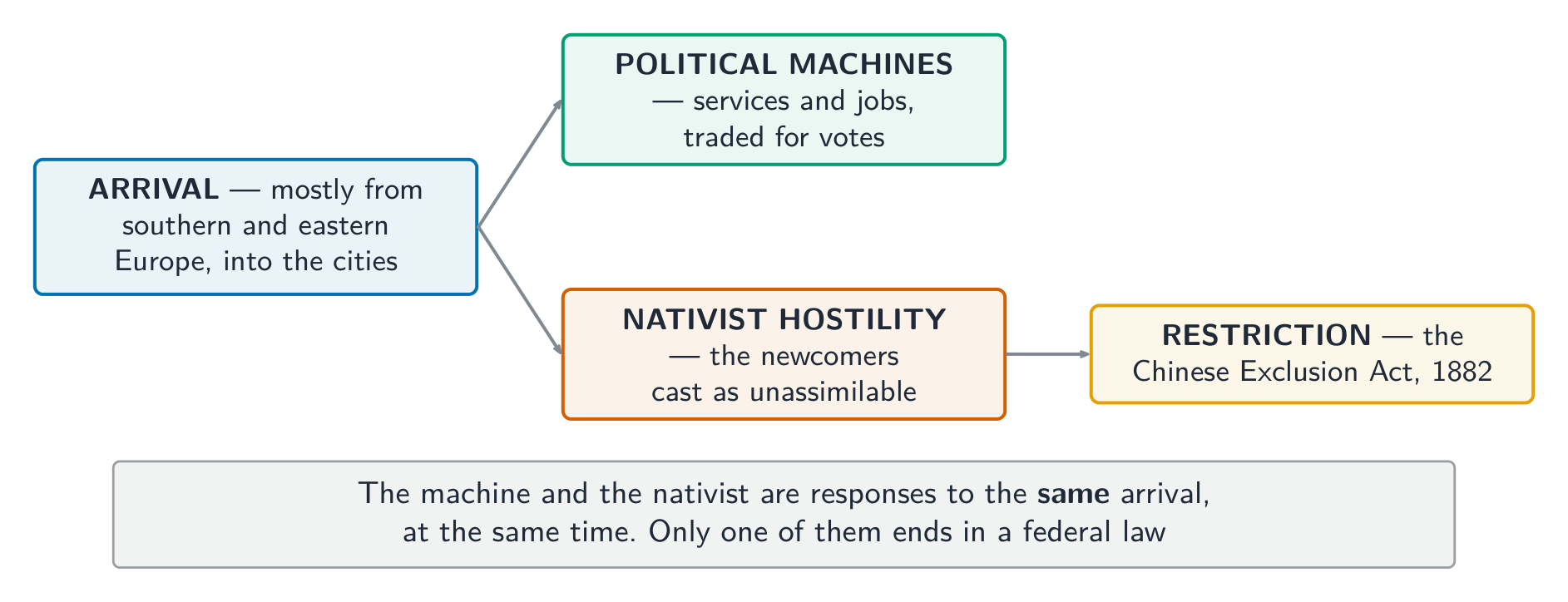
- Nativism 本土主义 is hostility to immigrants and the belief that native-born citizens should come first.
- The American Protective Association (1887) attacked Catholic immigrants; on the West Coast, mobs attacked Chinese workers, as at Rock Springs, Wyoming, in 1885, where 28 Chinese miners were killed.
What is nativism?
Dificultad 1/5 · 100 monedas + un pequeño bono en el primer intento de hoy
Anti-immigrant attitudes.
Social Darwinism
- Social Darwinism 社会达尔文主义 misapplied Darwin's ideas to society: the rich were "fit", and the poor had failed.
- Thinkers such as William Graham Sumner argued that government should not help the poor; it was used to justify inequality and restrictions on "inferior" immigrants.
What did Social Darwinists argue?
Dificultad 1/5 · 100 monedas + un pequeño bono en el primer intento de hoy
A justification of inequality.
Worked example: three responses compared
- Restriction: nativists pushed for laws such as the Chinese Exclusion Act (1882) and later literacy tests and quotas.
- Justification: Social Darwinists claimed inequality was natural, so neither the poor nor newcomers deserved help.
- Practical help: settlement houses 睦邻之家 such as Hull House helped immigrants learn English, find work and fight for safer housing and child-labour laws. One response excluded, one justified, one served.
Public debate, intellectual justification, or practical work?
Sort each response to immigration.
Match each response to an example.
Dificultad 2/5 · 140 monedas + un pequeño bono en el primer intento de hoy
Three kinds of response.
What did Hull House offer?
Dificultad 2/5 · 140 monedas + un pequeño bono en el primer intento de hoy
Practical services.
Assimilation debates
- Many reformers wanted immigrants to "Americanize": learn English, adopt American customs and give up old loyalties.
- Immigrants negotiated: they learned English and became citizens while keeping their religion, food and festivals.
The wealthy respond
- Andrew Carnegie's Gospel of Wealth (1889) argued that the rich had a duty to give money for libraries, universities and parks.
- He funded over 2500 public libraries, offering self-improvement rather than higher wages.
Carnegie's Gospel of Wealth argued that the rich should give money to public causes.
Dificultad 1/5 · 100 monedas + un pequeño bono en el primer intento de hoy
Libraries, universities, parks.
Social Darwinism was not science. It borrowed Darwin's language to defend existing inequality. Treat it as an argument used by people with interests, not as biology.
Social Darwinism was an accepted part of Darwin's biology.
Dificultad 1/5 · 100 monedas + un pequeño bono en el primer intento de hoy
It misused Darwin's language.
New immigrants met nativist hostility and restriction, Social Darwinist arguments that justified inequality, and practical help from settlement houses. Debates over assimilation continued as immigrants kept their own cultures while becoming American.
Compare the responses of nativists and settlement-house reformers to immigration.
Comparison.