Who Came to the Cities
Introducido| English | Significado |
|---|---|
| enclave | A neighbourhood where many people from one ethnic or national group live together. |
| political machine | A party organization in a city that gives jobs and favours in return for votes, often corruptly. |
Ellis Island opens, 1892
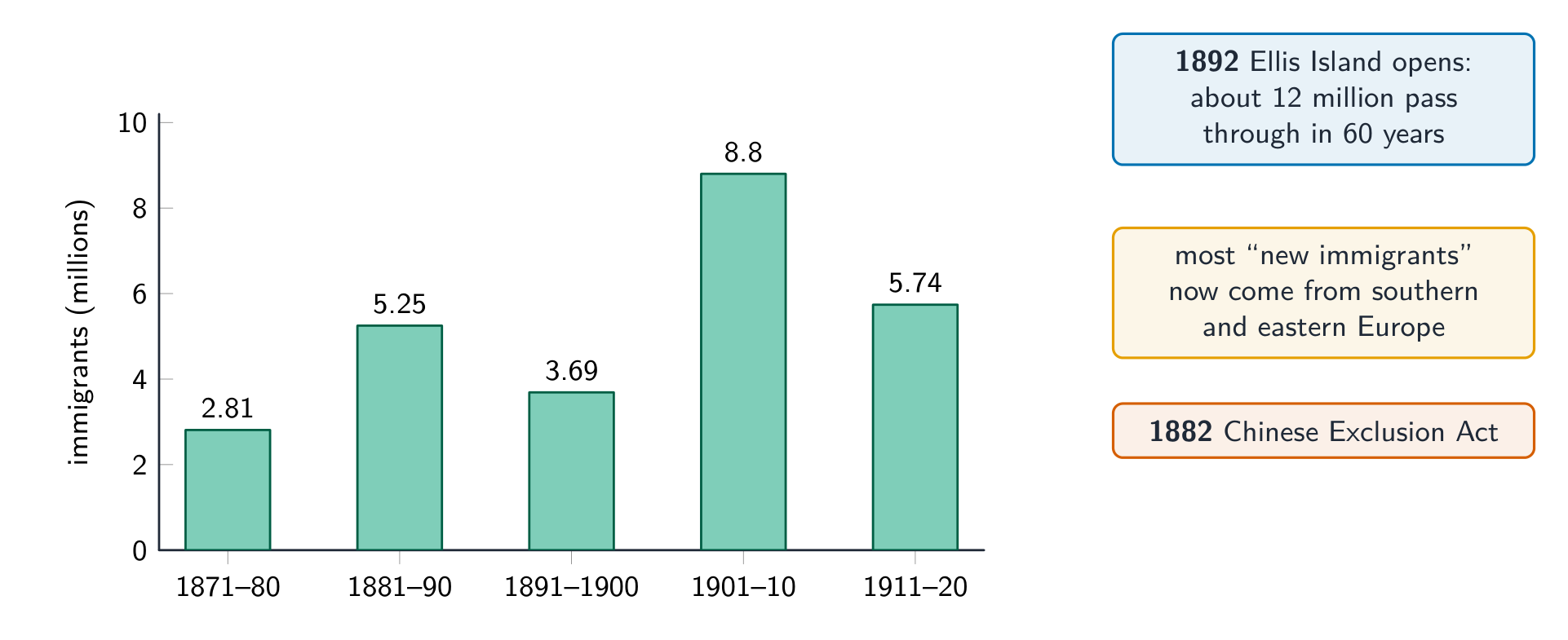
- On 1 January 1892, fifteen-year-old Annie Moore from Ireland became the first immigrant processed at Ellis Island in New York Harbor. Over the next sixty years, about 12 million people passed through it.
- Between 1880 and 1920, more than 20 million immigrants came to the United States, and American cities grew at record speed.
The "new immigrants"
- Earlier immigrants came mostly from Britain, Ireland, Germany and Scandinavia. After 1880 most came from southern and eastern Europe: Italians, Poles, Greeks, and Jews fleeing persecution in Russia.
- On the West Coast, Chinese and later Japanese immigrants arrived across the Pacific.
Which groups made up most of the "new immigrants" after 1880?
Dificultad 2/5 · 140 monedas + un pequeño bono en el primer intento de hoy
Southern and eastern Europe.
Why they came, why cities grew
- Push factors: poverty, land shortages and persecution. Pull factors: factory jobs and letters from relatives already in America.
- Chicago grew from about 300 000 people in 1870 to 1.7 million in 1900. Many rural Americans, including Black Southerners, also moved to cities.
Match each factor to push or pull.
Dificultad 2/5 · 140 monedas + un pequeño bono en el primer intento de hoy
Leaving and attracting.
Chicago grew from about 300 000 people in 1870 to 1.7 million in 1900. By how many people did it grow?
Dificultad 2/5 · 140 monedas + un pequeño bono en el primer intento de hoy
1 700 000 − 300 000.
Worked example: the enclave as opportunity and limit
New York's Lower East Side around 1900 was one of the most crowded places on Earth.
- Limit: families lived in dark, overcrowded tenements; landlords and employers often discriminated against newcomers.
- Opportunity: an enclave 聚居区 offered jobs through relatives, shops selling familiar food, newspapers in Yiddish or Italian, churches and synagogues, and mutual-aid societies.
- Conclusion: neighbourhoods were shaped by exclusion, but immigrants turned them into resources for survival.
Trace arrival to federal restriction
The political machine and the nativist are simultaneous responses to the same arrival.
Political machines
- A political machine 政治机器 such as New York's Tammany Hall gave immigrants jobs, food and help in return for votes.
- Machines were often corrupt — "Boss" William Tweed's ring stole millions — but they offered services no government then provided.
What did political machines offer immigrants?
Dificultad 1/5 · 100 monedas + un pequeño bono en el primer intento de hoy
Services for votes.
Limits on arrival
- The Chinese Exclusion Act of 1882 banned Chinese labourers from immigrating — the first US law to bar a group by nationality.
- Later laws, culminating in the quotas of the 1920s, restricted southern and eastern Europeans.
The Chinese Exclusion Act (1882) banned Chinese labourers from immigrating.
Dificultad 1/5 · 100 monedas + un pequeño bono en el primer intento de hoy
The first nationality-based ban.
Immigration was not just a story of numbers. Ask who came, from where, why, and how they built communities. Patterns of origin and settlement explain more than totals alone.
Knowing the total number of immigrants is enough to explain immigration's effects.
Dificultad 1/5 · 100 monedas + un pequeño bono en el primer intento de hoy
Origins, motives and settlement matter.
From 1880 to 1920, over 20 million immigrants, mainly from southern and eastern Europe and Asia, filled growing industrial cities. Enclaves and political machines helped them survive, while laws such as the Chinese Exclusion Act began to restrict who could come.
Explain how immigrants responded to life in American cities around 1900.
Responses.