Wages, Gaps and Unions
Introducido| English | Significado |
|---|---|
| strike/straɪk/ | Workers refusing to work, together, to win better pay or conditions. |
| real wages | Wages measured by what they can buy, after allowing for changes in prices. |
| collective bargaining/kəˈlektɪv ˈbɑːɡɪnɪŋ/ | Negotiation between employers and workers' representatives over pay, conditions and other terms of employment. |
The Homestead strike, 1892
- In July 1892, workers at Andrew Carnegie's Homestead steel works in Pennsylvania refused a pay cut. The company locked them out and sent 300 armed Pinkerton guards up the river on barges. In the battle, seven workers and three guards died; the state militia then broke the strike, and the union collapsed.
- Industry made America richer, but workers fought over how the wealth was shared.
Rising wages, widening gaps
- Real wages 实际工资 — pay adjusted for prices — rose for many workers in the late 1800s, and factory goods became cheaper.
- But the gap between rich and poor grew: in 1890 the richest 1% of families owned about a quarter of the nation's wealth.
What are real wages?
Dificultad 1/5 · 100 monedas + un pequeño bono en el primer intento de hoy
What wages can buy.
Who worked
- Factories employed immigrants, women and children. In 1900 about 1.75 million children aged 10 to 15 worked, many in mills, mines and factories.
- Days of 10 to 12 hours, six days a week, were common, and accidents were frequent.
In 1900 well over a million children aged 10 to 15 were working.
Dificultad 1/5 · 100 monedas + un pequeño bono en el primer intento de hoy
About 1.75 million.
Worked example: two unions compared
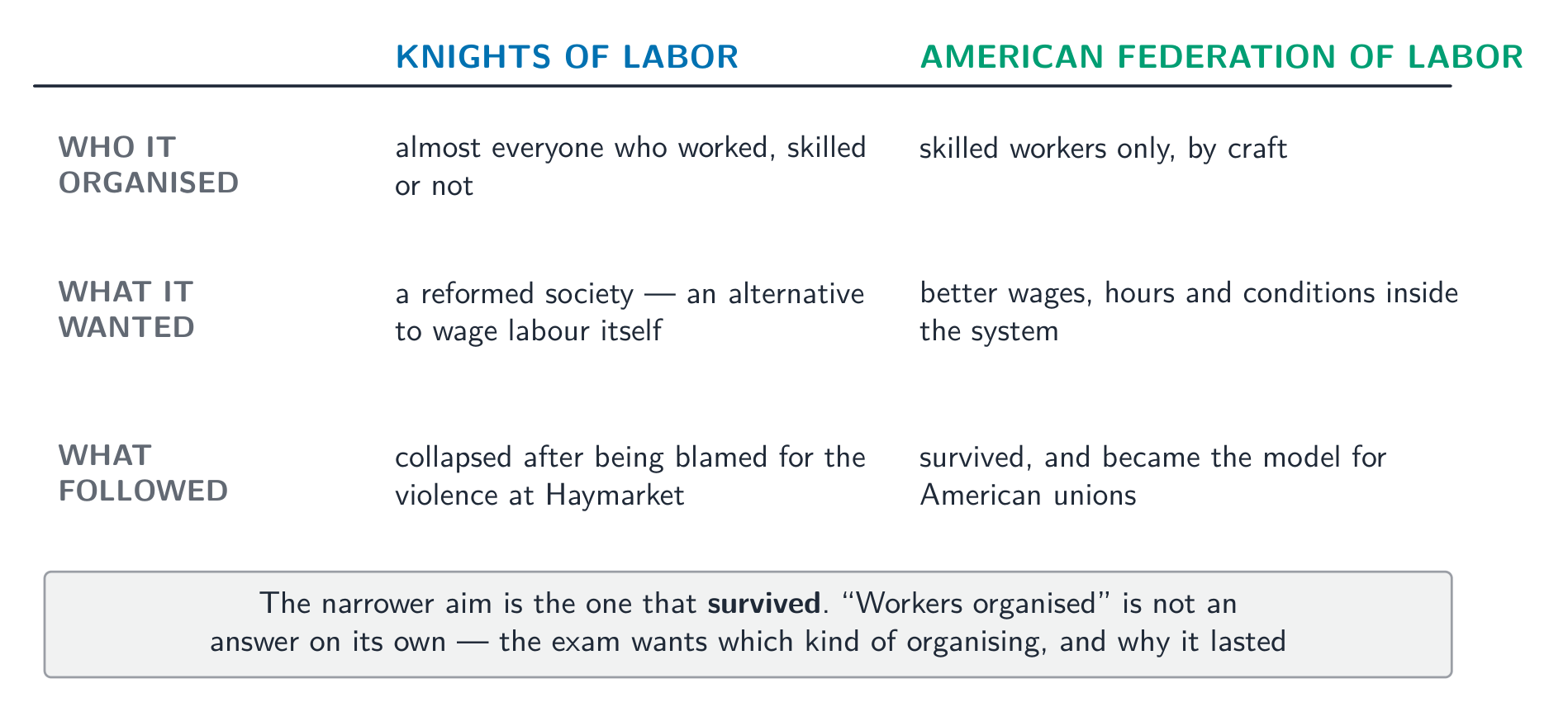
- Knights of Labor: open to almost all workers, skilled and unskilled, women and Black workers; wanted broad reform. About 700 000 members in 1886, but it declined after the Haymarket bombing in Chicago that year.
- American Federation of Labor (AFL): founded 1886 by Samuel Gompers; mostly skilled craft workers; focused on wages, hours and collective bargaining 集体谈判.
- Why the AFL lasted: its narrow aims and skilled members were harder to replace and less easily labelled radical.
An improvement, an inequality, or a form of conflict?
Sort each element of industrial society.
Match each feature to its union.
Dificultad 2/5 · 140 monedas + un pequeño bono en el primer intento de hoy
Broad versus narrow.
Strikes and force
- In the Great Railroad Strike of 1877 and the Pullman Strike of 1894, federal troops were used to end the strikes 罢工.
- Courts issued injunctions against unions, and employers hired replacement workers.
Put these strikes in order.
Dificultad 3/5 · 200 monedas + un pequeño bono en el primer intento de hoy
1877, 1886, 1892, 1894.
Why workers often lost
- Employers had money, the courts and often the government on their side.
- Workers were divided by skill, ethnicity and race, and new immigrants could replace strikers.
Why did strikers often lose?
Dificultad 2/5 · 140 monedas + un pequeño bono en el primer intento de hoy
Employers had more resources.
Rising real wages and growing inequality happened at the same time. Many workers were better off than their parents, while the richest gained far more. Don't treat one fact as disproving the other.
If real wages rose, inequality could not have grown.
Dificultad 1/5 · 100 monedas + un pequeño bono en el primer intento de hoy
Both happened together.
In the Gilded Age, real wages rose but inequality and child labour grew. Workers formed unions — the broad Knights of Labor and the narrower AFL — and struck at Homestead, Pullman and elsewhere, but employers, courts and troops usually defeated them.
Explain why the AFL survived while the Knights of Labor declined in the late 1800s.
Comparison.