Comparing the War's Effects
Introducido| English | Significado |
|---|---|
| secession | A state formally leaving a country or federation, as Southern states tried to do in 1860–61. |
| Reconstruction/ˌriːkənˈstrʌkʃn/ | The postwar effort to restore the Union and define freedom for formerly enslaved people. |
Texas v. White, 1869
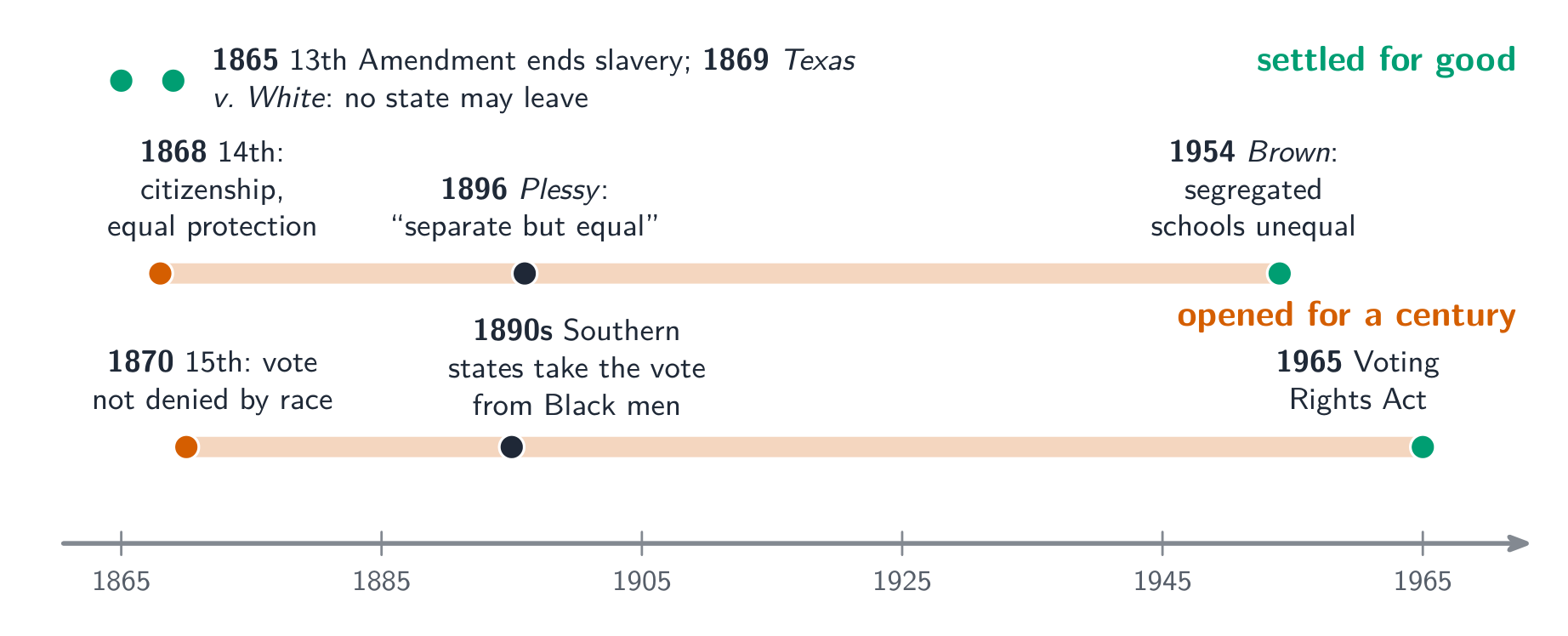
- After the war, the Supreme Court had to decide whether Texas had ever legally left the Union. In 1869 it ruled that the Union was "indestructible": a state could not leave on its own. The war had settled the question by force; the Court wrote it into law.
- The Civil War changed many things. Which changes mattered most?
In Texas v. White (1869), the Supreme Court ruled that states cannot leave the Union on their own.
Dificultad 1/5 · 100 monedas + un pequeño bono en el primer intento de hoy
An "indestructible" Union.
Settled: slavery and secession
- The Thirteenth Amendment (1865) ended slavery: about 4 million people were freed.
- Secession 脱离联邦 — a state leaving the Union — was no longer a legal option.
Which questions did the Civil War settle?
Dificultad 2/5 · 140 monedas + un pequeño bono en el primer intento de hoy
Rights enforcement stayed unresolved.
Growing federal power
- To fight the war, the federal government created the first income tax (1861), a national banking system (1863) and paper money called greenbacks.
- The Fourteenth Amendment (1868) made all people born in the US citizens and required states to give equal protection of the laws.
Match each amendment to what it did.
Dificultad 2/5 · 140 monedas + un pequeño bono en el primer intento de hoy
The Reconstruction amendments.
Which was a wartime expansion of federal power?
Dificultad 1/5 · 100 monedas + un pequeño bono en el primer intento de hoy
1861.0
Worked example: comparing significance
Prompt: Compare the significance of the end of slavery and the growth of federal power.
- Criterion: how long did the effect last, and how many people did it change?
- End of slavery: immediate and permanent for 4 million people — but freedom without land or protected rights left most freedpeople poor.
- Federal power: the Fourteenth Amendment's equal-protection clause was weakly enforced after Reconstruction 重建时期 ended in 1877, but it became the basis of civil rights rulings such as Brown v. Board (1954). One effect was settled at once; the other unfolded over a century.
A settled effect, an unresolved effect, or an effect on values?
Sort each effect of the Civil War.
Left unresolved
- How to guarantee citizenship and voting rights for African Americans; the Fifteenth Amendment (1870) banned racial voting bars, but Southern states found ways around it.
- How much the federal government should do inside states.
Which effect was left unresolved after 1877?
Dificultad 1/5 · 100 monedas + un pequeño bono en el primer intento de hoy
Southern states evaded the Fifteenth Amendment.
Effects on American ideals
- Lincoln presented the war as "a new birth of freedom", linking the nation to equality as well as union.
- Yet many white Americans, North and South, soon chose reconciliation between whites over rights for Black Americans.
State your measure before you rank effects. "The most important effect" means nothing without a criterion: how many people, how long it lasted, or how much it changed law. Different measures give different answers.
You can rank the importance of effects without stating a criterion.
Dificultad 1/5 · 100 monedas + un pequeño bono en el primer intento de hoy
State the measure first.
The war ended slavery and secession for good and expanded federal power through new taxes, banks and the Fourteenth Amendment. But how to protect freedpeople's rights stayed unresolved for a century. Comparing effects needs a clear criterion.
Compare the short-term and long-term significance of the Fourteenth Amendment.
Comparison of significance.