Immigration, Nativism and Two Labour Systems
Introducido| English | Significado |
|---|---|
| nativism | Favouring native-born people over immigrants. |
| Know-Nothings | the anti-immigrant, anti-Catholic American Party of the 1850s |
| Free Soil Party | an 1848 party that opposed the spread of slavery into the western territories |
| abolition | ending slavery completely |
Riots in Philadelphia, 1844
- In May and July 1844, crowds in Philadelphia attacked Irish Catholic neighbourhoods and burned two Catholic churches. The rioters believed rumours that Catholics wanted the Bible removed from public schools. About 20 people were killed, and the state militia fired cannon into the crowds.
- In the 1840s and 1850s, record immigration and the clash between free and slave labour divided Americans in new ways.
What were the 1844 Philadelphia riots directed against?
Dificultad 1/5 · 100 monedas + un pequeño bono en el primer intento de hoy
Rumours about the Bible in schools.
Record immigration
- The potato famine of 1845–52 killed about a million people in Ireland, and over a million Irish crossed to the United States, most to Northern cities. Germans came too, many after the failed revolutions of 1848.
- Immigration rose from about 84 000 in 1840 to a peak of 428 000 in 1854. The Irish took low-paid work on docks, canals and railways; many Germans bought farms in the Midwest.
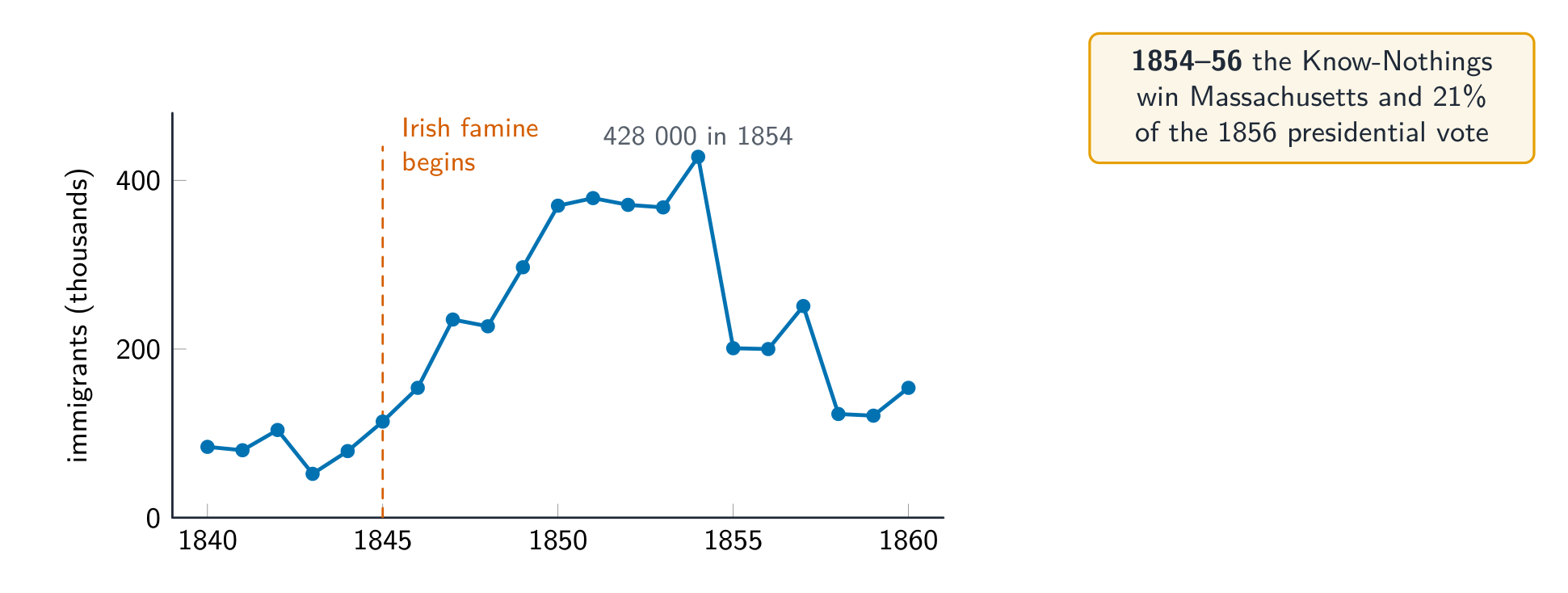
Immigration peaked at about 428 000 in 1854.
Dificultad 1/5 · 100 monedas + un pequeño bono en el primer intento de hoy
From about 84 000 in 1840.
Nativism and the Know-Nothings
- Nativism 本土主义 is hostility to immigrants. Secret nativist societies grew into the American Party, called the Know-Nothings 一无所知党 because members said "I know nothing" when asked about it.
- In 1854 they won the governorship and almost every seat in the Massachusetts legislature, and in 1856 their candidate, former president Millard Fillmore, won 21% of the national vote. They wanted a 21-year wait before an immigrant could become a citizen.
Hostility to immigrants is called ____.
Dificultad 1/5 · 100 monedas + un pequeño bono en el primer intento de hoy
The Know-Nothings were nativists.
Worked example: two voters, one vote. In 1848 the new Free Soil Party 自由土地党 ran Martin Van Buren on the slogan "free soil, free speech, free labour, free men" and won 10% of the vote. Voter A believed slavery was a sin. Voter B, a white labourer, did not want to compete with enslaved workers in the West. Both voted to keep slavery out of the territories, for different reasons — so a free-soil vote does not prove the voter was an abolitionist.
What did a free-soil vote show for certain?
Dificultad 1/5 · 100 monedas + un pequeño bono en el primer intento de hoy
The reasons could differ.
Abolitionists: a visible minority
- William Lloyd Garrison's Liberator (from 1831) demanded immediate abolition 废除奴隶制; Frederick Douglass, who had escaped slavery, wrote and lectured across the North. Harriet Tubman led about 70 people to freedom on the Underground Railroad.
- Most Northerners were not abolitionists, and abolitionist speakers were often attacked by mobs. Their influence came from keeping the issue in the news.
Which people were abolitionists?
Dificultad 2/5 · 140 monedas + un pequeño bono en el primer intento de hoy
Calhoun defended slavery.
How slavery's defenders argued
- In 1837 John C. Calhoun called slavery "a positive good", not a necessary evil. Writers such as George Fitzhugh (1857) claimed enslaved people were better cared for than Northern factory workers.
- Defenders also used false "scientific" claims about race and verses from the Bible. By 1860 there were about four million enslaved people in the South.
Abolitionist, free-soiler, nativist or defender of slavery?
Sort each position by the group that held it.
What did Calhoun mean by calling slavery "a positive good"?
Dificultad 1/5 · 100 monedas + un pequeño bono en el primer intento de hoy
A shift in the defence of slavery.
Do not treat "anti-slavery" as one group. Abolitionists wanted slavery ended everywhere; free-soilers wanted it kept out of the West, often for racist or economic reasons. Name which group you mean.
Between 1840 and 1860 immigration reached a peak of 428 000 a year, mostly Irish and German, and nativists organised the Know-Nothing party against them. At the same time Northerners defended free labour, a small abolitionist movement demanded an end to slavery, and Southern leaders such as Calhoun called slavery a positive good.
Explain how immigration and the debate over slavery divided Americans in the 1840s and 1850s.
Two divisions, kept distinct.