Westward Expansion
Introducido| English | Significado |
|---|---|
| Manifest Destiny/ˈmænɪfest ˈdestɪni/ | The nineteenth-century belief that the United States was destined by God to spread across North America. |
| annexation | Adding a territory to a country, often by force or by a one-sided act. |
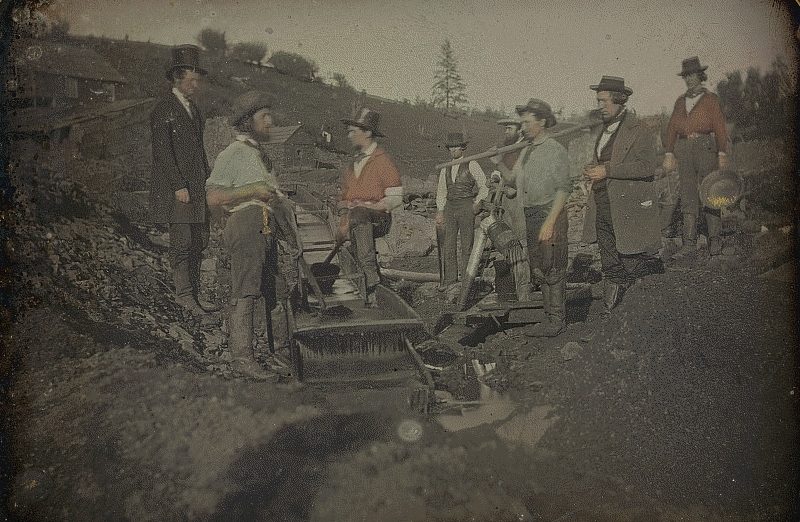
Gold at Sutter's Mill, 1848
- In January 1848 a carpenter found gold in a river in California. Within two years, around 100 000 people had rushed there, from the eastern states, Mexico, Chile, China and Europe. California became a state in 1850, skipping the usual years as a territory.
- Americans moved west in huge numbers in the 1840s and 1850s.
Manifest Destiny
- In 1845 the journalist John O'Sullivan wrote of America's "manifest destiny 天定命运 to overspread the continent".
- The idea claimed that God intended white Americans to spread their institutions across North America.
What did "Manifest Destiny" claim?
Dificultad 1/5 · 100 monedas + un pequeño bono en el primer intento de hoy
O'Sullivan, 1845.
How the nation grew
- The annexation 吞并 of Texas (1845), the Oregon Treaty with Britain (1846) and the Mexican Cession after the war with Mexico (1848) added the whole Southwest and Pacific coast.
- The Gadsden Purchase (1853) completed the southern border.
Put these gains in order.
Dificultad 3/5 · 200 monedas + un pequeño bono en el primer intento de hoy
1845, 1846, 1848, 1853.
Worked example: why people went west
- Economic opportunity: cheap farmland in Oregon, gold in California, and later free land under the Homestead Act of 1862.
- Religious refuge: in 1847 Mormons led by Brigham Young settled near the Great Salt Lake to escape persecution.
- Government help: laws and treaties opened land, and the Pacific Railway Act (1862) funded a railroad completed in 1869. Push and pull factors worked together.
A motive, an argument, or an accelerator?
Sort each element of westward expansion.
Match each group to its reason for going west.
Dificultad 2/5 · 140 monedas + un pequeño bono en el primer intento de hoy
Push and pull factors.
Which 1862 laws encouraged western settlement?
Dificultad 2/5 · 140 monedas + un pequeño bono en el primer intento de hoy
The other two are earlier.
Costs for those already there
- American Indian nations lost land, bison herds and lives to settlers, miners and the army. California's native population fell from about 150 000 in 1848 to about 30 000 by 1870.
- Mexicans in the new territories often lost their land despite promises in the 1848 treaty.
California's native population fell sharply after the Gold Rush.
Dificultad 1/5 · 100 monedas + un pequeño bono en el primer intento de hoy
From about 150 000 to about 30 000.
Beyond the Pacific
- In 1853–54 Commodore Matthew Perry's warships pressured Japan to open trade with the United States.
- Expansion pushed American interests into the Pacific.
Manifest Destiny was an argument, not a fact. It was a belief used to justify taking land from Mexico and American Indian nations. Treat it as a claim made by people with interests.
Manifest Destiny was a proven fact about history.
Dificultad 1/5 · 100 monedas + un pequeño bono en el primer intento de hoy
It was an argument used to justify expansion.
Economic opportunity, religious refuge and government policy drove Americans west, and the idea of Manifest Destiny justified it. Annexation, treaty and war took the US to the Pacific, at great cost to American Indians and Mexicans.
Explain the causes and effects of westward expansion in the 1840s.
Causation.