African American Experience
Introducido| English | Significado |
|---|---|
| gradual emancipation | Ending slavery step by step over years, for example by freeing only children born after a certain date. |
| abolitionist | A person who worked to end slavery. |
A church of their own
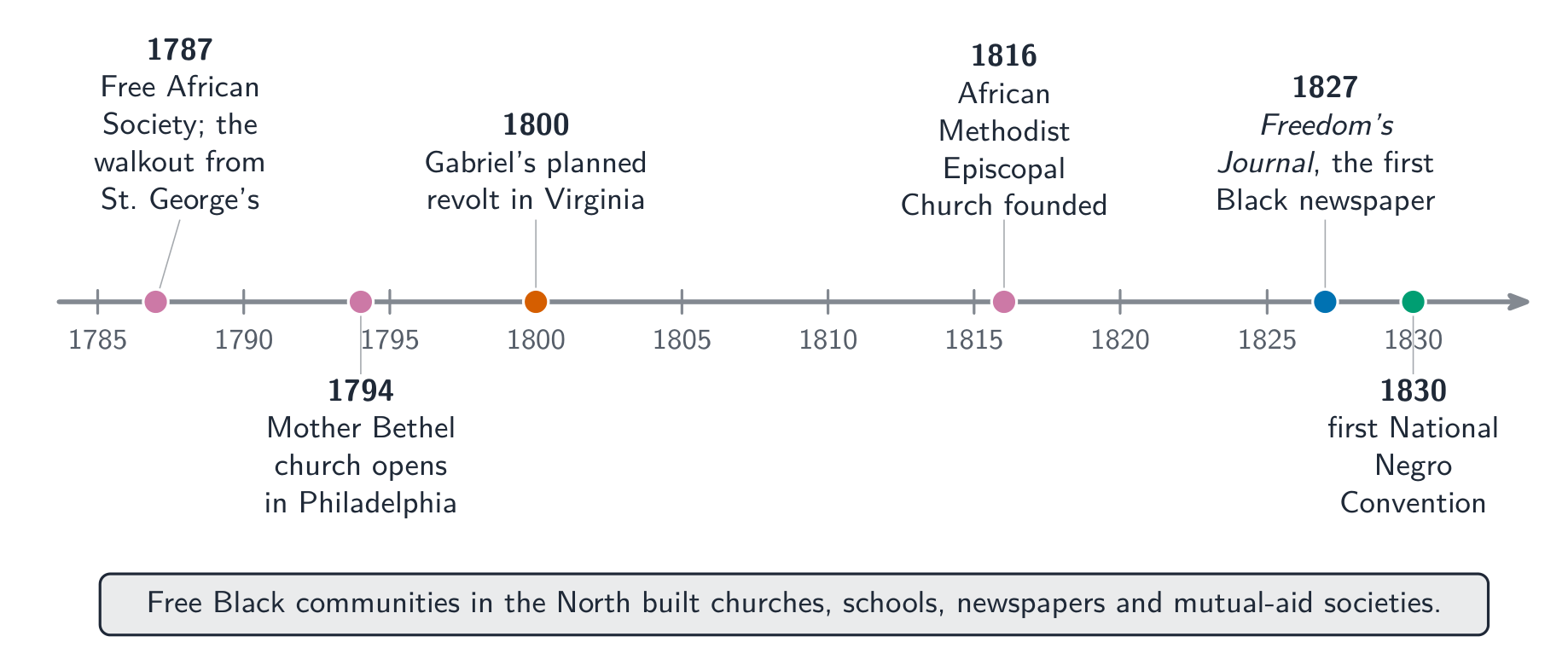
- In 1787 white leaders of a Philadelphia church pulled Black worshippers from their knees during prayer. Richard Allen, a formerly enslaved preacher, led them out. In 1816 his congregation became the centre of the African Methodist Episcopal (AME) Church, the first independent Black denomination in the United States.
- African Americans in the early republic built their own institutions, whether they were free or enslaved.
Freedom in the North, limited
- After the Revolution, Northern states ended slavery, often by gradual emancipation 逐步解放: Pennsylvania's law of 1780 freed only children born after it, and only at age 28.
- Free Black Northerners still faced segregation, exclusion from voting in many states, and the threat of kidnapping into slavery.
What did Pennsylvania's 1780 gradual emancipation law do?
Dificultad 1/5 · 100 monedas + un pequeño bono en el primer intento de hoy
Emancipation was slow.
Slavery tightens in the South
- Planned revolts — Gabriel's in Virginia (1800) and Denmark Vesey's in South Carolina (1822) — were discovered and crushed.
- In 1831 Nat Turner led about 70 enslaved and free Black men in Virginia; around 55 white people were killed. Southern states then banned teaching enslaved people to read and limited Black churches.
Match each revolt or plan to its year.
Dificultad 2/5 · 140 monedas + un pequeño bono en el primer intento de hoy
Each was crushed.
How did Southern states respond to Nat Turner's rebellion?
Dificultad 1/5 · 100 monedas + un pequeño bono en el primer intento de hoy
Laws became harsher.
Worked example: continuity and change
Prompt: Explain one continuity and one change for African Americans, 1800–1848.
- Change: free Black communities in Northern cities grew and created churches, schools and mutual-aid societies, such as Allen's AME Church.
- Continuity: in the South, slavery not only lasted but expanded, and laws after Turner's revolt made it harsher.
- Link: Black institutions in the North also became bases for abolitionists 废奴主义者, such as David Walker, whose 1829 Appeal called on enslaved people to resist.
A constraint, an act of creation, or a change?
Sort each element of African American experience, 1800-1848.
Building community under slavery
- Enslaved people kept families together where they could, passed on African traditions, and created their own forms of Christianity, often in secret meetings.
- Songs, stories and kinship networks preserved dignity under a system designed to deny it.
Enslaved people created their own forms of Christianity.
Dificultad 1/5 · 100 monedas + un pequeño bono en el primer intento de hoy
Often in secret meetings.
Free Black activism
- Free African Americans petitioned legislatures, published newspapers such as Freedom's Journal (1827), and held national conventions from 1830.
- Many opposed the American Colonization Society's plan to send free Black Americans to Africa.
Which institutions did free African Americans create?
Dificultad 2/5 · 140 monedas + un pequeño bono en el primer intento de hoy
The ACS was founded by white Americans.
Enslaved people were not passive victims. Besides rare revolts, they resisted daily, built families and created religion and culture. History that shows only suffering misses what they created.
Enslaved people only resisted through large revolts.
Dificultad 1/5 · 100 monedas + un pequeño bono en el primer intento de hoy
Daily resistance and culture-building too.
In the early republic, the North ended slavery slowly while free Black people built churches, schools and newspapers. In the South, failed revolts led to harsher laws, yet enslaved people sustained families and culture. Both free and enslaved African Americans resisted and created.
Compare the experiences of free African Americans in the North and enslaved African Americans in the South, 1800–1848.
Comparison.