The Age of Reform
Introducido| English | Significado |
|---|---|
| voluntary association | A group that people join freely to work for a shared cause, such as temperance or abolition. |
| abolitionist | A person who worked to end slavery. |
| Declaration of Sentiments | The 1848 Seneca Falls statement, modelled on the Declaration of Independence, demanding equal rights for women. |
A report on cages and chains, 1843
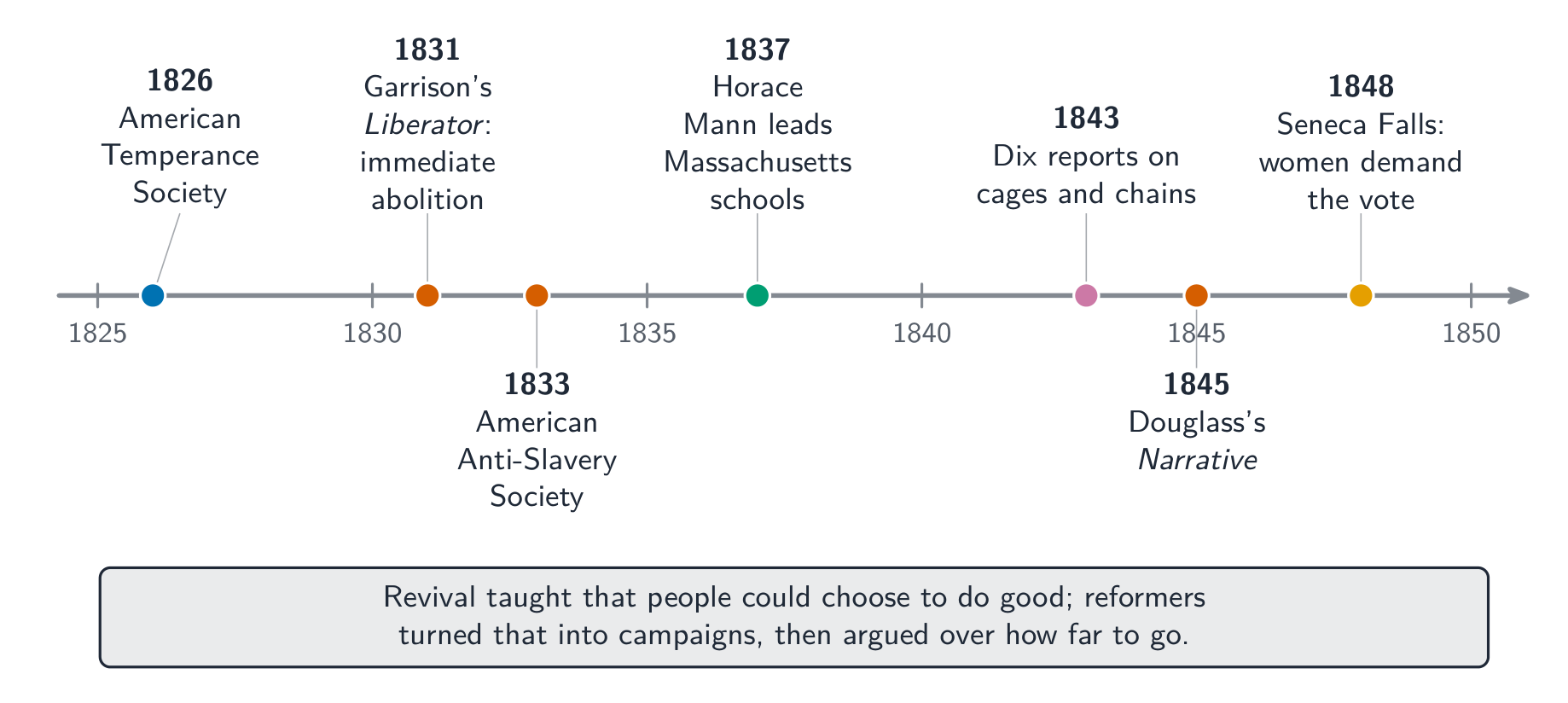
- In January 1843, the teacher Dorothea Dix presented a report to the Massachusetts legislature. For two years she had visited jails and poorhouses, and she described mentally ill people kept "in cages, closets, cellars, stalls, pens! Chained, naked, beaten with rods". The legislature voted money to expand the state hospital. Dix went on to campaign in other states, and over 30 new hospitals followed.
- Inspired by the revivals, Americans in the 1830s and 1840s formed movements to reform society.
What did Dorothea Dix campaign for?
Dificultad 1/5 · 100 monedas + un pequeño bono en el primer intento de hoy
Her 1843 report.
From revival to reform
- The Second Great Awakening taught that people could choose to do good and could improve the world. Many believers turned this into action.
- Reformers fought alcohol, slavery, poor prisons and asylums, and lack of schools.
Voluntary organizations
- Reformers formed voluntary associations 志愿团体 — groups people joined freely, with members, newspapers and lecturers.
- The American Temperance Society (1826) had over a million members by the mid-1830s; Horace Mann built a public school system in Massachusetts from 1837.
Which reform current?
Sort each element into its movement.
Match each reformer or group to its cause.
Dificultad 2/5 · 140 monedas + un pequeño bono en el primer intento de hoy
Voluntary associations.
Worked example: abolition, with a limit
- Immediate abolition: William Lloyd Garrison's newspaper The Liberator (1831) demanded an immediate end to slavery. Frederick Douglass, who had escaped slavery, published his Narrative in 1845.
- A different plan: the American Colonization Society (1816) wanted to send free Black Americans to Africa; it founded Liberia.
- The limit: many white Northerners who opposed slavery did not believe in racial equality, and abolitionists 废奴主义者 were often attacked by mobs.
What did the American Colonization Society want?
Dificultad 1/5 · 100 monedas + un pequeño bono en el primer intento de hoy
It founded Liberia.
Women's rights
- In July 1848, about 300 people met at Seneca Falls, New York. Elizabeth Cady Stanton's Declaration of Sentiments 情感宣言 began: "all men and women are created equal".
- The demand for the vote was the most controversial resolution, and it passed only narrowly, with Douglass's support.
About how many people attended the Seneca Falls Convention?
Dificultad 2/5 · 140 monedas + un pequeño bono en el primer intento de hoy
July 1848.
The resolution demanding the vote for women passed only narrowly at Seneca Falls.
Dificultad 1/5 · 100 monedas + un pequeño bono en el primer intento de hoy
With Douglass's support.
Arguments inside the movements
- Abolitionists split in 1840 over whether women should take leading roles.
- Many women first learned to organize in abolition and temperance societies, then turned to their own rights.
Reformers did not all agree. Abolitionists disagreed about immediate or gradual emancipation and about women's roles; even at Seneca Falls, many hesitated to demand the vote.
All reformers agreed on immediate abolition and women's rights.
Dificultad 1/5 · 100 monedas + un pequeño bono en el primer intento de hoy
They argued.
Inspired by the revivals, reformers formed voluntary associations for temperance, public schools, asylums, abolition and women's rights. Dorothea Dix, Garrison, Douglass and Stanton led campaigns, but reformers argued among themselves about how far change should go.
Explain how the Second Great Awakening contributed to reform movements.
Causation.