Why a Second Awakening
Introducido| English | Significado |
|---|---|
| Second Great Awakening/ˈsekənd ɡreɪt əˈweɪkənɪŋ/ | A wave of Protestant revivals in the United States from about 1800 to the 1840s that stressed personal choice of salvation. |
| circuit rider | A travelling preacher, usually Methodist, who rode a regular route to serve frontier settlements. |
Thousands in the woods at Cane Ridge, 1801
- In August 1801, between 10 000 and 20 000 people gathered at Cane Ridge, Kentucky, for a camp meeting that lasted almost a week. Preachers spoke from tree stumps and wagons, day and night. People wept, shouted, fainted and fell to the ground. Kentucky's largest town at the time had fewer than 2000 people.
- In the early nineteenth century, a wave of Protestant revivals — the Second Great Awakening — changed American religion and society.
At least how many people gathered at Cane Ridge in 1801?
Dificultad 2/5 · 140 monedas + un pequeño bono en el primer intento de hoy
Between 10 000 and 20 000.
Four causes together
- Democratic and individualistic beliefs, a reaction against rationalism, and two kinds of mobility — people moving west and people moving up or down in the market economy.
- Each cause made revivals more popular.
Which were causes of the Second Great Awakening?
Dificultad 2/5 · 140 monedas + un pequeño bono en el primer intento de hoy
Four causes together.
Democratic and individualistic beliefs
- Older Calvinist churches taught that God had already chosen who would be saved. Revival preachers such as Charles Finney taught that each person could choose salvation.
- This fitted a society that valued individual choice and equality among white men.
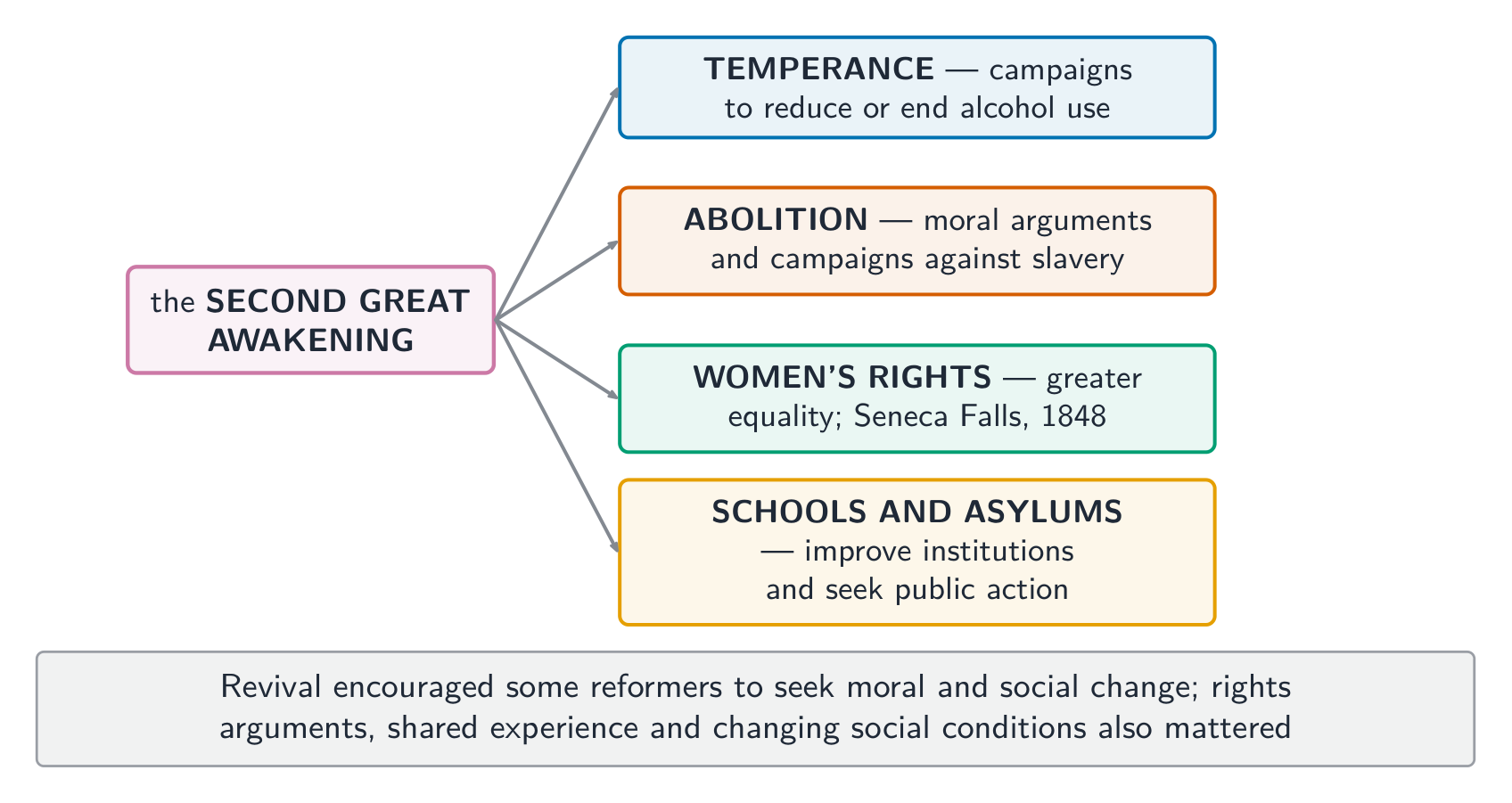
Get from revival to reform movement
Religious revival produces political movements because of one premise: a person can be perfected, so a society can.
How did Finney's teaching differ from Calvinism?
Dificultad 1/5 · 100 monedas + un pequeño bono en el primer intento de hoy
Individual choice.
Worked example: the growth of new churches
- Numbers: Methodist membership grew from about 60 000 in 1790 to over a million by the 1840s. Baptists also grew quickly.
- Method: travelling preachers called circuit riders 巡回传道士 rode from settlement to settlement on the frontier.
- New faiths: in western New York — called the "burned-over district" because of its many revivals — Joseph Smith founded the Church of Jesus Christ of Latter-day Saints (Mormons) in 1830.
Match each term to its meaning.
Dificultad 2/5 · 140 monedas + un pequeño bono en el primer intento de hoy
The revival's shape.
Methodist membership grew to over a million by the 1840s.
Dificultad 1/5 · 100 monedas + un pequeño bono en el primer intento de hoy
From about 60 000 in 1790.
A response to rationalism
- Some founders, such as Jefferson, had been deists who trusted reason more than revealed religion.
- The Second Great Awakening 第二次大觉醒运动 answered with emotional, personal faith.
Mobility
- People moving to new western settlements lacked established churches; revivals filled that gap.
- In growing market towns, revivals offered order and community to families facing rapid change.
Revivals were not only emotional events. They encouraged believers to improve society, leading directly to reform movements against alcohol and slavery and for education.
The revivals had no effect on reform movements.
Dificultad 1/5 · 100 monedas + un pequeño bono en el primer intento de hoy
They led directly to reform.
Democratic, individualistic beliefs, a reaction against rationalism and the mobility of frontier and market life fuelled the Second Great Awakening. Camp meetings like Cane Ridge, circuit riders and preachers such as Finney spread Methodist and Baptist churches and new faiths, and inspired reform.
Explain why the Second Great Awakening spread so widely.
Causation.