Widening the Vote
Introducido| English | Significado |
|---|---|
| national nominating convention | A meeting of party delegates from every state to choose the party's candidate for president, used from 1831. |
| spoils system | The practice of giving government jobs to a winning party's supporters. |
A property rule for Black voters only, 1821
- In 1821, a convention in New York rewrote the state constitution. It removed the property requirement for white men, so almost all of them could vote. For Black men, it raised the requirement to 250 dollars of property — a large sum. Of about 30 000 Black New Yorkers, only a few hundred could vote afterwards.
- In the early nineteenth century, democracy widened for white men while it narrowed for others.
What did New York's 1821 constitution do?
Dificultad 1/5 · 100 monedas + un pequeño bono en el primer intento de hoy
Widened and narrowed at once.
What changed
- By the 1830s, most states had ended property requirements for white men. Voter turnout in presidential elections rose from about 27% in 1824 to about 80% in 1840.
- Voters, not state legislatures, now chose presidential electors in almost every state.
Turnout rose from about 27% in 1824 to about 80% in 1840. By how many percentage points did it rise?
Dificultad 2/5 · 140 monedas + un pequeño bono en el primer intento de hoy
80 − 27.
What did not change — or got worse
- Several states took the vote away from free Black men: North Carolina in 1835 and Pennsylvania in 1838. Women could not vote anywhere.
- In Rhode Island, the Dorr Rebellion (1842) protested property requirements that still kept many white men from voting.
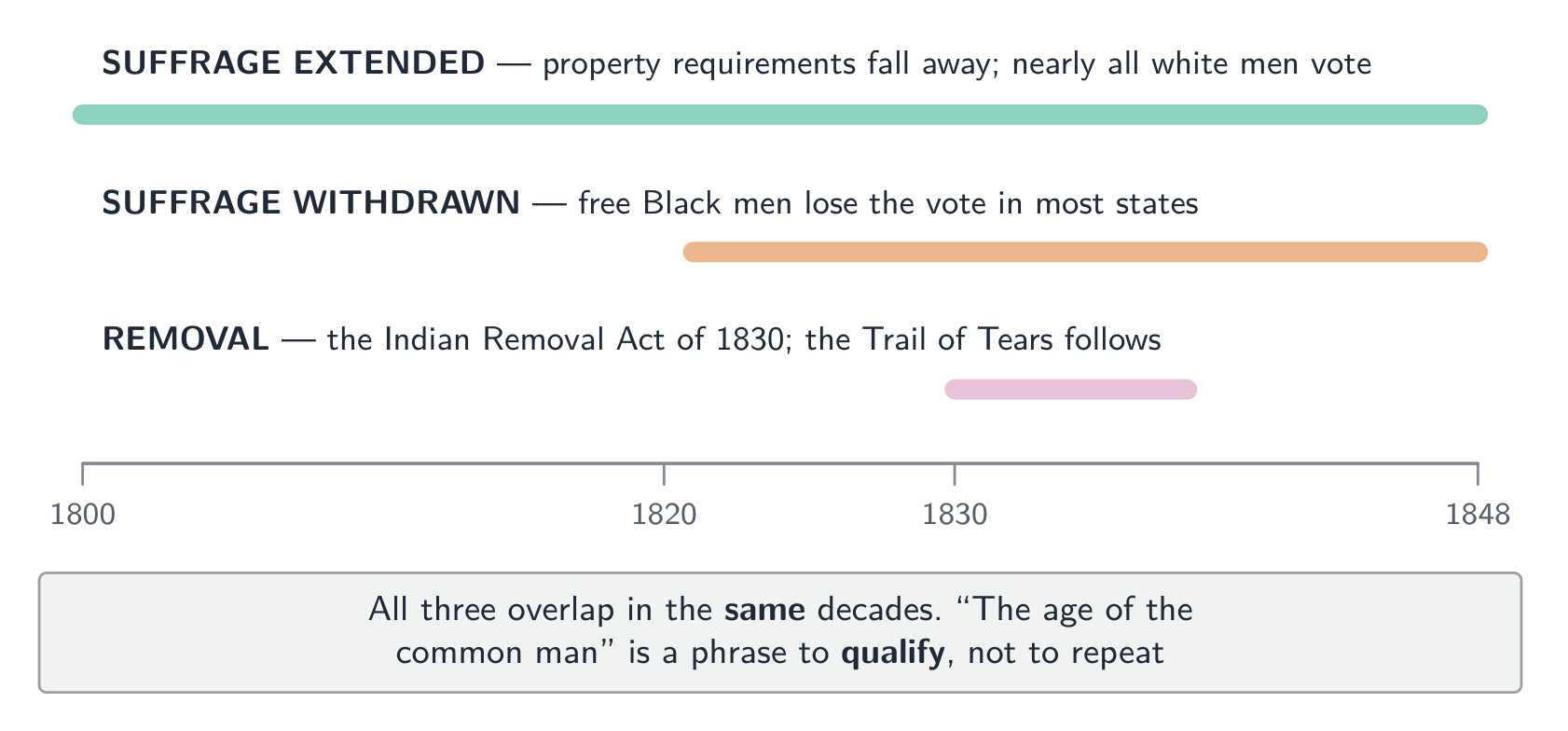
Follow the widening and the narrowing together
Democratisation and exclusion run through the same decades, which is what the phrase has to be qualified against.
Where did free Black men lose the vote in this period?
Dificultad 2/5 · 140 monedas + un pequeño bono en el primer intento de hoy
Democracy narrowed for them.
The Dorr Rebellion protested property requirements for voting in Rhode Island.
Dificultad 1/5 · 100 monedas + un pequeño bono en el primer intento de hoy
1842.0
Worked example: parties grow alongside
- Conventions: from 1831, each party held a national nominating convention 全国提名大会 to choose candidates, instead of small meetings of congressmen.
- Campaigns: in 1840, Whigs held huge rallies and parades with log cabins and cider for William Henry Harrison.
- Machines: party organizations such as New York's Tammany Hall rewarded supporters with government jobs — the spoils system 政党分肥制.
Match each development to its description.
Dificultad 2/5 · 140 monedas + un pequeño bono en el primer intento de hoy
Mass politics.
Why it matters
- Mass politics made ordinary white men central to elections, and politicians had to appeal to them.
- Andrew Jackson's election in 1828 was seen as the triumph of the "common man".
Who was left out
- Women, free Black men in most states, enslaved people and Native Americans had no vote.
- Women's rights activists at Seneca Falls (1848) demanded the vote.
"Jacksonian democracy" applied to white men. In the same years, free Black men lost the vote in several states. Always qualify the claim that democracy expanded.
Democracy expanded for all Americans in the Jacksonian era.
Dificultad 1/5 · 100 monedas + un pequeño bono en el primer intento de hoy
For white men only.
From the 1820s to 1840, property requirements fell, turnout rose to about 80% and parties built conventions, rallies and machines. But democracy narrowed for free Black men, who lost the vote in New York (in practice), North Carolina and Pennsylvania, and women remained excluded.
To what extent did democracy expand in the United States between 1820 and 1840?
Extent.