Who the Market Changed
Introducido| English | Significado |
|---|---|
| wage/weɪdʒ/ | Payments to workers in return for their labour. |
| labor union | An organization of workers that bargains with employers over wages, hours and conditions. |
| cult of domesticity/kʌlt ɒv dəmɪˈstɪsɪti/ | The nineteenth-century middle-class ideal that women should make the home a moral refuge while men earned money outside it. |
The mill girls walk out, 1834
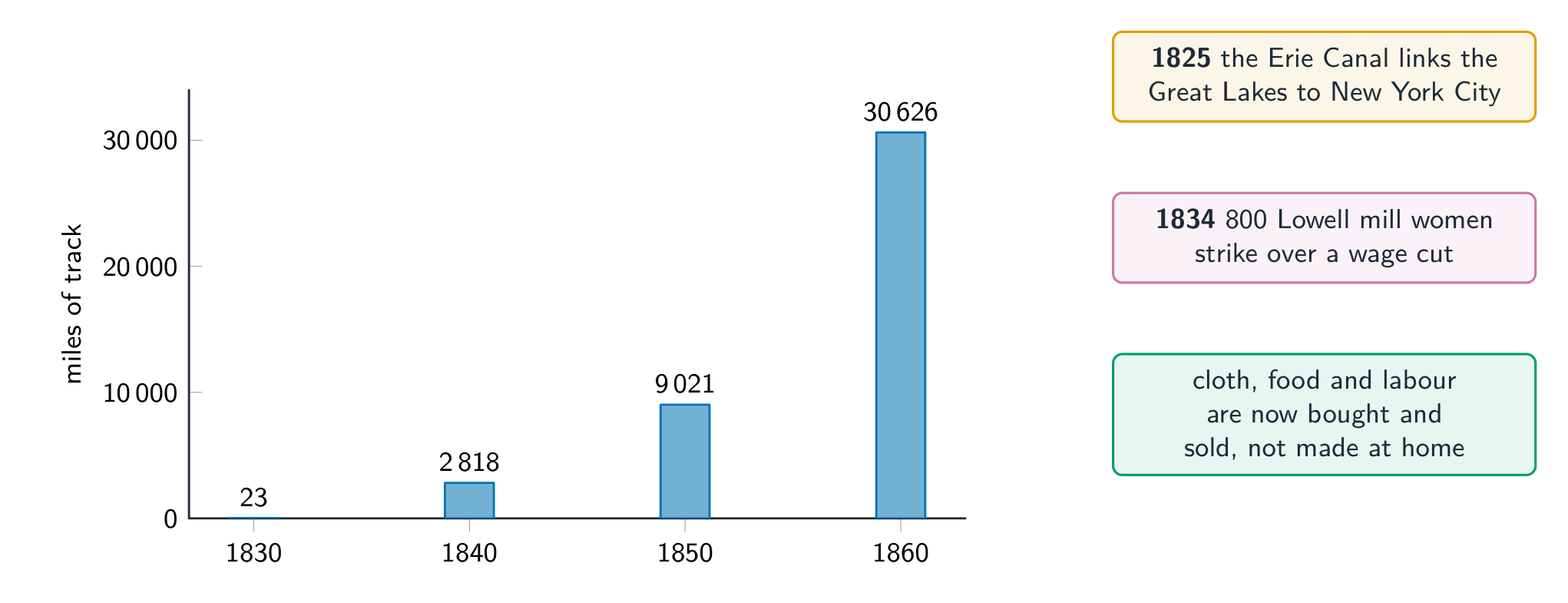
- In February 1834, about 800 young women walked out of the cotton mills at Lowell, Massachusetts, after the owners announced a wage cut. Most had come from New England farms to earn money for themselves and their families, living in company boarding houses with strict rules. The strike failed within days, but it was one of the first strikes by women workers in the United States.
- The market revolution changed how Americans worked, where they lived and how families were organized — but not in the same way for everyone.
Why did the Lowell mill workers strike in 1834?
Dificultad 1/5 · 100 monedas + un pequeño bono en el primer intento de hoy
About 800 women walked out.
Two migrations at once
- Young Americans moved from farms to towns and factories. Immigrants arrived in large numbers: about 1.5 million Irish came in 1845–55, many fleeing the famine, and many Germans came too.
- Cities such as New York grew rapidly, and immigrants often took the lowest-paid jobs.
About how many million Irish immigrants came to the US in 1845–55?
Dificultad 2/5 · 140 monedas + un pequeño bono en el primer intento de hoy
Many fled the famine.
Prosperity for some
- Merchants, factory owners and professionals formed a growing middle class. Skilled craftsmen lost out as factories made goods more cheaply.
- Unskilled workers, especially immigrants, often lived in crowded, unhealthy city districts.
Which segment of society?
Sort each effect by the group it describes.
Who often lost out in the market revolution?
Dificultad 2/5 · 140 monedas + un pequeño bono en el primer intento de hoy
Owners gained.
Worked example: from household to wage labour
- Before: many families made cloth, shoes and tools at home or in small workshops, and decided their own hours.
- After: workers earned wages 工资 in factories, where owners and clocks set the hours — often 12 or more a day.
- Response: workers formed early labor unions 工会; in Commonwealth v. Hunt (1842), a Massachusetts court ruled that unions were legal.
Match each change to its example.
Dificultad 2/5 · 140 monedas + un pequeño bono en el primer intento de hoy
Work and family.
New family ideals
- As work moved out of the home, middle-class families developed the cult of domesticity 家庭崇拜: women should make the home a moral refuge; men should earn money outside it.
- Working-class women could not follow this ideal; they had to earn wages.
Working-class women could easily follow the cult of domesticity.
Dificultad 1/5 · 100 monedas + un pequeño bono en el primer intento de hoy
They had to earn wages.
Different for different groups
- In the South, the market revolution increased demand for cotton and enslaved labour.
- Western farmers grew crops for distant markets, linked by canals and railroads.
The market revolution did not affect all groups the same way. It enriched the middle class, hurt many craftsmen, drew women and immigrants into factories, and deepened slavery in the South.
The market revolution affected all Americans in the same way.
Dificultad 1/5 · 100 monedas + un pequeño bono en el primer intento de hoy
Different groups, different effects.
The market revolution drew farm youth and immigrants into factories and cities, created a prosperous middle class and a struggling wage-earning class, and moved work out of the home. Middle-class families embraced the cult of domesticity, while workers began to organize unions.
Explain how the market revolution changed work and family life in the North.
Change.