Claiming a Hemisphere
Introducido| English | Significado |
|---|---|
| Louisiana Purchase/luːˌiːzɪˈænə ˈpɜːtʃɪs/ | The 1803 acquisition of a vast territory from France. |
| Monroe Doctrine/ˈmɒnrəʊ ˈdɒktrɪn/ | The 1823 warning that European powers should not recolonise the Americas. |
A warning to Europe, 1823
- In December 1823 President James Monroe told Congress that the Americas were "henceforth not to be considered as subjects for future colonization by any European powers". The United States had only a small navy and could not enforce this. The British Royal Navy, which wanted Latin American trade open, effectively did.
- The young republic was claiming a hemisphere.
The US navy was strong enough to enforce the Monroe Doctrine in 1823.
Dificultad 1/5 · 100 monedas + un pequeño bono en el primer intento de hoy
Britain's navy did.
Expanding across the continent
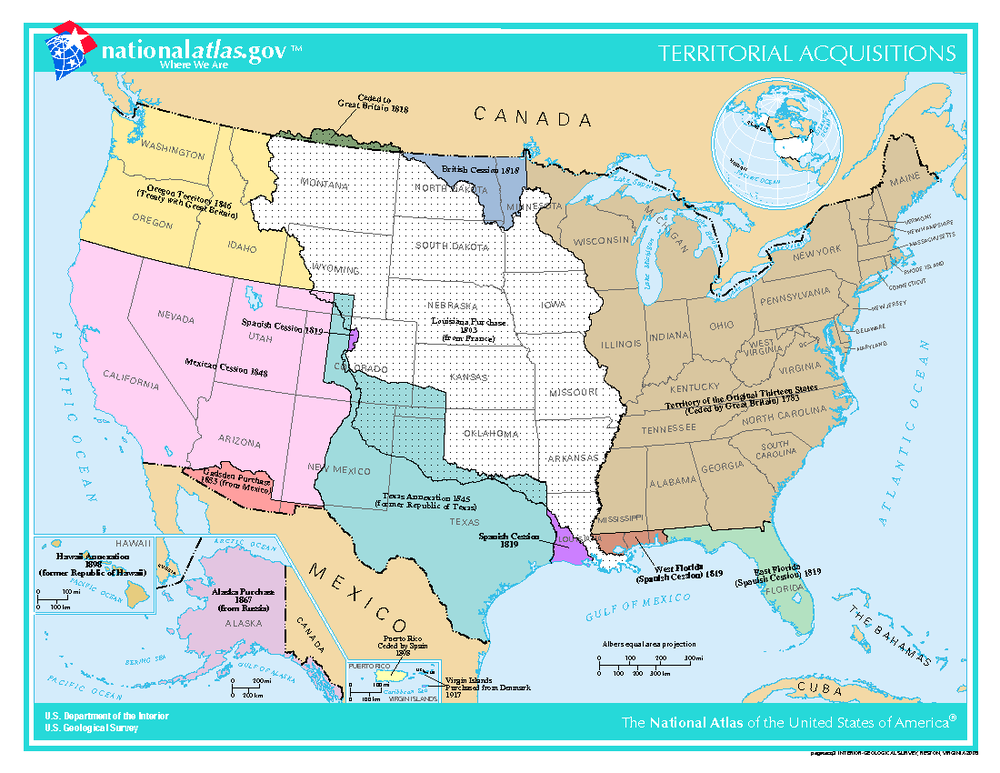
- The Louisiana Purchase 路易斯安那购地 of 1803 bought about 2 million square kilometres from France for 15 million dollars, doubling the country's size.
- In the Adams–Onís Treaty of 1819, Spain gave up Florida and agreed a border reaching the Pacific.
From which country did the US buy the Louisiana territory in 1803?
Dificultad 1/5 · 100 monedas + un pequeño bono en el primer intento de hoy
Napoleon sold it for 15 million dollars.
Trade and conflict at sea
- Americans wanted to trade freely with Europe. British and French interference with ships and the seizure of sailors led to the War of 1812.
- The war ended in a draw in 1815, but Americans saw it as proof of independence.
Put these in order.
Dificultad 3/5 · 200 monedas + un pequeño bono en el primer intento de hoy
1803, 1812, 1819, 1823.
Worked example: what did the Monroe Doctrine achieve?
- The claim: Europe should not create new colonies in the Americas; the US would stay out of European affairs.
- The limit: in 1823 the US navy could not stop a European fleet; Britain's navy kept Spain from reconquering its former colonies.
- The significance: the Monroe Doctrine 门罗主义 became the basis of later US policy, used to justify intervention in Latin America in the 1900s.
An aim, a means, or the framing?
Sort each element of early American foreign policy.
What did the Monroe Doctrine claim?
Dificultad 1/5 · 100 monedas + un pequeño bono en el primer intento de hoy
A closed hemisphere.
Foreign policy at home
- Expansion also meant pushing American Indians off their land through treaties, wars and, later, the Indian Removal Act of 1830.
- Each new territory raised a question: would it allow slavery?
Expansion raised questions about whether new territories would allow slavery.
Dificultad 1/5 · 100 monedas + un pequeño bono en el primer intento de hoy
A growing conflict.
Why policy expanded
- Farmers wanted land; merchants wanted markets; leaders wanted security from European powers on the borders.
- Ideas of an "empire of liberty" made expansion seem right to many white Americans.
Which motivated US expansion in the early 1800s?
Dificultad 2/5 · 140 monedas + un pequeño bono en el primer intento de hoy
Land, markets and security.
The Monroe Doctrine was not enforced by the United States in 1823. It was a statement of intent. Britain's navy did the work at first; the US gained the power to back it up only decades later.
After 1800 the United States expanded through purchase, treaty and war, and in 1823 claimed the Western Hemisphere as closed to new European colonies. Expansion served farmers, merchants and security — and came at the cost of American Indian lands and fresh conflict over slavery.
Explain how and why US foreign policy expanded between 1800 and 1823.
Foreign policy.