Independent Events
Introducido| English | Significado |
|---|---|
| independent events/ˌɪndɪˈpendənt ɪˈvents/ | eventos independientes |
When knowing one tells you nothing
- Two events are independent 独立事件 if one happening doesn't change the other's probability.
- Formally, when $P(B)>0$: $P(A \mid B) = P(A)$. Equivalently, $P(A\cap B)=P(A)P(B)$, which also covers zero-probability events.
- Coin tosses are independent: the first result tells you nothing about the second.
- If knowing $B$ does shift $P(A)$, the events are dependent.
The multiplication shortcut
- For independent events, the multiplication rule simplifies:
-
$$P(A \cap B) = P(A)\,P(B)$$
- Since $P(A \mid B) = P(A)$, the condition drops out — just multiply.
- Multiplying the unconditional probabilities is valid only for independent events; otherwise use a conditional probability.
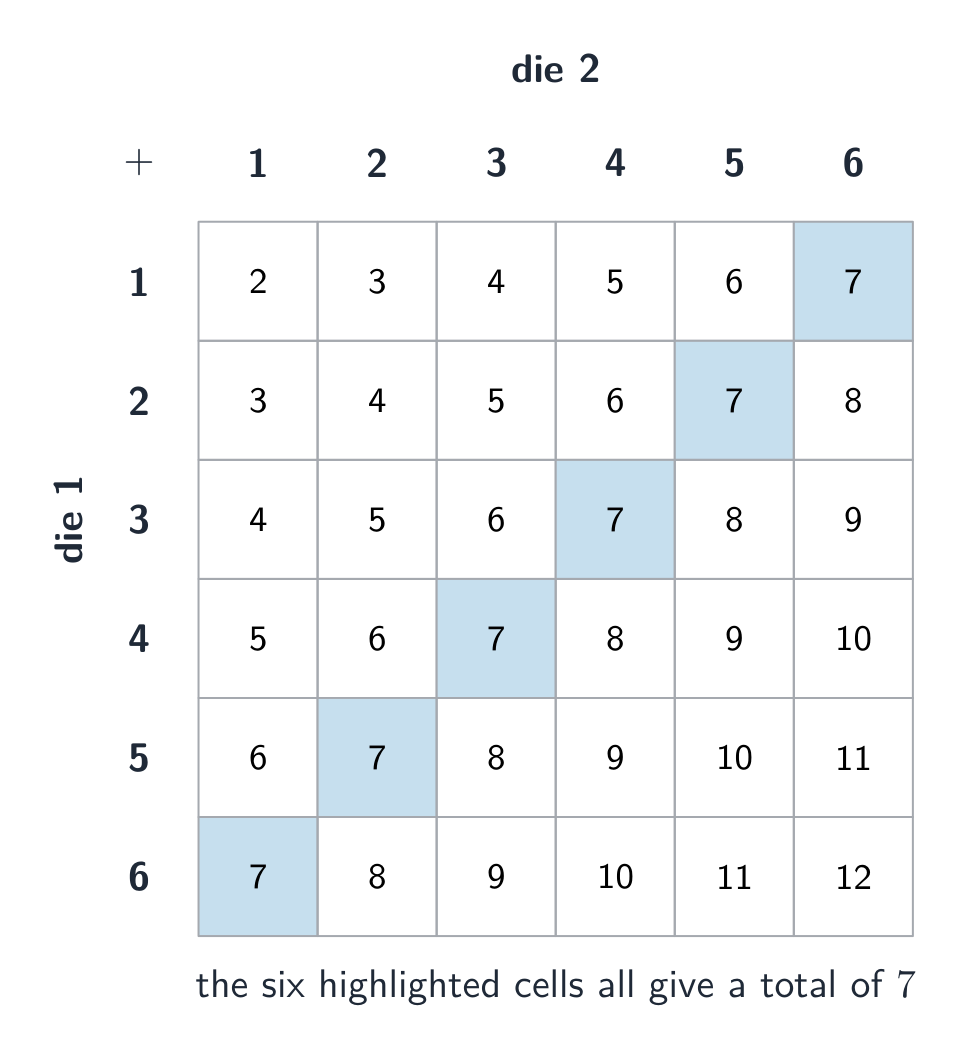
A sample space diagram lists every equally likely outcome
Independent ≠ mutually exclusive
- These are different concepts, not opposites: dependent events need not be disjoint.
- Mutually exclusive: they can't both happen ($P(A \cap B) = 0$).
- Independent: their joint probability is the product of their probabilities; for positive-probability events, they can happen together.
- In fact, two events with nonzero probability that are disjoint are always dependent.
Combining rules
- Compound problems chain the addition and multiplication rules.
- "At least one" is often easiest via the complement: $1 - P(\text{none})$.
- $P(\text{none}) = P(\text{not }A)\,P(\text{not }B)\cdots$ for independent events.
- Break the event into "and"s (multiply) and "or"s (add), step by step.
Independent and mutually exclusive are different concepts. If disjoint events both have positive probability, learning one occurred makes the other impossible, so they are dependent. This does not imply perfect negative correlation. Only use $P(A\cap B)=P(A)P(B)$ after you've checked independence; never assume it just because the problem gives you $P(A)$ and $P(B)$.
Flip a fair coin twice (independent flips).
- $P(\text{two heads}) = P(H)\,P(H) = 0.5 \times 0.5 = 0.25$.
- $P(\text{at least one head}) = 1 - P(\text{no heads}) = 1 - 0.5 \times 0.5 = 0.75$.
- The complement turns a messy "or" into a clean "and."
Events are independent when $P(A \mid B) = P(A)$; then $P(A \cap B) = P(A)\,P(B)$ (multiply). This is not the same as mutually exclusive (which means $P(A\cap B)=0$) — positive-probability disjoint events are dependent. Combine the addition and multiplication rules for compound events, often using the complement for "at least one."
Write from the data: find the joint probability
- Events A and B are independent.
- P of A is 0.2 and P of B is 0.4. The lesson values 0.25 and 0.75 are another pair.
A and B are independent, with P(A)=0.2 and P(B)=0.4. Find P(A and B), and explain why the multiplication shortcut applies.
Independent events multiply.
A and B are independent, with P(A)=0.2 and P(B)=0.4. What is P(A and B)?
Dificultad 1/5 · 100 monedas + un pequeño bono en el primer intento de hoy
0.2 times 0.4 is 0.08.
Independent events branch by branch
For independent events, multiply along the branches.
Two independent events have P(A)=0.5 and P(B)=0.5. Find P(A and B).
Dificultad 2/5 · 140 monedas + un pequeño bono en el primer intento de hoy
Independent → multiply: 0.5 × 0.5 = 0.25.
Independent events and mutually exclusive events are the same thing.
Dificultad 1/5 · 100 monedas + un pequeño bono en el primer intento de hoy
Independence means P(A and B)=P(A)P(B). Disjointness means P(A and B)=0. They differ: disjoint events with positive probabilities are dependent, but dependent events can overlap.
Flip a fair coin twice. Find P(at least one head).
Dificultad 2/5 · 140 monedas + un pequeño bono en el primer intento de hoy
1 − P(no heads) = 1 − 0.5×0.5 = 0.75.
For P(B)>0, which equality defines independence of A and B?
Dificultad 1/5 · 100 monedas + un pequeño bono en el primer intento de hoy
Independence: the condition doesn't change A's probability.
For 'at least one', it is often easiest to use the ___ rule (1 minus P(none)).
Dificultad 1/5 · 100 monedas + un pequeño bono en el primer intento de hoy
P(at least one) = 1 − P(none).