Selecting a Design
Introducido| English | Significado |
|---|---|
| completely randomized design/kəmˈpliːtli ˈrændəmaɪzd dɪˈzaɪn/ | diseño completamente aleatorizado |
| blocking/ˈblɒkɪŋ/ | bloqueo |
| randomized block design/ˈrændəmaɪzd blɒk dɪˈzaɪn/ | diseño de bloques aleatorizados |
| matched-pairs design/mætʃt peəz dɪˈzaɪn/ | diseño de pares apareados |
The completely randomized design
- The simplest design: a completely randomized design 完全随机设计.
- All experimental units are assigned to treatments purely by chance.
- No grouping first — just randomize everyone into the treatment groups.
- It relies on randomization alone to balance out differences.
Blocking cuts variability
- Sometimes units differ in a known way that affects the response (e.g. age, sex).
- Blocking 区组化 groups similar units into blocks, then randomizes within each block.
- This removes that known source of variation from the comparison.
- "Block what you can, randomize what you can't."
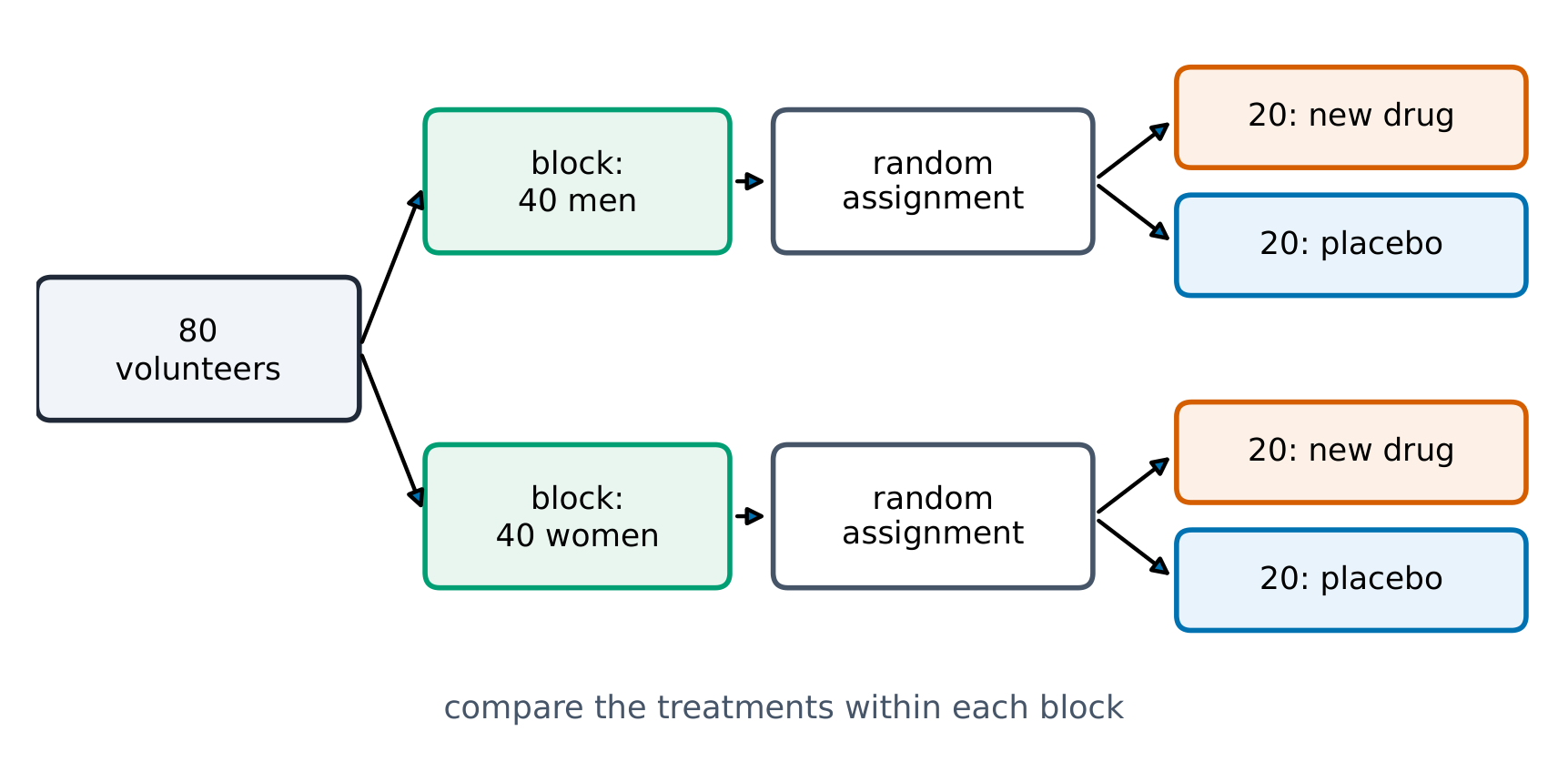
A randomized block design 随机区组设计: group similar subjects, then randomize within each block
Block and matched-pairs designs
- A randomized block design: form blocks of similar units, randomize treatments inside each.
- A matched-pairs design 配对设计: the special case of blocks of size $2$.
- For two similar units, randomly assign one to each treatment. If the same unit receives both treatments, randomize treatment order and allow for carryover effects.
- Comparing within pairs reduces variation from differences between individuals; matching does not guarantee identical individuals.
Choosing a design
- Pick the design that controls the biggest known source of variability.
- If a variable (age, baseline skill) clearly affects the response → block on it.
- If no strong nuisance variable stands out → a completely randomized design is fine.
- The goal is a fair comparison where only the treatment differs.
Blocking is not the same as stratifying. Same idea (group similar units), different setting: stratified sampling is about choosing a representative sample; blocking is about designing an experiment to reduce variability. Also, don't block on a variable that has nothing to do with the response — you only block on a known nuisance variable.
Testing a workout plan on people of very different fitness.
- Fitness strongly affects the response → block by fitness level.
- Randomized block design: within each fitness block, randomly assign plan A or B.
- Matched pairs: pair each person with a similar-fitness partner; randomize who gets A.
A completely randomized design assigns all units to treatments by chance. Blocking groups similar units to remove a known source of variability, giving a randomized block design (or a matched-pairs design when blocks have size $2$). Choose the design that controls the largest known nuisance variable.
Write from this case
- Subjects differ a lot in fitness.
- The designer groups similar fitness levels before assigning the treatment inside each group.
Fitness affects the response. Subjects are grouped by similar fitness, then treatments are randomly assigned within each group. What design step is the grouping, and why use it?
Blocks remove a known source of variation.
What is grouping by fitness before assignment?
Dificultad 1/5 · 100 monedas + un pequeño bono en el primer intento de hoy
Similar units share a block.
Units grouped into blocks
Blocking groups similar units before randomizing within each.
A matched-pairs design is a special case of a randomized block design with blocks of size...
Dificultad 1/5 · 100 monedas + un pequeño bono en el primer intento de hoy
Matched pairs = blocks of size 2.
Blocking groups similar experimental units to remove a known source of variability.
Dificultad 1/5 · 100 monedas + un pequeño bono en el primer intento de hoy
That's exactly the purpose of blocking.
Fitness strongly affects the response. The best design is to...
Dificultad 1/5 · 100 monedas + un pequeño bono en el primer intento de hoy
Block on the known nuisance variable (fitness).
The simplest design, assigning all units to treatments purely by chance, is a completely ___ design.
Dificultad 1/5 · 100 monedas + un pequeño bono en el primer intento de hoy
A completely randomized design uses randomization alone.
Blocking (in experiments) is most like which sampling method?
Dificultad 1/5 · 100 monedas + un pequeño bono en el primer intento de hoy
Both group similar units — blocking (design) parallels stratifying (sampling).