Do the Data Tell the Truth?
Introducido| English | Significado |
|---|---|
| bias/ˈbaɪəs/ | sesgo |
| representative/ˌreprɪˈzentətɪv/ | representativo |
| population/ˌpɒpjʊˈleɪʃn/ | población |
| generalization/ˌdʒenərəlaɪˈzeɪʃn/ | generalización |
Can we trust the data?
- Before any graph or calculation, ask: were the data collected honestly and well?
- The method of collection decides what conclusions are even possible.
- Bad data can't be rescued by clever analysis — "garbage in, garbage out."
- Unit 3 is about getting good data, so Units 4–9 can trust them.
Bias: a lopsided method
- Bias 偏差 is a systematic tendency to miss the truth in the same direction.
- A biased method favors certain outcomes no matter how much data you gather.
- It's different from random error, which averages out; bias does not average out.
- The danger: a sample that isn't representative 有代表性的 of the population 总体.
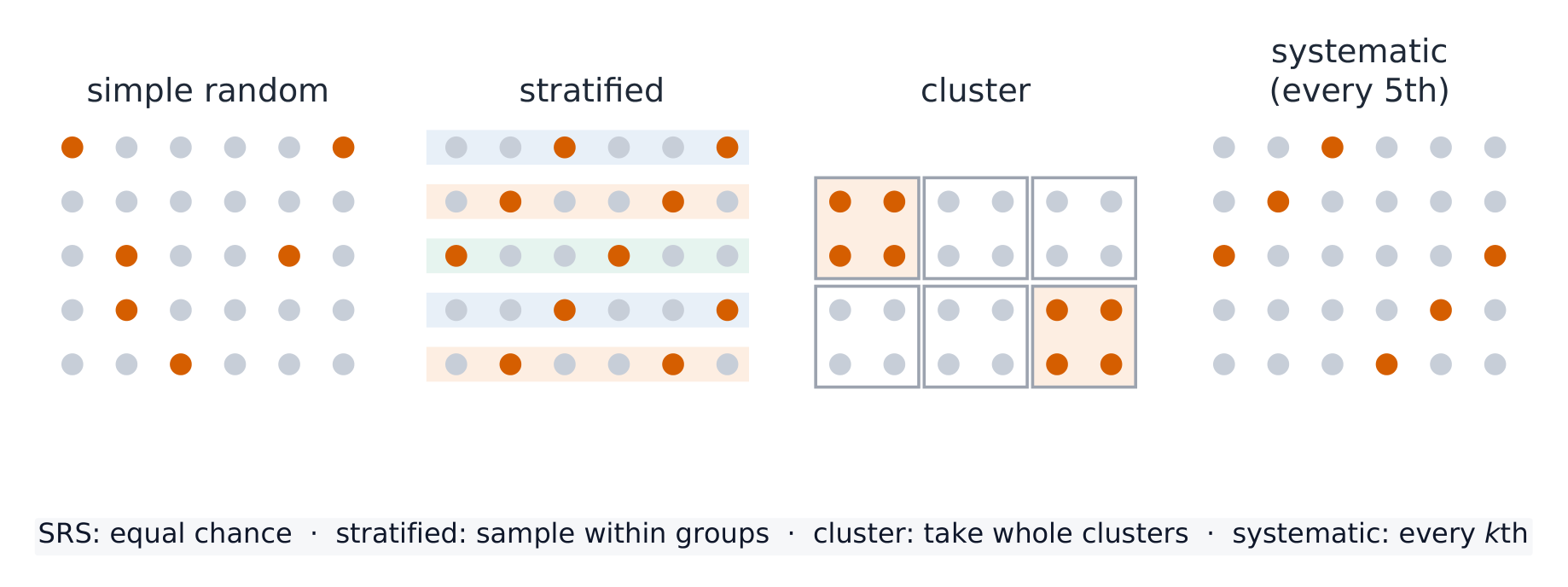
Trustworthy data starts with how it was collected: four random sampling designs
When can we generalize?
- A generalization 推广 extends a sample's finding to the whole population.
- This is only justified when the sample was gathered without bias (ideally at random).
- Data from a lopsided method describe only that lopsided group — not everyone.
- "Who was actually reached?" decides how far a conclusion can travel.
Plan before you collect
- Good data collection is planned in advance, not patched up afterward.
- Decide the population, the sampling method, and the questions before gathering.
- A careful plan is the cheapest way to avoid bias you can't fix later.
- Analysis is only as trustworthy as the collection that fed it.
A bigger sample does not fix bias. If the method systematically misses part of the population, collecting more responses the same flawed way just gives you a more precise wrong answer. Size fights random error; only a better method fights bias. Always ask how the data were collected before trusting any conclusion.
A radio host asks listeners to call in whether they support a new law.
- Only motivated, opinionated listeners call — not a representative sample.
- The result is biased; it describes callers, not the population.
- Getting $10{,}000$ callers instead of $100$ makes it no less biased.
The method of data collection determines what we can conclude. Bias is a systematic error that makes a sample unrepresentative of the population, and it does not shrink with a larger sample. Only bias-free (ideally random) collection justifies a generalization — so plan collection carefully before analyzing.
Write from this case
- A website asks visitors to vote.
- Only people who find the site and care enough to click reply.
A website invites visitors to vote, and only those who care enough click to reply. Why is generalizing these votes to the wider population unreliable?
A self-selected web vote does not represent everyone.
A website vote lets visitors decide whether to respond. What is the problem with using it to estimate the wider population’s views?
Dificultad 1/5 · 100 monedas + un pequeño bono en el primer intento de hoy
Who chooses to answer is not a random sample.
A biased sample over-represents one group
When one slice dominates, the sample isn't representative of the population.
Collecting a much larger sample using the same flawed method will remove the bias.
Dificultad 1/5 · 100 monedas + un pequeño bono en el primer intento de hoy
Size fights random error, not bias — a flawed method stays biased at any size.
A radio call-in poll mainly reaches motivated listeners. Its result is...
Dificultad 1/5 · 100 monedas + un pequeño bono en el primer intento de hoy
Self-selected callers aren't representative — the poll is biased.
A systematic tendency to miss the truth in the same direction is called ___.
Dificultad 1/5 · 100 monedas + un pequeño bono en el primer intento de hoy
Bias is systematic, directional error that doesn't average out.
Extending a sample's finding to the whole population is justified only when the sample is...
Dificultad 1/5 · 100 monedas + un pequeño bono en el primer intento de hoy
Only bias-free collection supports generalization.
The method of data collection determines what conclusions are possible.
Dificultad 1/5 · 100 monedas + un pequeño bono en el primer intento de hoy
Good conclusions require good collection — plan it before analyzing.