Comparing Distributions of a Quantitative Variable
Introducido| English | Significado |
|---|---|
| parallel boxplots/ˈpærəlel ˈbɒksplɒts/ | diagramas de caja paralelos |
Putting two groups side by side
- Often the real question is a comparison: do boys and girls, or two treatments, differ?
- Show the groups together with parallel boxplots 平行箱线图 or back-to-back displays.
- Then compare them explicitly, feature by feature.
- A good comparison names the difference and its direction, in context.
One group's boxplot
Placing two boxplots side by side lets you compare their centers, spreads, and shapes explicitly.
Parallel boxplots are a good way to compare two or more distributions.
Dificultad 1/5 · 100 monedas + un pequeño bono en el primer intento de hoy
They align groups on the same scale.
Compare shape, center, spread
- Shape: is each group symmetric or skewed? Do they differ in form?
- Center: which group has the higher median (or mean)? By how much?
- Spread: which group is more variable (bigger IQR or SD)?
- Address all three — a comparison that mentions only the center is incomplete.
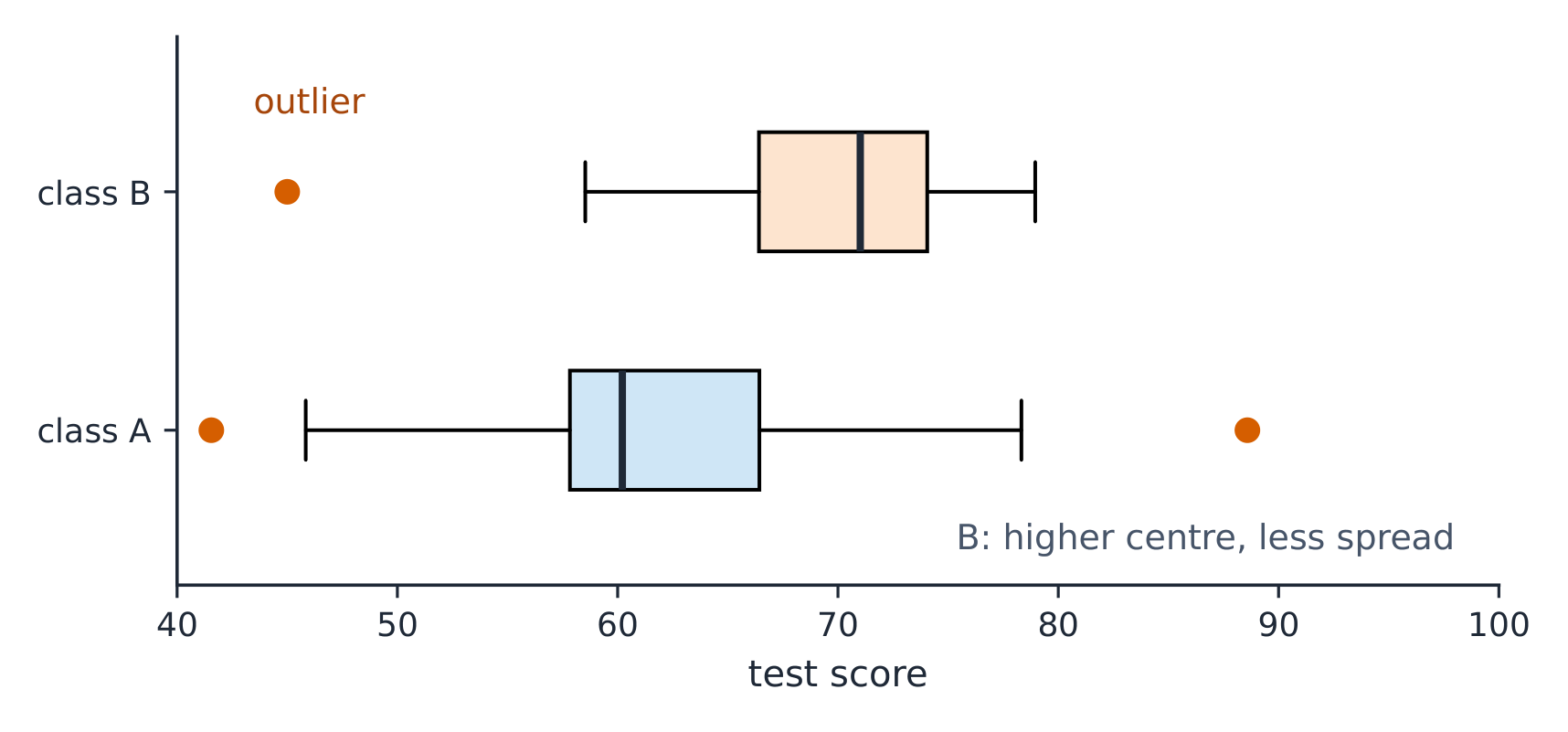
Parallel box plots compare centre, spread and outliers of two groups
A complete comparison of two groups addresses which features?
Dificultad 2/5 · 140 monedas + un pequeño bono en el primer intento de hoy
Shape, center, spread, and unusual features for both groups.
A wider box (larger IQR) means a group is...
Dificultad 1/5 · 100 monedas + un pequeño bono en el primer intento de hoy
Bigger IQR = more spread = more variable.
Use comparative language
- Say it comparatively: "Group A's median is greater than Group B's," or "Group A is more variable than Group B."
- Vague statements ("they're different") earn no credit — be specific about what differs and which way.
- Always tie the comparison to the context (the actual variable and groups).
- Comparative words — greater, less, more spread out — are what graders look for.
Which statement earns credit on the AP exam?
Dificultad 1/5 · 100 monedas + un pequeño bono en el primer intento de hoy
Explicit, directional, in context.
Comparisons should be ____ — stating which group is greater and by how much.
Dificultad 1/5 · 100 monedas + un pequeño bono en el primer intento de hoy
Directional, quantified, in context.
Note outliers and unusual features
- Do the groups differ in outliers or other unusual features?
- One group might have a high outlier the other lacks, or a gap.
- Mention these differences too — they can be the most interesting finding.
- A complete comparison covers shape, center, spread, and unusual features for both groups.
If one group has a low outlier the other lacks, you should...
Dificultad 1/5 · 100 monedas + un pequeño bono en el primer intento de hoy
Differences in outliers are part of a complete comparison.
Comparisons must be explicit and directional: "Group A's median (72) is higher than Group B's (65)" — not just "the medians are different." State which group is greater/more variable, by roughly how much, in context. Merely describing each group separately, without comparing, misses the point.
Suppose parallel boxplots show these summaries for Class A and Class B test scores: medians 78 and 70, a wider box for B, roughly balanced boxes and whiskers, and a low outlier only in B.
- Center: Class A's median ($78$) is greater than Class B's ($70$).
- Spread: Class B is more variable (a wider box/IQR).
- Shape/unusual: the balanced boxes and whiskers suggest roughly symmetric main bodies, but Class B has a low outlier that Class A lacks. Boxplots cannot reveal every feature of shape.
Compare distributions with parallel boxplots (or back-to-back plots), addressing shape, center, spread, and unusual features for both groups. Use explicit comparative language ("greater than," "more variable than") with direction and context — not just "they differ."
Write from a higher median
- Group A has median 42 and a small spread.
- Group B has median 55 and a similar spread.
Group A has median 42 and a small spread; Group B has median 55 and a similar spread. Compare their centers and spreads.
Compare centers with the medians when those are the summaries given.
Group A has median 42; Group B has median 55. Which group has the higher median?
Dificultad 1/5 · 100 monedas + un pequeño bono en el primer intento de hoy
55 is greater than 42.