Sensación
Introducido| English | Significado |
|---|---|
| Sensation/senˈseɪʃn/ | sensación |
| transduction/trænsˈdʌkʃn/ | transducción |
| threshold/ˈθreʃəʊld/ | umbral |
| just-noticeable difference/dʒʌst ˈnəʊtɪsəbl ˈdɪfrəns/ | diferencia mínima perceptible |
| Weber's law/ˈwebəz lɔː/ | ley de Weber |
| Sensory adaptation/ˈsensəri ˌædæpˈteɪʃn/ | adaptación sensorial |
| retina/ˈretɪnə/ | retina |
| visual accommodation/ˈvɪʒuːəl əˌkɒməˈdeɪʃn/ | acomodación visual |
| Rods/rɒdz/ | Conos |
| cones/kəʊnz/ | Cones |
| trichromatic theory/ˌtrɪkrəʊˈmætɪk ˈθɪəri/ | Teoría tricromática |
| opponent-process theory/əˈpəʊnənt ˈprəʊses ˈθɪəri/ | Teoría de procesos opuestos |
| pitch/pɪtʃ/ | Altura |
| loudness/ˈlaʊdnəs/ | Intensidad |
| Olfaction/ɒlˈfækʃn/ | Olfato |
| gustation/ɡʌˈsteɪʃn/ | Gustación |
| Gate control theory/ɡeɪt kənˈtrəʊl ˈθɪəri/ | Teoría del control de puerta |
| vestibular sense/veˈstɪbjʊlə sens/ | Sentido vestibular |
| kinesthesis/ˈkaɪnsθəsɪs/ | Cinestesia |
You stop noticing the clock after a minute
- A sound that was obvious becomes unnoticeable while it is still there.
- Your senses are not recording devices — they report change.
- This lesson is about how the body turns physical energy into a signal, and what it discards.
Sensation and transduction
- Sensation 感觉 is detecting information from the environment that meets a certain threshold 阈限, and turning it into a neural signal.
- That conversion is transduction 换能.
- Below threshold, the stimulus is present but produces no signal at all.
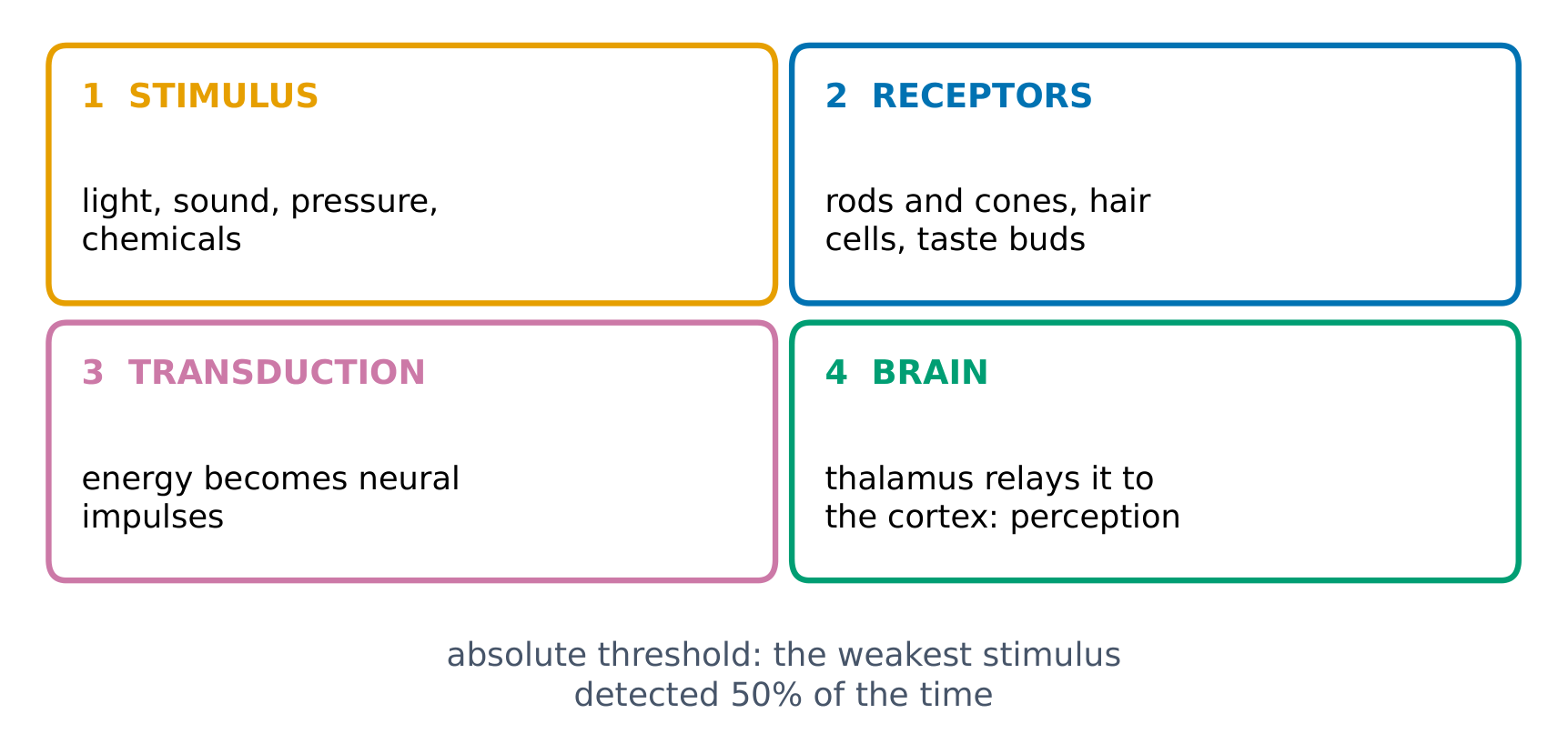
Sensation: receptors transduce energy into neural signals that travel to the brain
La conversión de un estímulo físico en una señal neural se llama ____.
Dificultad 1/5 · 100 monedas + un pequeño bono en el primer intento de hoy
Transducción es la etapa de conversión; por debajo del umbral no se produce ninguna señal.
Detecting change, and stopping
- The just-noticeable difference 最小可觉差 is the smallest change you can detect.
- Weber's law 韦伯定律 says that difference is a proportion of the original, not a fixed amount.
- Sensory adaptation 感觉适应 is the diminished response to an unchanging stimulus — the clock you stop hearing.
La ley de Weber establece que la diferencia umbral es...
Dificultad 1/5 · 100 monedas + un pequeño bono en el primer intento de hoy
Una cucharada de azúcar se detecta en una taza pero no en una jarra: lo que importa es la proporción.
Sensory adaptation is not the same as habituation. Adaptation happens in the sense organ itself — the receptors stop responding. Habituation is a learned drop in response that happens in the brain. The exam distinguishes them.
¿Qué sistema sensorial?
Clasifica cada estructura o término según el sentido al que pertenece.
El CED dice que la visión del color se explica solo por la teoría tricromática.
Dificultad 1/5 · 100 monedas + un pequeño bono en el primer intento de hoy
La visión del color se explica mediante ambas teorías: la tricromática y la de proceso opuesto.
Vision, in the terms the exam uses
- The retina 视网膜 is the photosensitive surface at the back of the eye; the lens focuses light onto it by visual accommodation 视觉调节.
- Rods 视杆细胞 in the periphery detect shape and movement but not colour; cones 视锥细胞 detect colour and detail.
- Colour vision is explained by both the trichromatic theory 三色理论 and the opponent-process theory 对立过程理论.
Selecciona todos los que correspondan a los sentidos corporales en lugar de la vista o la audición.
Dificultad 2/5 · 140 monedas + un pequeño bono en el primer intento de hoy
La retina forma parte del sistema visual; las otras tres son sentidos corporales.
Asocia cada término con el sentido al que corresponde.
Dificultad 2/5 · 140 monedas + un pequeño bono en el primer intento de hoy
Los conos y bastones codifican la luz, la teoría de lugar codifica el tono, y el olfato evita el tálamo.
Hearing, chemistry, touch and balance
- Sound is air movement: wavelength gives pitch 音高 and amplitude gives loudness 响度. Pitch perception is explained by place, volley and frequency theories.
- Olfaction 嗅觉 is the only sense not routed through the thalamus; gustation 味觉 has sweet, sour, salty, bitter, umami and oleogustus.
- Gate control theory 闸门控制理论 describes pain being processed in body and brain together.
- The vestibular sense 前庭觉 gives balance; kinesthesis 动觉 gives the sense of your own body's movement.
Add one spoon of sugar to a cup of tea and you taste the difference. Add one spoon to a large jug and you do not. The amount added is identical — what changed is the proportion, which is exactly what Weber's law predicts.
Sensation detects stimuli above threshold and transduces them into neural signals. The just-noticeable difference follows Weber's law as a proportion, and sensory adaptation removes unchanging stimuli. Vision uses rods and cones with two colour theories; hearing codes pitch and loudness; and vestibular and kinesthetic senses track balance and body movement.
Write from the data: find the just-noticeable difference
- A 100 g weight needs an extra 2 g before the change is noticed. A 1000 g weight is judged by the same proportion.
- Find the extra mass needed on the heavier weight.
Un cambio de 2 g es apenas perceptible sobre un peso de 100 g. Usando la misma proporción, ¿qué cambio es apenas perceptible sobre un peso de 1000 g?
El 2 por ciento de 1000 g corresponde a 20 g. Un estímulo inicial más pesado requiere un cambio absoluto mayor.
¿Qué cambio es apenas perceptible sobre el peso de 1000 g?
Dificultad 1/5 · 100 monedas + un pequeño bono en el primer intento de hoy
La proporción se mantiene en el 2 por ciento, por lo que sobre 1000 g se necesita un cambio de 20 g. Otras opciones — 2 g (la misma cucharada absoluta de azúcar que en la lección); 1000 g (el peso total).