Vectors · Vectores
| English | Español |
|---|---|
| vector/ˈvektə/ | vectorial |
| magnitude/ˈmæɡnɪtjuːd/ | magnitud |
| scalar/ˈskeɪlə/ | escalar |
| component form/kəmˈpəʊnənt fɔːm/ | forma componential |
Size and direction together
- "Drive $5$ km" is incomplete — you need to know which way.
- Many quantities are like this: velocity, force, displacement all carry a direction.
- A single number cannot capture both how much and which way.
- We need a new object — the vector — drawn as an arrow.
Tamaño y dirección juntos
- "Conducir $5$ km" es incompleto: necesitas saber hacia dónde.
- Muchas cantidades son así: la velocidad, la fuerza y el desplazamiento tienen todas una dirección.
- Un solo número no puede capturar tanto cuánto como hacia dónde.
- Necesitamos un nuevo objeto —el vector— dibujado como una flecha.
What a vector is
- A vector 向量 has two pieces of information: a magnitude 大小 (length) and a direction.
- It is drawn as an arrow: the length is the magnitude, the way it points is the direction.
- Contrast a scalar 标量 — a plain number with size only, like temperature or mass.
- Velocity is a vector; speed (just the number) is a scalar.
Qué es un vector
- Un vector 向量 tiene dos partes de información: una magnitud 大小 (longitud) y una dirección.
- Se dibuja como una flecha: la longitud es la magnitud, la forma en que apunta es la dirección.
- Contrasta con un escalar 标量 —un número simple con tamaño únicamente, como la temperatura o la masa—.
- La velocidad es un vector; la rapidez (solo el número) es un escalar.
A vector is a quantity with… · Un vector es una cantidad con…
A vector carries both size and direction, unlike a scalar (a plain number with size only). · Un vector tiene tanto tamaño como dirección, a diferencia de un escalar (un número simple con solo tamaño).
Component form
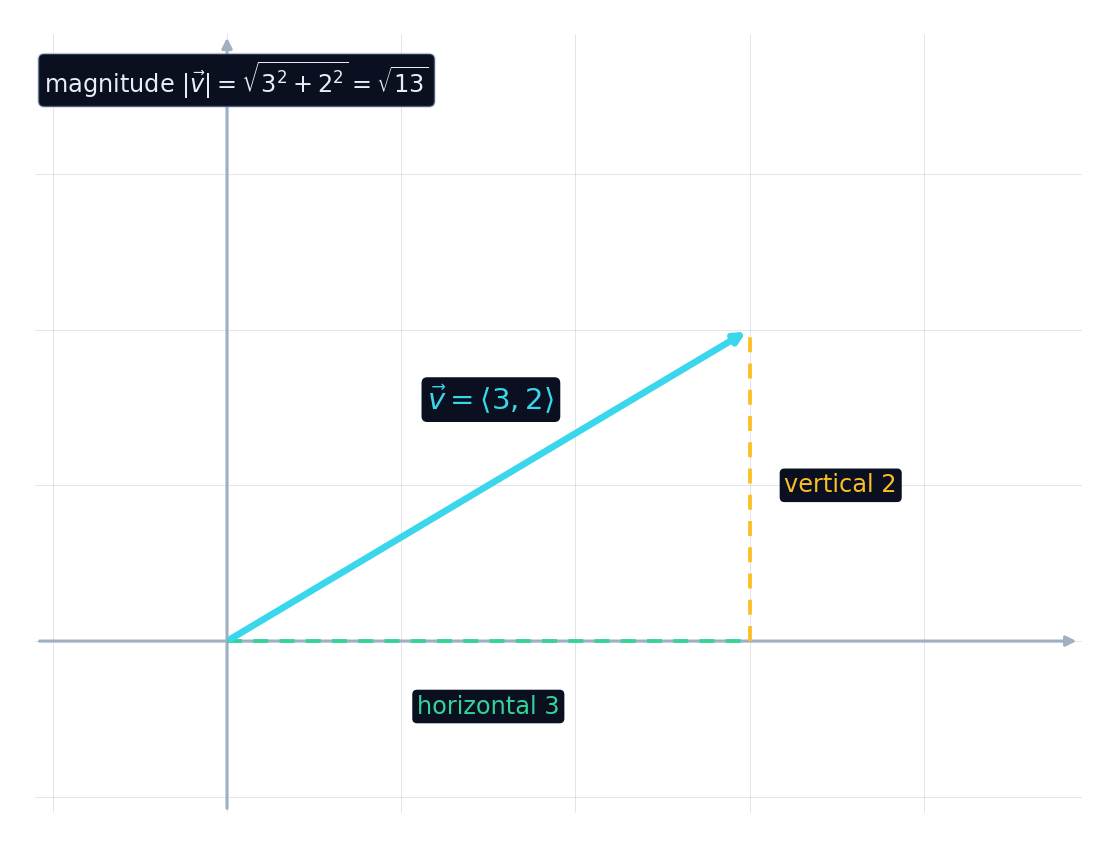
- Break a vector into how far it goes across and up: its component form 分量形式.
- $\langle 3, 2\rangle$ means $3$ to the right and $2$ up.
- The horizontal and vertical components are like the legs of a right triangle.
- Adding vectors is as easy as adding their components separately.
Forma de componentes
- Descompón un vector en cuánto se mueve horizontalmente y verticalmente: su forma de componentes 分量形式.
- $\langle 3, 2\rangle$ significa $3$ a la derecha y $2$ hacia arriba.
- Los componentes horizontal y vertical son como los catetos de un triángulo rectángulo.
- Sumar vectores es tan fácil como sumar sus componentes por separado.
Add two vectors tip to tail · Sumar dos vectores punta a cola
Drag the two vectors and watch their sum. A vector has both a direction and a magnitude, unlike a plain number. · Arrastra los dos vectores y observa su suma. Un vector tiene tanto dirección como magnitud, a diferencia de un número simple.
The · El component form $\langle 3, 2\rangle$ means the vector goes… · La forma de componentes $\langle 3, 2\rangle$ significa que el vector va…
Component form lists the horizontal change then the vertical change: $\langle 3, 2\rangle$ is 3 right, 2 up. · Forma de componentes lista el cambio horizontal seguido del cambio vertical: $\langle 3, 2\rangle$ es 3 a la derecha, 2 arriba.
What is the magnitude of the vector $\langle 3, 4\rangle$? · ¿Cuál es la magnitud del vector $\langle 3, 4\rangle$?
Magnitude · Magnitud $= \sqrt{3^2 + 4^2} = \sqrt{25} = 5$ — the length of the arrow, by the Pythagorean theorem. · Magnitud $= \sqrt{3^2 + 4^2} = \sqrt{25} = 5$ — la longitud de la flecha, por el teorema de Pitágoras.
Select all · todos true statements about vectors. · Selecciona todas las afirmaciones verdaderas sobre vectores.
A single number is a scalar, not a vector. The other three are correct. · Un número único es un escalar, no un vector. Las otras tres son correctas.
Finding the magnitude
- The magnitude is the arrow's length, found by the Pythagorean theorem.
- For $\langle a, b\rangle$, the magnitude is $\sqrt{a^2 + b^2}$.
- So $\langle 3, 4\rangle$ has magnitude $\sqrt{9 + 16} = 5$.
- The components are the legs; the magnitude is the hypotenuse.
Encontrar la magnitud
- La magnitud es la longitud de la flecha, encontrada mediante el teorema de Pitágoras.
- Para $\langle a, b\rangle$, la magnitud es $\sqrt{a^2 + b^2}$.
- Por lo tanto, $\langle 3, 4\rangle$ tiene magnitud $\sqrt{9 + 16} = 5$.
- Los componentes son los catetos; la magnitud es la hipotenusa.
Multiplying a vector by the scalar $2$ doubles its length but keeps its direction. · Multiplicar un vector por el escalar $2$ duplica su longitud pero mantiene su dirección.
A positive scalar scales the magnitude and leaves the direction unchanged; a negative one also reverses it. · Un escalar positivo escala la magnitud y deja la dirección sin cambios; uno negativo también la invierte.
Scaling and adding
- Multiply a vector by a scalar to stretch or shrink it: $2\langle 3, 2\rangle = \langle 6, 4\rangle$.
- A negative scalar also flips its direction.
- Add two vectors by adding components, or geometrically tip-to-tail.
- These operations let vectors model combined forces and motions.
Escalado y suma
- Multiplica un vector por un escalar para estirarlo o encogerlo: $2\langle 3, 2\rangle = \langle 6, 4\rangle$.
- Un escalar negativo también invierte su dirección.
- Suma dos vectores sumando sus componentes, o geométricamente punta con cola.
- Estas operaciones permiten que los vectores modelen fuerzas combinadas y movimientos.
Do not confuse a vector's magnitude with its components. The vector $\langle 3, 4\rangle$ has components $3$ and $4$, but magnitude $5$ — not $7$. The length is the hypotenuse, never the sum of the parts.
No confundas la magnitud de un vector con sus componentes. El vector $\langle 3, 4\rangle$ tiene componentes $3$ y $4$, pero magnitud $5$ —no $7$—. La longitud es la hipotenusa, nunca la suma de las partes.
A boat heads $\langle 6, 8\rangle$ (km east, km north). How far has it travelled?
- The distance is the magnitude: $\sqrt{6^2 + 8^2} = \sqrt{36 + 64} = \sqrt{100} = 10$ km.
- Its direction is up-and-to-the-right, steeper than $45°$ (more north than east).
- Doubling the vector to $\langle 12, 16\rangle$ would double the distance to $20$ km.
Un bote se dirige $\langle 6, 8\rangle$ (km al este, km al norte). ¿Qué distancia ha recorrido?
- La distancia es la magnitud: $\sqrt{6^2 + 8^2} = \sqrt{36 + 64} = \sqrt{100} = 10$ km.
- Su dirección es hacia arriba y a la derecha, más empinada que $45°$ (más al norte que al este).
- Duplicar el vector a $\langle 12, 16\rangle$ duplicaría la distancia a $20$ km.
A vector carries both magnitude and direction, drawn as an arrow — unlike a scalar (a plain number). Its component form $\langle a, b\rangle$ lists horizontal and vertical parts, and its magnitude is $\sqrt{a^2 + b^2}$. Scale by multiplying, add by combining components.
Un vector lleva tanto magnitud como dirección, dibujado como una flecha —a diferencia de un escalar (un número simple)—. Su forma de componentes $\langle a, b\rangle$ enumera las partes horizontal y vertical, y su magnitud es $\sqrt{a^2 + b^2}$. Escala multiplicando, suma combinando componentes.