Construcción y aplicación de un modelo
Introducido| English | Significado |
|---|---|
| function model/ˈfʌŋkʃn ˈmɒdl/ | modelo de función |
| regression/rɪˈɡreʃn/ | regresión |
| interpolation/ɪnˌtɜːpəˈleɪʃn/ | interpolación |
| extrapolation/ekˈstræpəleɪʃn/ | extrapolación |
| parameters/pəˈræmɪtəz/ | parámetros |
From data to a formula
- Selecting a model family is only half the job; now you build the actual rule.
- A good model turns a table of measurements into a formula you can compute with.
- Once you have the formula, you can predict values you never measured.
- This is how precalculus becomes a tool for the real world.
Build the model
- A function model 函数模型 is a rule that captures how one quantity depends on another.
- You can build it from a verbal description, a table of values, or a graph.
- "Costs $\$5$ to start plus $\$2$ per item" becomes $C = 5 + 2n$ straight away.
- Match the family to the shape (Lesson 1.13), then pin down the exact numbers.
Regression finds the best fit
- With many scattered points, regression 回归 finds the best-fit line or curve using technology.
- It chooses the model that comes closest to all the data at once.
- The result gives you the numbers in the model rule, ready to use.
- No single point sits on it perfectly — it captures the overall trend.
Una línea de modelo — lee su tasa y valor inicial
y = ax + b
Aquí a es la tasa de cambio y b es el valor inicial. Ajustalos para que se adapten a los datos, luego introduce una entrada para hacer una predicción.
Una regresión encuentra…
Dificultad 1/5 · 100 monedas + un pequeño bono en el primer intento de hoy
La regresión ajusta el modelo que se acerca más a todos los puntos al mismo tiempo: el modelo de mejor ajuste, usando tecnología.
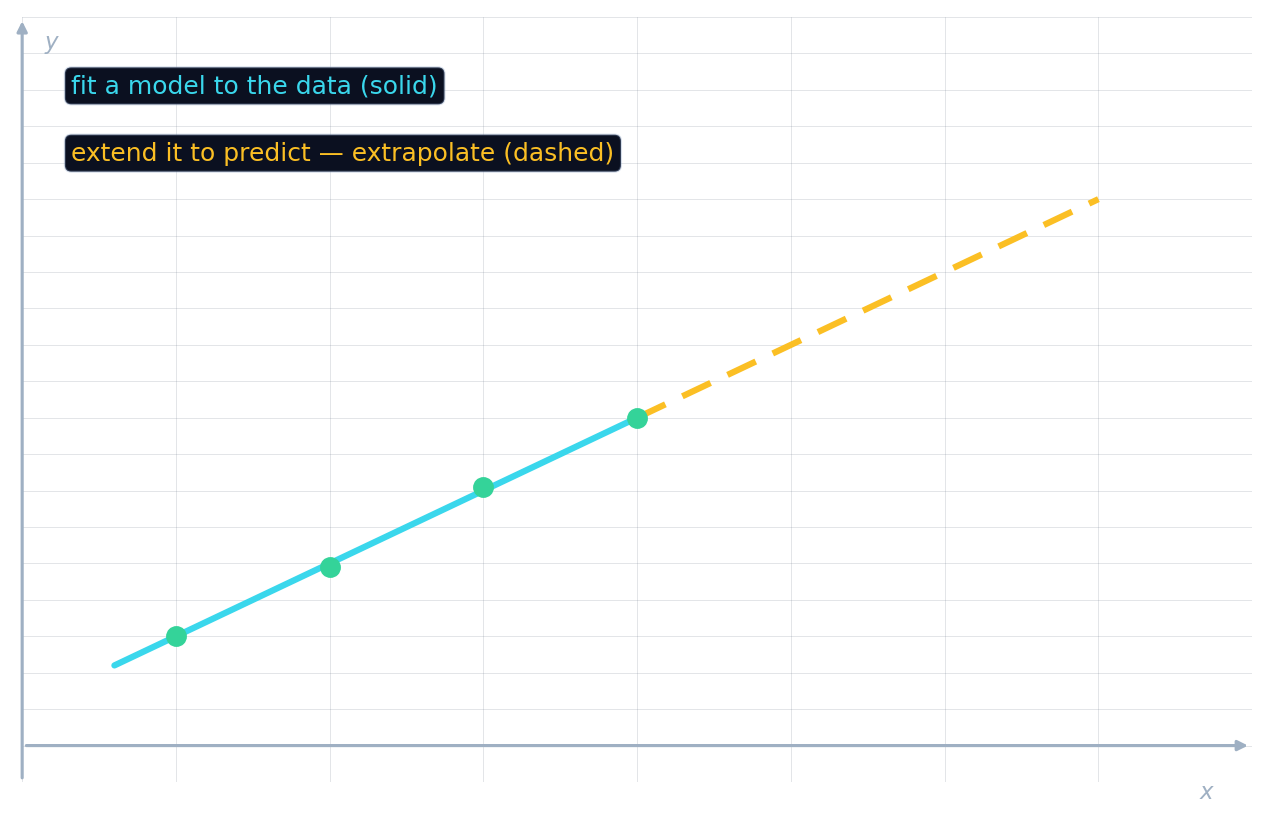
Interpolate versus extrapolate
- Interpolation 内插 predicts between known data points — usually safe.
- Extrapolation 外推 predicts beyond the data — riskier the further you go.
- A model with no data to lean on can drift far from reality.
- Trust interpolation more than extrapolation, and say which one you used.
Predecir un valor entre puntos de datos conocidos se llama ____.
Dificultad 1/5 · 100 monedas + un pequeño bono en el primer intento de hoy
Interpolación se mantiene dentro del rango de los datos, por lo que suele ser confiable.
Predecir muy fuera del rango de los datos (extrapolación) suele ser…
Dificultad 1/5 · 100 monedas + un pequeño bono en el primer intento de hoy
Lejos de los datos, el modelo no tiene evidencia en la que apoyarse, por lo que extrapolación es la predicción más arriesgada.
Interpret the parameters
- The parameters 参数 (the numbers in the rule) carry real-world meaning.
- In $C = 5 + 2n$, the $5$ is the fixed start-up cost and the $2$ is the cost per item.
- Reading parameters in context turns a formula back into a story about the situation.
- A good answer always says what each number means, with its units.
Un modelo da costo $= 2x + 1$ (en miles). Predice el costo cuando $x = 10$.
Dificultad 2/5 · 140 monedas + un pequeño bono en el primer intento de hoy
Sustituye: $2(10) + 1 = 21$ mil. Introducir una entrada en el modelo es cómo lo aplicas.
Los parámetros de un modelo (como la pendiente) pueden interpretarse en términos de la situación real.
Dificultad 1/5 · 100 monedas + un pequeño bono en el primer intento de hoy
En costo $= 2x + 1$, el $2$ es el costo por unidad y el $1$ es el costo fijo inicial de arranque — significados reales.
Coloca los pasos para usar un modelo en orden.
Dificultad 3/5 · 200 monedas + un pequeño bono en el primer intento de hoy
Datos → ajuste → predicción → verificación. La verificación final detecta un modelo que se ha desviado de la realidad.
Extrapolating too far is a classic trap. A linear sales model may predict billions of sales in twenty years — clearly nonsense. Always sanity-check a prediction against the real situation before trusting it.
A phone battery drops from $100\%$ by about $8\%$ per hour.
- Model: $B = 100 - 8h$, a linear function model.
- Interpolate at $h = 3$: $B = 100 - 24 = 76\%$ — inside the data, reliable.
- Extrapolate at $h = 20$: $B = -60\%$ — impossible, so the model has broken down.
Build a function model from words, a table, or a graph, using regression for the best fit. Use it to interpolate (safe, inside the data) or extrapolate (risky, beyond it), interpret its parameters in context, and always check the prediction makes real-world sense.
Write from the data: find the cost
- Cost in thousands is 3x plus 4.
- Predict the cost when x equals 6.
Un modelo da un costo igual a 3x más 4, en miles. ¿Qué predice cuando x es igual a 6?
18 más 4 es 22.
¿Qué costo predice el modelo?
Dificultad 1/5 · 100 monedas + un pequeño bono en el primer intento de hoy
3 por 6 más 4 es 22. Otras opciones — 21 (la predicción de la lección); 6 (la entrada).