Funciones Racionales y Ceros
Introducido| English | Significado |
|---|---|
| rational function/ˈræʃənl ˈfʌŋkʃn/ | función racional |
| zeros/ˈzɪərəʊz/ | ceros |
| numerator/ˈnjuːməreɪtə/ | numerador |
| domain/dəˈmeɪn/ | dominio |
| denominator/dɪˈnɒmɪneɪtə/ | denominador |
When is a fraction zero?
- Think of $\frac{0}{5}$, $\frac{5}{5}$, and $\frac{5}{0}$: only the first is zero.
- A fraction is zero exactly when its top is zero — the bottom just cannot be zero too.
- Rational functions follow the same simple rule.
- So finding their zeros means looking only at the numerator.
Zeros come from the numerator
- A rational function 有理函数 is $\frac{\text{numerator}}{\text{denominator}}$.
- Its zeros 零点 are the inputs that make the whole thing equal $0$.
- That happens only where the numerator 分子 equals $0$.
- So set the top equal to zero and solve — those are your candidate x-intercepts.
Una fracción es igual a cero exactamente cuando…
Dificultad 1/5 · 100 monedas + un pequeño bono en el primer intento de hoy
Una fracción es cero solo cuando su numerador es cero (y su denominador no lo es). $\frac{0}{5} = 0$, pero $\frac{5}{0}$ está indefinido.
…but only if they are allowed
- A candidate zero counts only if the value is in the domain 定义域 of the function.
- If it also makes the denominator 分母 zero, the function is undefined there — no zero.
- So check each numerator zero against the bottom before you trust it.
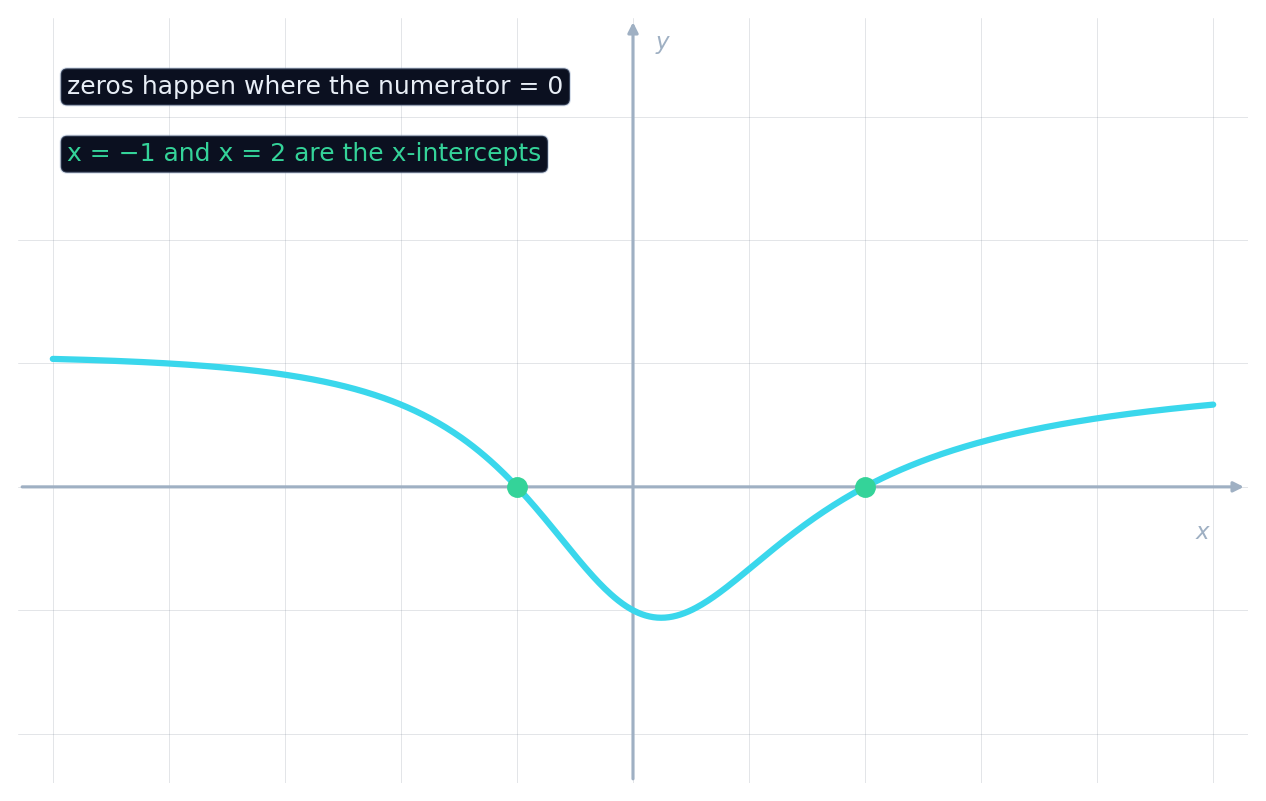
¿Dónde cruza y dónde se rompe?
y = a/(x − b) + c
La curva cruza el eje x en su cero, pero se rompe en x = b donde el denominador es cero. Esos son dos lugares diferentes.
Un cero del numerador es un cero real de la función solo si ese valor se encuentra en el ____ de la función.
Dificultad 1/5 · 100 monedas + un pequeño bono en el primer intento de hoy
Si un valor hace que tanto el numerador como el denominador sean cero, no está en el dominio, por lo que es un hueco, no un cero.
Excluded values are not zeros
- A value that makes only the denominator zero is excluded from the domain.
- There the function is undefined — it produces a vertical asymptote or a hole, not a zero.
- Never call an excluded value an x-intercept.
- Zero on top → a zero of the function; zero on the bottom → trouble, not a zero.
Un valor que hace que el denominador sea cero es un cero de la función.
Dificultad 1/5 · 100 monedas + un pequeño bono en el primer intento de hoy
Un denominador cero está excluido del dominio — la función está indefinida allí, no es cero.
Verify by evaluating
- To confirm a zero, substitute the value and check that the function really gives $0$.
- $f(x) = \frac{x-4}{x+1}$ at $x = 4$: $\frac{0}{5} = 0$. Yes — $x = 4$ is a zero.
- The same test rejects an excluded value, because you would be dividing by zero.
- Evaluating is the reliable final check.
¿Cuántos ceros tiene $f(x) = \dfrac{(x-3)(x+2)}{x^2+1}$?
Dificultad 2/5 · 140 monedas + un pequeño bono en el primer intento de hoy
El numerador es cero en $x = 3$ y $x = -2$; el denominador $x^2+1$ nunca es cero, así que ambos son válidos — $2$ ceros.
Seleccione todas las afirmaciones verdaderas sobre los ceros de una función racional.
Dificultad 2/5 · 140 monedas + un pequeño bono en el primer intento de hoy
Un cero del denominador está excluido, no es una intersección con el eje x. Las otras tres son correctas.
Do not confuse a numerator zero (a real zero, an x-intercept) with a denominator zero (an excluded value). They are opposite: one is where the graph touches the axis, the other is where the graph breaks.
Find the zeros of $f(x) = \dfrac{(x-2)(x+3)}{x-2}$.
- Numerator zero candidates: $x = 2$ and $x = -3$.
- But $x = 2$ also makes the denominator zero, so it is excluded — a hole, not a zero.
- Only $x = -3$ is a real zero of the function.
The zeros of a rational function are the zeros of its numerator that lie in the domain. A value that makes the denominator zero is excluded, not a zero. Always check numerator zeros against the bottom, and verify by evaluating.
Write from the data given
- f of x equals (x minus 1)(x minus 4)(x plus 5) divided by (x squared plus 4).
- Count the zeros.
¿Cuántos ceros tiene f de x igual a (x menos 1)(x menos 4)(x más 5) dividido por (x al cuadrado más 4)?
Tres factores del numerador sobreviven.
¿Cuántos ceros tiene la función?
Dificultad 1/5 · 100 monedas + un pequeño bono en el primer intento de hoy
El denominador no cancela ningún cero del numerador. Otras opciones — 2 ceros (la cuenta de la lección); 5 ceros (las constantes sumadas).