Electric Potential
Introducido| English | Significado |
|---|---|
| volt/vəʊlt/ | voltio |
Voltage is like "electric height"
- A ball rolls downhill from high ground to low; a positive charge "rolls" from high voltage to low.
- Voltage measures the electric potential energy per unit charge at a point.
- It is like the height of an electric landscape — energy waiting to be released.
- The difference in voltage between two points is what drives current in a circuit.
Potential is energy per charge
- Electric potential $V$ is potential energy per unit charge: $V = \dfrac{U}{q}$.
- Its unit is the volt 伏特 ($1\ \text{V} = 1\ \tfrac{\text{J}}{\text{C}}$).
- Unlike the field, potential is a scalar — just a number at each point, no direction.
- For a point charge, $V = \dfrac{kq}{r}$, falling off as $1/r$.
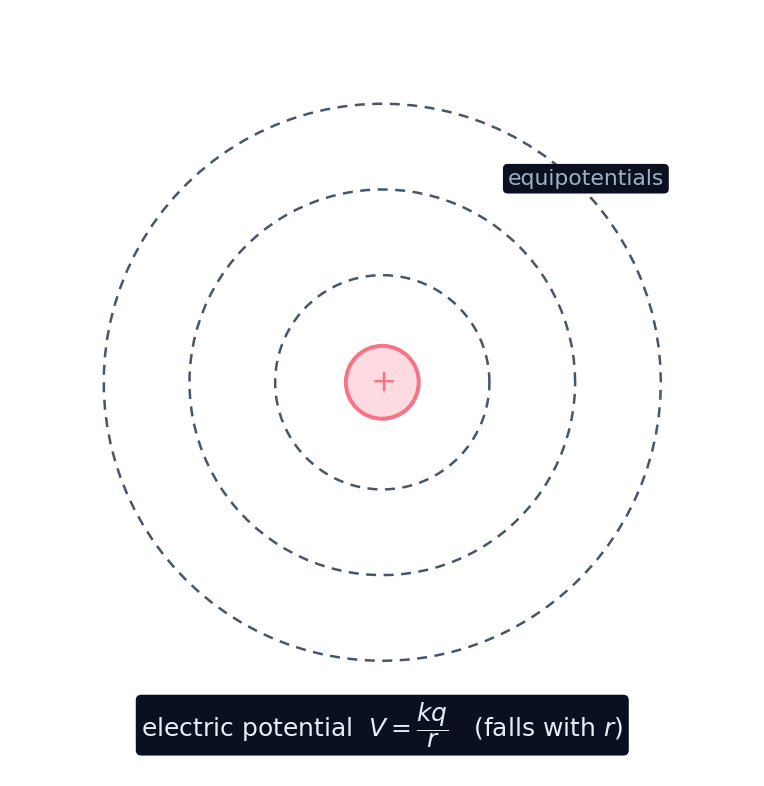
Field and potential together
See how the field lines relate to the potential that falls off around a charge.
Electric potential is a vector with a direction at each point.
Dificultad 1/5 · 100 monedas + un pequeño bono en el primer intento de hoy
False. Electric potential is a scalar measured in volts; it is the electric field that has a direction.
One volt equals one joule per ____.
Dificultad 1/5 · 100 monedas + un pequeño bono en el primer intento de hoy
$1\ \text{V} = 1\ \tfrac{\text{J}}{\text{C}}$ — energy per unit charge.
Equipotentials and potential difference
- Points at the same potential form equipotential surfaces: spheres around a point charge, drawn as circles in a cross-section.
- The electric force does zero work moving a charge along an equipotential; slow motion requires zero net external work.
- The potential difference $\Delta V$ between two points is the "voltage" between them.
- For $\Delta V = V_f - V_i$, the potential-energy change is $\Delta U = q\Delta V$; electric work is $W_{\text{electric}} = -q\Delta V$.
A $+2\ \text{C}$ charge moves slowly to a point $6\ \text{V}$ higher in potential. How much external work is required, in $\text{J}$?
Dificultad 2/5 · 140 monedas + un pequeño bono en el primer intento de hoy
For slow motion, $W_{\text{ext}} = \Delta U = q\Delta V = 2 \times 6 = 12\ \text{J}$. Electric work is $-12\ \text{J}$.
How much work is needed to move a charge along an equipotential surface?
Dificultad 1/5 · 100 monedas + un pequeño bono en el primer intento de hoy
Points on an equipotential are at the same potential, so no work is needed to move between them.
Select todos true statements about electric potential.
Dificultad 2/5 · 140 monedas + un pequeño bono en el primer intento de hoy
Potential is a scalar in volts, and its difference drives current. Only the field has a direction.
Why it matters for circuits
- A battery maintains a fixed potential difference across its terminals.
- That voltage is the "push" that drives charges around a circuit.
- In a resistor, conventional current goes from high to low potential; electrons drift the opposite way, and electrical energy becomes thermal energy.
- So potential is the bridge from static charges to working circuits (next topic).
Which correctly distinguishes potential from field?
Dificultad 1/5 · 100 monedas + un pequeño bono en el primer intento de hoy
Potencial $V = U/q$ (scalar, volts); field $E = F/q$ (vector, N/C).
Don't confuse potential $V$ (a scalar, in volts) with the field $E$ (a vector, in $\tfrac{\text{N}}{\text{C}}$). Potential is energy per charge; the field is force per charge. And only differences in potential do work — the zero point is your choice.
How much energy does it take to move a $2\ \text{C}$ charge through a potential difference of $6\ \text{V}$?
- $W = q\,\Delta V = 2 \times 6 = 12\ \text{J}$.
For a +2 C charge moving to a potential 6 V higher, $\Delta U = +12\ \text{J}$ and electric work is $-12\ \text{J}$. Moving 6 V lower reverses both signs.
Electric potential $V = U/q$ (in volts) is the potential energy per unit charge — a scalar, like "electric height". For a point charge $V = kq/r$. The potential difference ($\Delta V$, the voltage) drives current, and $\Delta U = q\Delta V$, while work by the field is $-q\Delta V$.
Write from the data: find the energy
- A 3 C charge moves through a potential difference of 8 V.
- Find the energy transferred.
How much energy is transferred when a 3 C charge moves through a potential difference of 8 V? Answer in joules.
3 times 8 is 24.
A charge of magnitude 3 C moves between points with potential difference magnitude 8 V. What is the magnitude of the energy transfer?
Dificultad 1/5 · 100 monedas + un pequeño bono en el primer intento de hoy
Charge times potential difference is 24 J. Other options — 12 J (the lesson transfer); 8 J (the voltage used as the energy).