Rotational Kinematics
Introducido| English | Significado |
|---|---|
| angular velocity/ˈæŋɡjʊlə vəˈlɒsɪti/ | velocidad angular |
| angular acceleration/ˈæŋɡjʊlə əkˌseləˈreɪʃn/ | aceleración angular |
| angular displacement/ˈæŋɡjʊlə dɪˈspleɪsmənt/ | desplazamiento angular |
| radian/ˈreɪdɪən/ | radián |
A spinning wheel needs a new set of words
- A car drives in a straight line; a wheel just spins in place. Both are "moving", but differently.
- To describe spinning we measure angles, not distances travelled.
- Three new quantities appear — angle, angular velocity, angular acceleration.
- They mirror position, velocity and acceleration exactly, so everything you learned carries over.
The three angular quantities
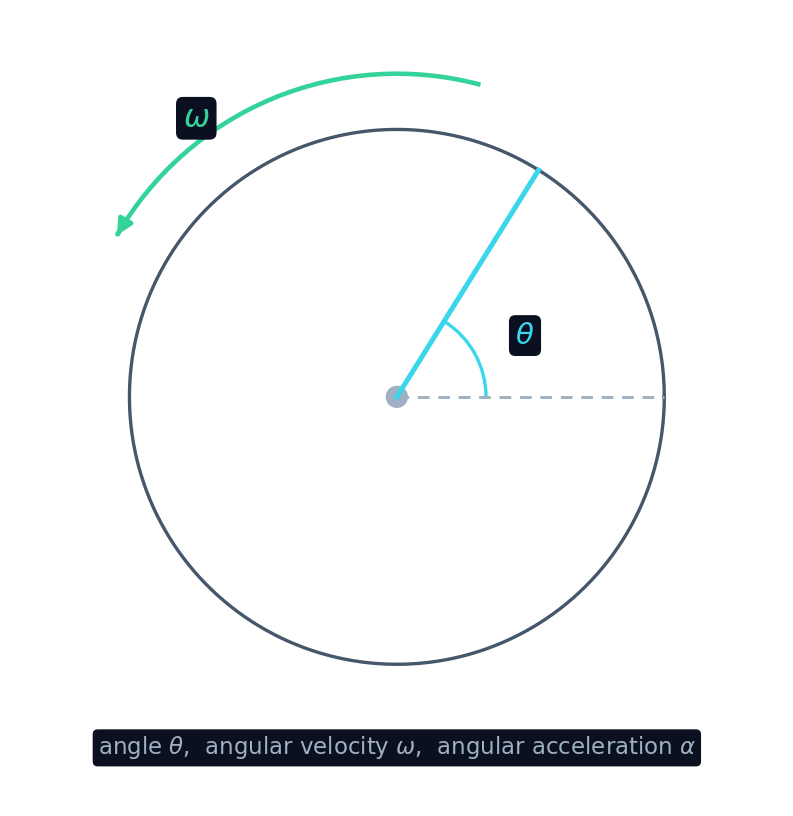
- Angular displacement 角位移 $\theta$ — the angle turned, measured in radians 弧度.
- Average angular velocity 角速度 $\omega_{avg}$ — the angle change per elapsed time, $\omega = \dfrac{\Delta\theta}{\Delta t}$ (in $\tfrac{\text{rad}}{\text{s}}$).
- Average angular acceleration 角加速度 $\alpha_{avg}$ — the angular-velocity change per elapsed time, $\alpha = \dfrac{\Delta\omega}{\Delta t}$.
- These are the spin versions of $x$, $v$ and $a$.
A wheel goes from rest to $\omega = 12\ \tfrac{\text{rad}}{\text{s}}$ hacia adentro $4\ \text{s}$. What is its angular acceleration, in $\tfrac{\text{rad}}{\text{s}^2}$?
Dificultad 2/5 · 140 monedas + un pequeño bono en el primer intento de hoy
$\alpha = \Delta\omega/\Delta t = 12/4 = 3\ \tfrac{\text{rad}}{\text{s}^2}$.
Angular velocity is the rate of change of the ____.
Dificultad 1/5 · 100 monedas + un pequeño bono en el primer intento de hoy
$\omega = \Delta\theta/\Delta t$ — the rate of change of the ángulo.
Radians, the natural angle
- A radian is the angle for which the arc length equals the radius.
- A full circle is $2\pi$ radians ($\approx 6.28$), so $180^\circ = \pi$ radians.
- Radians make the linking formulas (next lesson) clean and simple.
- Always work in radians for rotational physics, not degrees.
Sweep an angle in radians
Change the angle and radius to feel how radians measure the turn and the arc length.
How many radians are there in one complete turn?
Dificultad 1/5 · 100 monedas + un pequeño bono en el primer intento de hoy
One full circle is $2\pi$ radians ($\approx 6.28$).
A half turn ($180^\circ$) is how many radians? Use $\pi = 3.14$.
Dificultad 2/5 · 140 monedas + un pequeño bono en el primer intento de hoy
$180^\circ = \pi$ radianes $\approx 3.14\ \text{rad}$.
The same equations, new symbols
- With constant angular acceleration, the SUVAT equations reappear, symbol for symbol.
- $\omega = \omega_0 + \alpha t$ mirrors $v = u + at$.
- $\theta = \omega_0 t + \tfrac12 \alpha t^2$ mirrors $s = ut + \tfrac12 a t^2$.
- Learn the analogy once and every rotation problem becomes a translation exercise.
Match each rotational quantity to its linear twin.
Dificultad 2/5 · 140 monedas + un pequeño bono en el primer intento de hoy
$\theta \leftrightarrow x$, $\omega \leftrightarrow v$, $\alpha \leftrightarrow a$ — the rotational quantities mirror the linear ones.
Use radians, not degrees, in rotational formulas. A relation like $v = r\omega$ only works when $\omega$ is in $\tfrac{\text{rad}}{\text{s}}$. Mixing in degrees is one of the most common rotational-motion mistakes.
Rotational formulas like $v = r\omega$ require $\omega$ to be in radians per second.
Dificultad 1/5 · 100 monedas + un pequeño bono en el primer intento de hoy
These relations are derived using radians; using degrees gives wrong answers.
A wheel starts from rest and reaches $\omega = 12\ \tfrac{\text{rad}}{\text{s}}$ in $4\ \text{s}$ at constant angular acceleration.
- $\alpha = \dfrac{\Delta\omega}{\Delta t} = \dfrac{12 - 0}{4} = 3\ \tfrac{\text{rad}}{\text{s}^2}$.
This is exactly like finding a linear acceleration — only the symbols changed.
Rotation is described by angular displacement $\theta$, angular velocity $\omega$ and angular acceleration $\alpha$ — the spin twins of $x$, $v$, $a$. Measure angles in radians ($2\pi$ per turn). With constant $\alpha$, the SUVAT equations reappear with $\theta,\omega,\alpha$.
Write from the data: find the angular acceleration
- A wheel speeds up from rest to 10 rad/s in 5 s.
- Find the angular acceleration.
A wheel starts from rest and reaches 10 rad/s in 5 s. What is its angular acceleration, in rad/s squared?
Average angular acceleration is $\alpha=\Delta\omega/\Delta t=(10-0)/5=2\ \tfrac{\text{rad}}{\text{s}^2}$. It is also the instantaneous acceleration throughout the interval if the acceleration is constant.
A wheel starts from rest and reaches 10 rad/s in 5 s. What is its angular acceleration, in rad/s squared?
Dificultad 1/5 · 100 monedas + un pequeño bono en el primer intento de hoy
Average angular acceleration is $\alpha=\Delta\omega/\Delta t=(10-0)/5=2\ \tfrac{\text{rad}}{\text{s}^2}$. It is also the instantaneous acceleration throughout the interval if the acceleration is constant.