Changes in Factor Demand and Factor Supply
Introducido| English | Significado |
|---|---|
| factor of production | factor of production |
| wage/weɪdʒ/ | Salario |
| factor demand/ˈfæktə dɪˈmænd/ | Demanda de factores |
| factor supply/ˈfæktə səˈplaɪ/ | oferta de factores |
| derived demand/dɪˈraɪvd dɪˈmænd/ | Demand for an input that arises from demand for the goods or services it helps produce. |
| marginal revenue product/ˈmɑːdʒɪnl ˈrevənjuː ˈprɒdʌkt/ | The additional revenue generated by employing one more unit of a factor of production. |
| output price/ˈaʊtpʊt praɪs/ | precio de salida |
| productivity/ˌprɒdəkˈtɪvɪti/ | productividad |
| related input/rɪˈleɪtɪd ˈɪnpʊt/ | insumo relacionado |
Why nurses' pay rose in 2021
- During the pandemic, hospitals needed far more nurses, and US pay for travel nurses more than doubled within a year. The nurses had not changed overnight: the demand for their work had.
- Labour, like any factor of production 生产要素, has its own market. The wage 工资 and the number of workers hired move when either factor demand or factor supply shifts.
Factor demand is a derived demand
- A firm hires a worker only for what the worker produces. So the demand for labour is a derived demand 派生需求: it comes from the demand for the product. The demand curve for labour is the marginal revenue product 边际收益产品 curve: $MRP = MP \times P$ (in perfect competition).
- Anything that changes $MP$ (how much a worker adds) or $P$ (what the output sells for) changes MRP at every number of workers, so it shifts factor demand. A change in the wage alone moves the firm along its MRP curve.
What shifts factor demand
- A rise in the output price 产品价格 raises $P$, so MRP rises and factor demand 要素需求 shifts right. Better productivity 生产率 (training, better tools) raises $MP$, with the same result.
- A change in the price of a related input 相关投入品: if a complementary input (software nurses use) gets cheaper, firms use more of it, and labour demand rises. If a substitute input (a machine that can replace workers) gets cheaper, firms switch towards it, and labour demand falls.
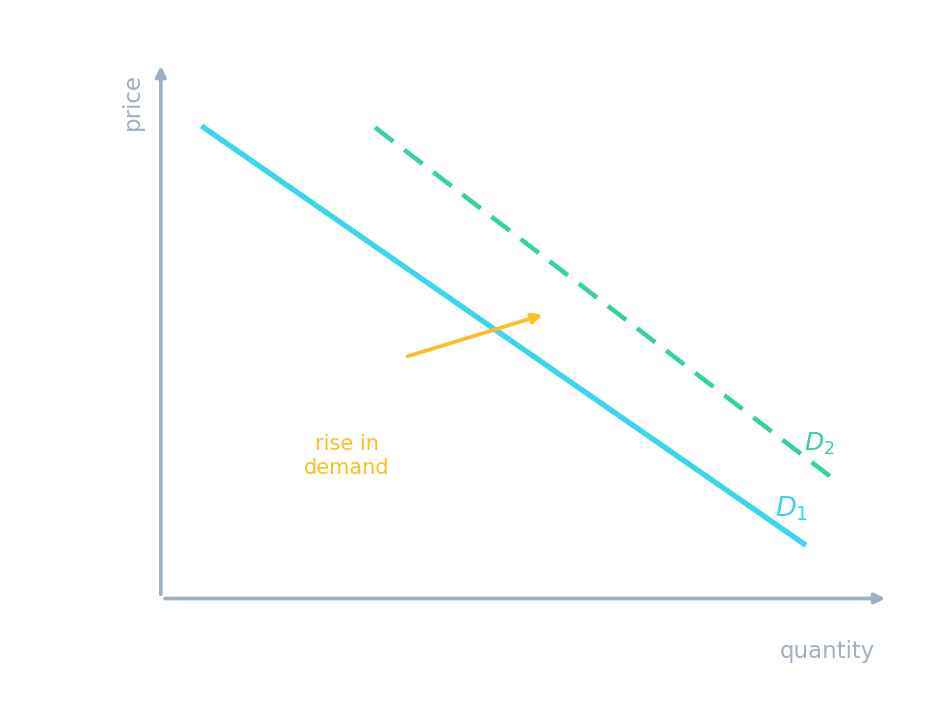
El mercado laboral
The wage is set where labour demand meets labour supply. A more valuable product or more productive workers shift demand right, raising the wage.
The product a firm sells becomes more valuable. The firm's demand for workers:
Dificultad 1/5 · 100 monedas + un pequeño bono en el primer intento de hoy
A higher output price raises each worker's MRP, shifting factor demand right.
Select todos that shift factor (labour) demanda.
Dificultad 2/5 · 140 monedas + un pequeño bono en el primer intento de hoy
Output price, productivity and related-input prices shift demand; more workers shifts supply.
Better training or technology raises worker ______, shifting factor demand right.
Dificultad 1/5 · 100 monedas + un pequeño bono en el primer intento de hoy
Higher productivity means a higher marginal product, so a higher MRP.
Self-checkout machines become much cheaper, and they can do the work of cashiers. What happens to the demand for cashiers?
Dificultad 1/5 · 100 monedas + un pequeño bono en el primer intento de hoy
A cheaper substitute input pulls firms away from labour, so labour demand falls at every wage.
Worked example: a price rise shifts MRP
A bakery sells bread at 2 dollars a loaf and pays 30 dollars a day per worker.
| Workers | MP (loaves) | MRP at 2 dollars | MRP at 3 dollars |
|---|---|---|---|
| 1 | 30 | 60 | 90 |
| 2 | 20 | 40 | 60 |
| 3 | 15 | 30 | 45 |
| 4 | 10 | 20 | 30 |
| 5 | 6 | 12 | 18 |
- At 2 dollars, the bakery hires while MRP ≥ wage: 3 workers (the 3rd adds 30 = 30; the 4th adds only 20).
- The price of bread rises to 3 dollars. MRP rises at every number of workers, so labour demand shifts right. Now the 4th worker adds 30 = 30, so the bakery hires 4 workers at the same wage.
A tech boom raises the price of apps, with worker supply unchanged. The wage and number of programmers:
Dificultad 1/5 · 100 monedas + un pequeño bono en el primer intento de hoy
Higher MRP shifts labour demand right; with fixed supply, both wage and quantity rise.
In the bakery table, bread stays at 3 dollars but the daily wage rises to 45 dollars. How many workers does the bakery hire?
Dificultad 2/5 · 140 monedas + un pequeño bono en el primer intento de hoy
At 3 dollars, MRP is 90, 60, 45, 30, 18. Hire while MRP ≥ 45, so 3 workers. The wage rise moves the bakery along its MRP curve.
What shifts factor supply
- The number of qualified workers: immigration, population growth or more training places shift factor supply 要素供给 right; a longer training requirement or workers leaving shifts it left.
- The appeal of the job compared with others: better conditions in this job shift its supply right; higher wages in other jobs the same workers could do shift it left. Then read the new equilibrium, just as in a product market.
A wave of immigration into a country tends to shift the labour supply curve:
Dificultad 1/5 · 100 monedas + un pequeño bono en el primer intento de hoy
More available workers increase labour supply, shifting the curve right.
Match each change to the curve it shifts.
Dificultad 2/5 · 140 monedas + un pequeño bono en el primer intento de hoy
Product value and productivity move demand; the number of workers moves supply.
Market and firm: side by side
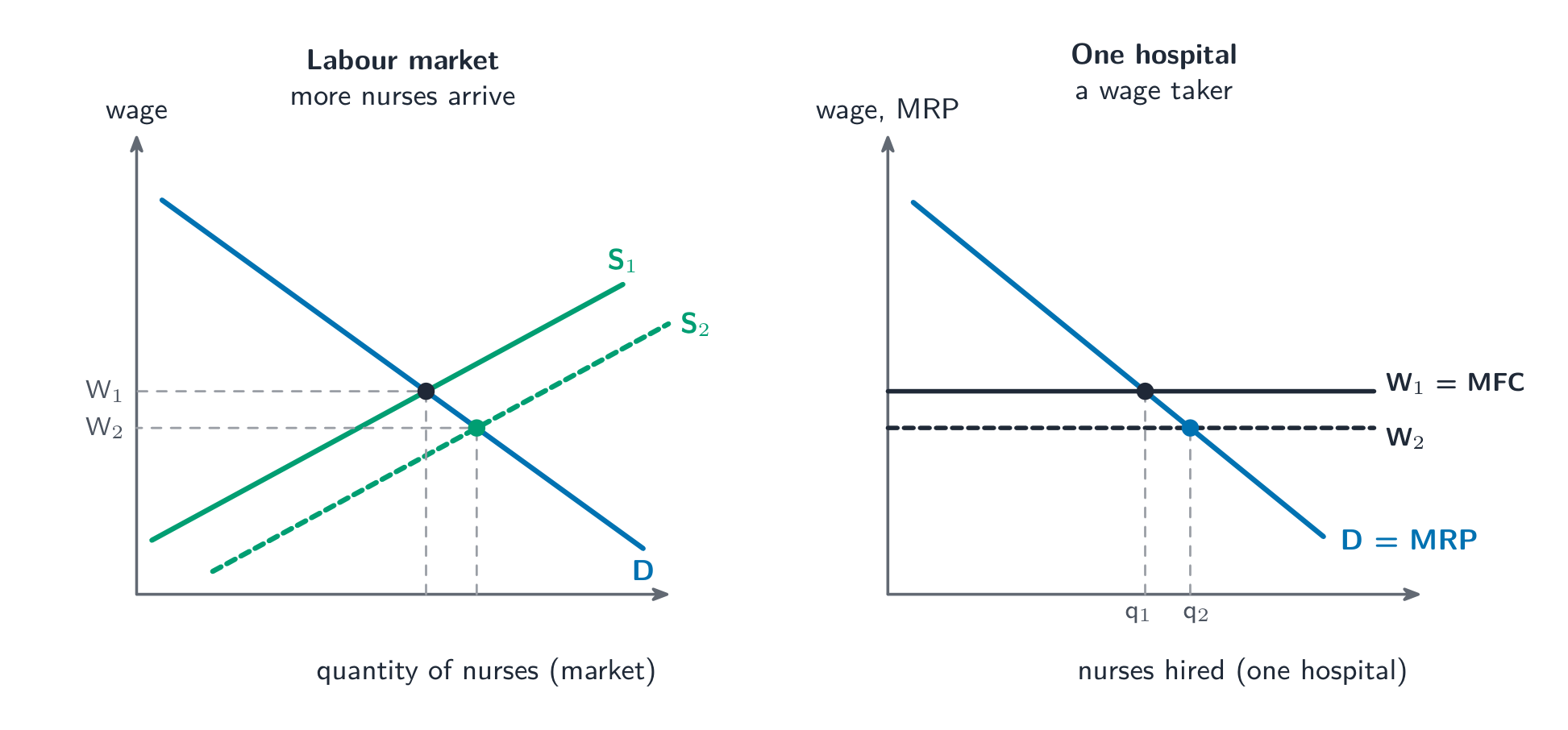
- In a perfectly competitive labour market, the market sets the wage where labour demand meets labour supply. Each firm is a wage taker: it can hire as many workers as it wants at that wage, so its marginal factor cost (MFC) is a horizontal line at the wage.
- The firm hires where MRP = MFC = wage. When the market wage changes, the firm's MFC line moves, and the firm moves along its own MRP curve.
In a perfectly competitive labour market, the market wage rises. For one firm,
Dificultad 1/5 · 100 monedas + un pequeño bono en el primer intento de hoy
The firm takes the new wage; its MRP is unchanged, so it moves up and to the left along MRP.
Worked FRQ answer
Question: The market for nurses and Hospital H, which hires nurses, are both perfectly competitive. (a) Draw side-by-side graphs of the market for nurses and Hospital H, showing the market wage and the number of nurses H hires. (b) Many trained nurses arrive from abroad. Show the effect on the market wage and on the number of nurses H hires. (c) Separately, a new machine lets each nurse treat more patients. Explain what happens to H's demand for nurses.
(a) Market: wage on the vertical axis, quantity of nurses on the horizontal, downward-sloping D and upward-sloping S, with the wage W₁ where they cross. Hospital H: a horizontal line at W₁ labeled MFC, a downward-sloping MRP curve, and q₁ where they meet.
(b) Supply shifts right, so the market wage falls to W₂ and the number of nurses employed in the market rises. For H, the wage line falls to W₂, so H hires more nurses (q₂ > q₁), moving down along its MRP curve.
(c) Each nurse's marginal product rises, so MRP = MP × P rises at every number of nurses. H's demand for nurses (its MRP curve) shifts right.
- Why it scores: (a) the firm's wage line is horizontal and labeled MFC, and the firm hires where it meets MRP; (b) the firm moves along MRP, it does not shift; (c) the answer goes through MP to MRP, not just "demand rises".
FRQ practice. The labour market for fruit pickers and Farm F are both perfectly competitive. (a) The price of apples rises sharply. Explain the effect on Farm F's MRP of pickers. (b) What happens to the market demand for pickers, the market wage and the number of pickers employed? (c) Separately, wages for warehouse jobs, which pickers could also do, rise. What happens to the supply of pickers and the market wage?
Name the curve that shifts and the reason before reading the new equilibrium.
Common errors. Shifting the demand for labour when only the wage changed: that is a movement along it. Saying a rise in the market wage shifts the firm's MRP curve. Forgetting that a cheaper substitute input lowers labour demand, while a cheaper complement raises it. Drawing the firm's wage line sloping upward: in a competitive market the firm is a wage taker.
Labour demand is a derived demand; its curve is MRP = MP × P. It shifts with the output price, productivity and the prices of related inputs (complement cheaper → right; substitute cheaper → left). Factor supply shifts with the number of qualified workers and with pay and conditions in other jobs. The market sets the wage; a competitive firm takes it and hires where MRP = MFC = wage.
Write from a wage of 55 and employment of 130
- A boom raises the price of the product the workers make.
- The wage moves from 40 to 55 and employment from 100 to 130.
A product boom leaves labour supply fixed. The wage moves from 40 to 55 and the number of workers from 100 to 130. Which curve shifted, and in which direction?
A higher output price raises each worker's marginal revenue product.
What happens in the labour market?
Dificultad 1/5 · 100 monedas + un pequeño bono en el primer intento de hoy
Higher marginal revenue product shifts demand right, raising both wage and employment.