Price Discrimination
Introducido| English | Significado |
|---|---|
| price discrimination/praɪs dɪˌskrɪmɪˈneɪʃn/ | discriminación de precios |
| market power/ˈmɑːkɪt ˈpaʊə/ | poder de mercado |
| willingness to pay/ˈwɪlɪŋnəs tə peɪ/ | disposición a pagar |
| resale/ˈriːseɪl/ | reventa |
| perfect price discrimination/ˈpɜːfekt praɪs dɪˌskrɪmɪˈneɪʃn/ | discriminación de precios perfecta |
| first-degree/fɜːst dɪˈɡriː/ | de primer grado |
| allocatively efficient/ˈæləkətɪvli ɪˈfɪʃənt/ | eficiente desde el punto de vista de la asignación |
| consumer surplus/kənˈsuːmə ˈsɜːpləs/ | Excedente del consumidor |
| producer surplus/prəˈdjuːsə ˈsɜːpləs/ | Excedente del productor |
Same seat, different prices
- The person next to you on the plane may have paid half what you did.
- Students, seniors, and early bookers all get their own price.
- This is no accident — it is a deliberate strategy to squeeze out more profit.
- It is called price discrimination 价格歧视.
Price discrimination means:
Dificultad 1/5 · 100 monedas + un pequeño bono en el primer intento de hoy
It bases each buyer's price on their willingness to pay.
Three conditions
- The firm needs market power 市场势力 — it must be a price maker.
- It must sort buyers by their willingness to pay 支付意愿.
- It must prevent resale 转售, so cheap buyers cannot resell to expensive ones.
- Miss any one condition and price discrimination falls apart.
Can the firm price-discriminate?
Price discrimination needs market power, sortable buyers, and no resale. If any condition fails, one price must be charged.
Select todos conditions needed for price discrimination.
Dificultad 2/5 · 140 monedas + un pequeño bono en el primer intento de hoy
Market power, sortable buyers, and no resale — perfect competition rules it out.
If buyers can freely resell the good to one another, price discrimination breaks down.
Dificultad 1/5 · 100 monedas + un pequeño bono en el primer intento de hoy
Cheap buyers would resell to expensive ones, undercutting the firm's scheme.
Perfect price discrimination
- In perfect price discrimination 完全价格歧视 (also first-degree 一级), the firm charges each buyer their exact maximum willingness to pay.
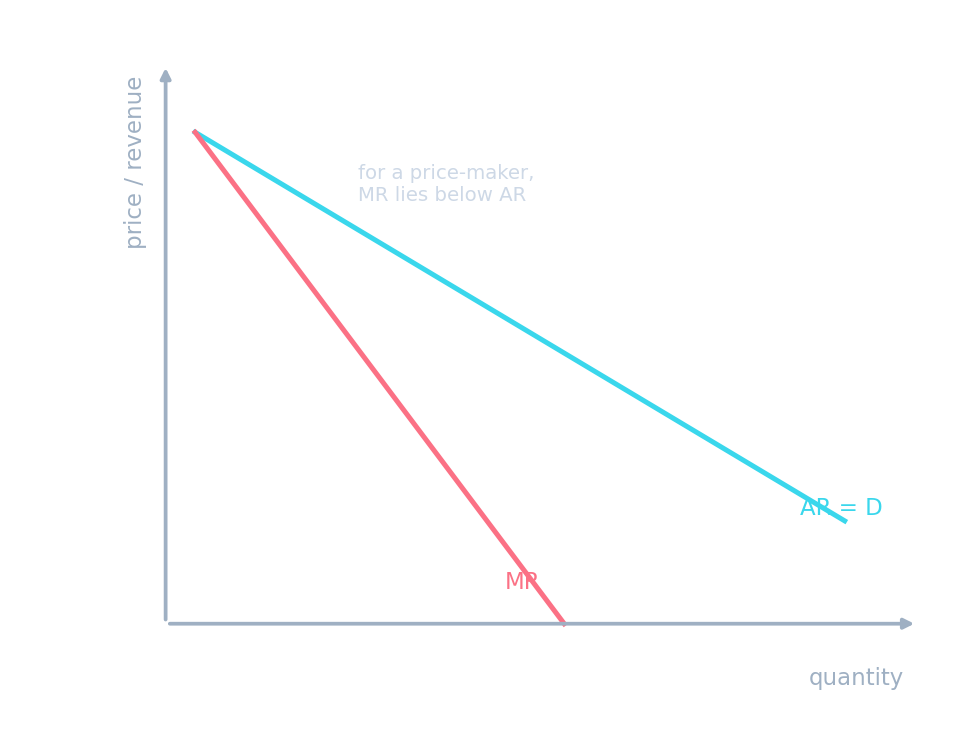
- Now no price cut on earlier units is needed, so the demand curve becomes the marginal-revenue curve.
- The firm keeps selling until $P = MC$ — the allocatively efficient 配置有效率 quantity, with no deadweight loss.
Demand is P = 100 − Q and MC = 20. A perfect price discriminator sells until P = MC. What quantity does it produce?
Dificultad 2/5 · 140 monedas + un pequeño bono en el primer intento de hoy
Set 100 − Q = 20 → Q = 80 — the efficient quantity, double the single-price monopoly's 40.
Because it produces where P = MC, perfect price discrimination has no ______ loss.
Dificultad 1/5 · 100 monedas + un pequeño bono en el primer intento de hoy
It reaches the allocatively efficient quantity — the same as perfect competition.
Who gets the surplus
- The efficiency is real, but the welfare split is brutal.
- All consumer surplus 消费者剩余 is captured by the firm.
- Producer surplus 生产者剩余 swells to include the entire gains-from-trade triangle.
Under perfect price discrimination, consumer surplus is:
Dificultad 1/5 · 100 monedas + un pequeño bono en el primer intento de hoy
The firm charges each buyer their maximum willingness to pay, so no consumer surplus is left.
Worked example: cinema tickets for two groups
A cinema has a marginal cost of 2 dollars per seat. Adults would buy 100 tickets at 12 dollars; students would buy 80 tickets at 6 dollars but only 20 at 12 dollars. Compare one price of 12 dollars with charging each group its own price.
- Single price 12 dollars: 120 tickets, profit $=120\times(12-2)=$ 1,200 dollars.
- Discrimination: adults pay 12, students 6 (with ID checks to stop resale). Profit $=100\times10+80\times4=$ 1,320 dollars. The cinema gains, and 60 more students now see the film, so output rises and some deadweight loss is removed.
Why do airlines print the passenger's name on each ticket?
Dificultad 1/5 · 100 monedas + un pequeño bono en el primer intento de hoy
Price discrimination fails if cheap tickets can be resold.
Under perfect price discrimination, consumer surplus is zero.
Dificultad 1/5 · 100 monedas + un pequeño bono en el primer intento de hoy
Each buyer pays exactly their willingness to pay.
Price discrimination charges different buyers different prices; it needs market power, sortable willingness to pay, and no resale. Perfect price discrimination reaches the efficient $P = MC$ quantity with no deadweight loss — but the firm captures all the consumer surplus.
Write from the data: find the discriminating quantity
- Demand is P = 50 minus Q and marginal cost is 10.
- A perfect price discriminator sells until price equals marginal cost.
Demand is P = 50 minus Q and marginal cost is 10. What quantity does a perfect price discriminator sell?
50 minus 10 is 40.
What quantity does the perfect price discriminator sell?
Dificultad 1/5 · 100 monedas + un pequeño bono en el primer intento de hoy
50 minus 10 is 40, where price meets marginal cost. Other options — 20 (the single-price quantity on this demand); 80 (the lesson discriminator).