Short-Run Production Costs
Introducido| English | Significado |
|---|---|
| variable costs/ˈveərɪəbl kɒsts/ | costos variables |
| fixed costs/fɪkst kɒsts/ | costos fijos |
| raw materials/rɔː məˈtɪərɪəlz/ | materias primas |
| total cost/ˈtəʊtl kɒst/ | costo total |
| average fixed cost/ˈævrɪdʒ fɪkst kɒst/ | costo fijo promedio |
| average variable cost/ˈævrɪdʒ ˈveərɪəbl kɒst/ | costo variable promedio |
| average total cost/ˈævrɪdʒ ˈtəʊtl kɒst/ | costo total promedio |
| marginal cost/ˈmɑːdʒɪnl kɒst/ | Costo marginal |
Which costs move, and which don't
- Rent on the factory is due whether you make 1 unit or 10,000.
- Wages and materials, though, climb every time you make more.
- Sorting costs by how they behave is the key to pricing a firm's output.
- It starts with two types: fixed and variable.
Fixed and variable costs
- Fixed costs 固定成本 (FC) do not change with output — like factory rent. You pay them even at zero output.
- Variable costs 可变成本 (VC) rise as output rises — like wages and raw materials 原材料.
- Together they make total cost 总成本: $TC = FC + VC$.
Total cost equals fixed cost plus ______ cost.
Dificultad 1/5 · 100 monedas + un pequeño bono en el primer intento de hoy
TC = FC + VC. Fixed costs stay put; variable costs rise with output.
Match each cost to its example.
Dificultad 2/5 · 140 monedas + un pequeño bono en el primer intento de hoy
Rent is fixed, wages/materials vary with output, and MC is the cost of the next unit.
Per-unit costs
- Average fixed cost 平均固定成本: $AFC = \tfrac{FC}{Q}$ — always falls as output rises (spread over more units).
- Average variable cost 平均可变成本: $AVC = \tfrac{VC}{Q}$. Average total cost 平均总成本: $ATC = \tfrac{TC}{Q} = AFC + AVC$.
- Marginal cost 边际成本 (MC) is the extra cost of one more unit: $MC = \tfrac{\Delta TC}{\Delta Q}$.
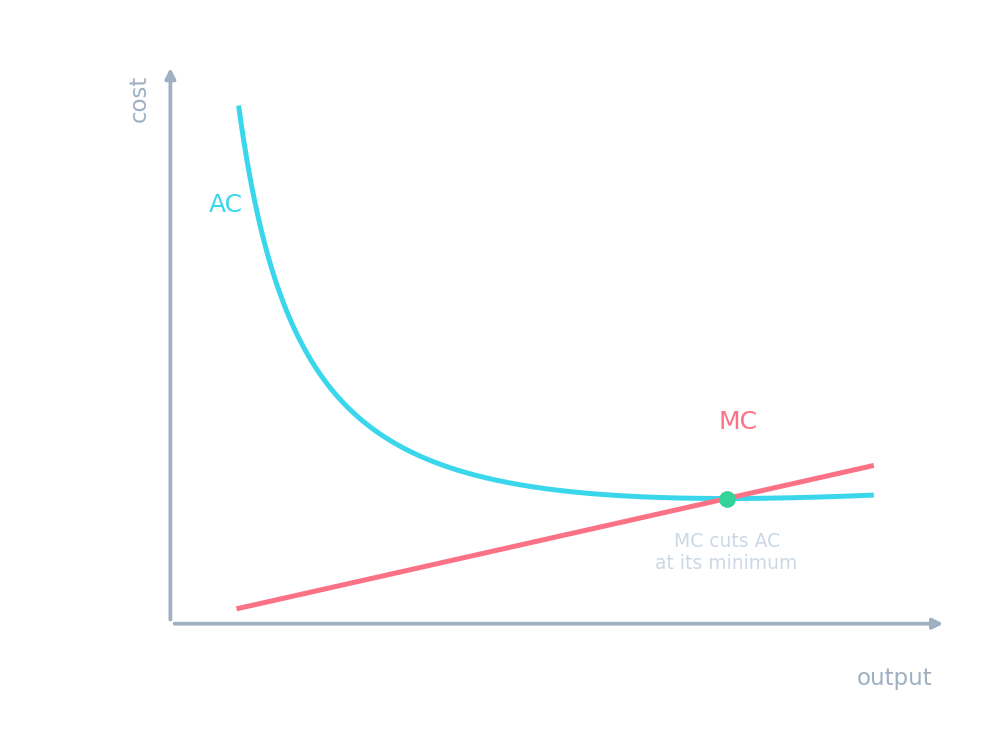
Las curvas de costo de la empresa
Average cost is U-shaped, and marginal cost cuts it exactly at the minimum. Drag the output and watch marginal cost pull the average up or down.
Total cost is 160 at 10 units and 175 at 11 units. What is the marginal cost of the 11th unit?
Dificultad 2/5 · 140 monedas + un pequeño bono en el primer intento de hoy
MC = ΔTC/ΔQ = (175 − 160)/1 = 15.
As output rises, average fixed cost:
Dificultad 1/5 · 100 monedas + un pequeño bono en el primer intento de hoy
The same fixed cost divided by a larger quantity keeps shrinking.
MC cuts the average at its minimum
- When MC is below the average, it pulls the average down; when above, it pulls it up.
- So MC crosses AVC and ATC exactly at their lowest points.
- The curves are U-shaped for the same reason as diminishing returns: cheap extra units at first, dearer ones later.
The marginal cost curve crosses the average total cost curve at its lowest point.
Dificultad 1/5 · 100 monedas + un pequeño bono en el primer intento de hoy
Below the average MC pulls it down, above it pulls it up — so they cross at the minimum.
If the marginal cost of the next unit is below average total cost, then ATC will:
Dificultad 1/5 · 100 monedas + un pequeño bono en el primer intento de hoy
A below-average marginal cost pulls the average down.
Worked examples
1. A firm has total fixed cost 100. At $Q = 10$, total variable cost is 150, so $TC = 250$, $ATC = 250/10 = 25$, $AVC = 150/10 = 15$ and $AFC = 100/10 = 10$. Check: $AVC + AFC = ATC$.
2. If producing the 11th unit raises total cost to 262, then $MC = 262 - 250 = 12$. Because $MC < ATC$, the extra unit pulls average total cost down.
Total cost is 200 at 8 units and 232 at 9 units. What is the marginal cost of the 9th unit?
232 minus 200 is 32.
What is the marginal cost of the 9th unit?
Dificultad 1/5 · 100 monedas + un pequeño bono en el primer intento de hoy
232 minus 200 is 32. Other options — 15 (the lesson marginal cost); 232 (the new total cost).
Total cost = fixed + variable. Per unit: AFC always falls, and ATC = AFC + AVC. Marginal cost crosses AVC and ATC at their minimum points — below the average pulls it down, above pulls it up. All three short-run curves are U-shaped.
Write from the data: find the marginal cost
- Total cost is 200 at 8 units and 232 at 9 units.
- Find the marginal cost of the 9th unit.