The Production Function · La Función de Producción
| English | Español |
|---|---|
| output/ˈaʊtpʊt/ | salida |
| production function/prəˈdʌkʃn ˈfʌŋkʃn/ | función de producción |
| short run/ʃɔːt rʌn/ | corto plazo |
| long run/lɒŋ rʌn/ | largo plazo |
| inputs/ˈɪnpʊts/ | insumos |
| fixed/fɪkst/ | fijo |
| variable/ˈveərɪəbl/ | variable |
| average product/ˈævrɪdʒ ˈprɒdʌkt/ | producto promedio |
| total product/ˈtəʊtl ˈprɒdʌkt/ | producto total |
| marginal product/ˈmɑːdʒɪnl ˈprɒdʌkt/ | producto marginal |
| law of diminishing marginal returns/lɔː ɒv dɪˈmɪnɪʃɪŋ ˈmɑːdʒɪnl rɪˈtɜːnz/ | ley de rendimientos marginales decrecientes |
One oven, more and more bakers
- Put one baker in a kitchen with a single oven — plenty of output.
- Add a second, a third, a fourth... the kitchen gets crowded.
- Each new baker still helps, but adds less than the one before.
- This simple story is the heart of the production function 生产函数.
Un horno, cada vez más panaderos
- Pon un panadero en una cocina con un solo horno — mucha producción.
- Añade un segundo, un tercero, un cuarto... la cocina se llena.
- Cada nuevo panadero aún ayuda, pero añade menos que el anterior.
- Esta historia simple es el corazón de la función de producción 生产函数.
Short run vs long run
- The production function links inputs 投入 to output 产出 — the most a firm can make.
- In the short run 短期, at least one input is fixed 固定 (usually the factory); only variable 可变 inputs like workers can change.
- In the long run 长期, every input is variable — the firm can resize completely.
Corto plazo vs largo plazo
- La función de producción vincula los inputs 投入 con la output 产出 — lo máximo que una empresa puede producir.
- En el short run 短期, al menos un input es fixed 固定 (generalmente la fábrica); solo los inputs variable 可变 como los trabajadores pueden cambiar.
- En el long run 长期, cada input es variable: la empresa puede redimensionarse por completo.
Short run or long run? · ¿Corto plazo o largo plazo?
In the short run at least one input is fixed; only variable inputs can change. In the long run every input is variable. · En el corto plazo, al menos un insumo es fijo; solo los insumos variables pueden cambiar. En el largo plazo, todos los insumos son variables.
In the short run, a firm has: · En el corto plazo, una empresa tiene:
The short run has at least one fixed input; the long run has none. · El corto plazo tiene al menos un insumo fijo; el largo plazo no tiene ninguno.
Select all · todos that are usually variable inputs in the short run. · Seleccione todos los que suelen ser insumos variables en el corto plazo.
Labour, materials and utilities flex in the short run; the factory is the fixed input. · La mano de obra, materiales y servicios públicos se ajustan en el corto plazo; la fábrica es el insumo fijo.
Total, marginal, average product
- Total product 总产量 (TP) is all the output from all the workers together.
- Marginal product 边际产量 (MP) is the extra output from one more worker: $MP = \dfrac{\Delta TP}{\Delta L}$.
- Average product 平均产量 (AP) is output per worker: $AP = \dfrac{TP}{L}$.
Producto total, marginal y promedio
- El producto total 总产量 (PT) es toda la output generada por todos los trabajadores juntos.
- El producto marginal 边际产量 (PM) es la extra output de un trabajador más: $MP = \dfrac{\Delta TP}{\Delta L}$.
- El producto promedio 平均产量 (PP) es la output por trabajador: $AP = \dfrac{TP}{L}$.
Marginal product is: · El producto marginal es:
MP = ΔTP/ΔL — the change in total product from adding a worker. (Output per worker is average product.) · MP = ΔTP/ΔL — el cambio en el producto total al añadir un trabajador. (La producción por trabajador es el producto promedio.)
A bakery makes 24 loaves with 2 workers and 33 loaves with 3 workers. What is the marginal product of the 3rd worker? · Una panadería produce 24 panes con 2 trabajadores y 33 panes con 3 trabajadores. ¿Cuál es el producto marginal del 3er trabajador?
MP of the 3rd worker = 33 − 24 = 9 loaves. · PM del 3er trabajador = 33 − 24 = 9 panes.
The law of diminishing marginal returns
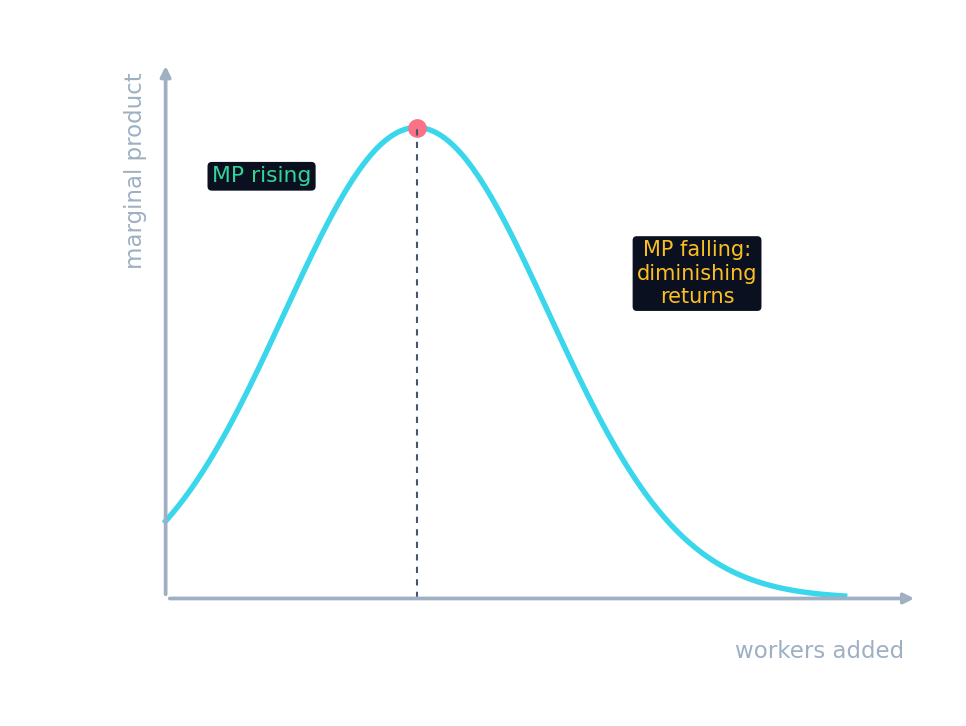
- Keep adding workers to a fixed factory and, past some point, each adds less than the last.
- This is the law of diminishing marginal returns 边际收益递减规律.
- Workers crowd the same machines, so marginal product falls.
- When MP is still positive, TP keeps rising — just more slowly. When MP hits zero, TP is at its peak.
La ley de los rendimientos marginales decrecientes
- Sigue añadiendo trabajadores a una fábrica fixed y, pasado cierto punto, cada uno añade menos que el anterior.
- Esto es la ley de los rendimientos marginales decrecientes 边际收益递减规律.
- Los trabajadores se amontonan en las mismas máquinas, por lo que el producto marginal disminuye.
- Cuando el PM sigue siendo positivo, el PT sigue aumentando, aunque más lentamente. Cuando el PM llega a cero, el PT está en su punto máximo.
Diminishing marginal returns means each extra worker (added to a fixed factory) eventually adds less output than the one before. · Los rendimientos marginales decrecientes significan que cada trabajador adicional (añadido a una fábrica fija) eventualmente añade menos producción que el anterior.
Past some point, crowding the fixed input makes marginal product fall. · Después de cierto punto, amontonar el insumo fijo hace que el producto marginal disminuya.
Total product is at its maximum when marginal product equals ______. · El producto total está en su máximo cuando el producto marginal es igual a ______.
While MP is positive TP rises; at MP = 0 it peaks; when MP is negative TP falls. · Mientras el PM es positivo, la PT aumenta; en PM = 0 alcanza su pico; cuando el PM es negativo, la PT disminuye.
The production function turns inputs into output. In the short run some input is fixed; in the long run all are variable. As you add a variable input to a fixed one, marginal product eventually falls — the law of diminishing marginal returns.
La función de producción convierte inputs en output. En el short run algún input es fixed; en el long run todos son variables. A medida que añades un input variable a uno fijo, el producto marginal eventualmente cae: la ley de los rendimientos marginales decrecientes.