International Trade and Public Policy
Introducido| English | Significado |
|---|---|
| world price/wɜːld praɪs/ | precio mundial |
| importer/ɪmˈpɔːtə/ | importador |
| exporter/ekˈspɔːtə/ | exportador |
| autarky/ˈɔːtɑːki/ | autarquía |
| free trade/friː treɪd/ | libre comercio |
| tariff/ˈtærɪf/ | arancel |
| deadweight loss/ˈdedweɪt lɒs/ | pérdida de eficiencia |
| import quota/ɪmˈpɔːt ˈkwəʊtə/ | cuota de importación |
When a market opens to the world
- A country on its own trades at its domestic equilibrium price.
- Open the borders, and it can buy or sell at the world price 世界价格 instead.
- That single change reshuffles who gains and who loses at home.
- But for the country as a whole, trade makes the pie bigger.
Importer or exporter?
- Under autarky 自给自足 a country does not trade — its price is just the domestic equilibrium.
- If the world price is below the domestic price → the country becomes an importer 进口国.
- If the world price is above the domestic price → it becomes an exporter 出口国.
- Free trade 自由贸易 raises total surplus for the country, even though one side gains and the other loses.
Open up to world trade
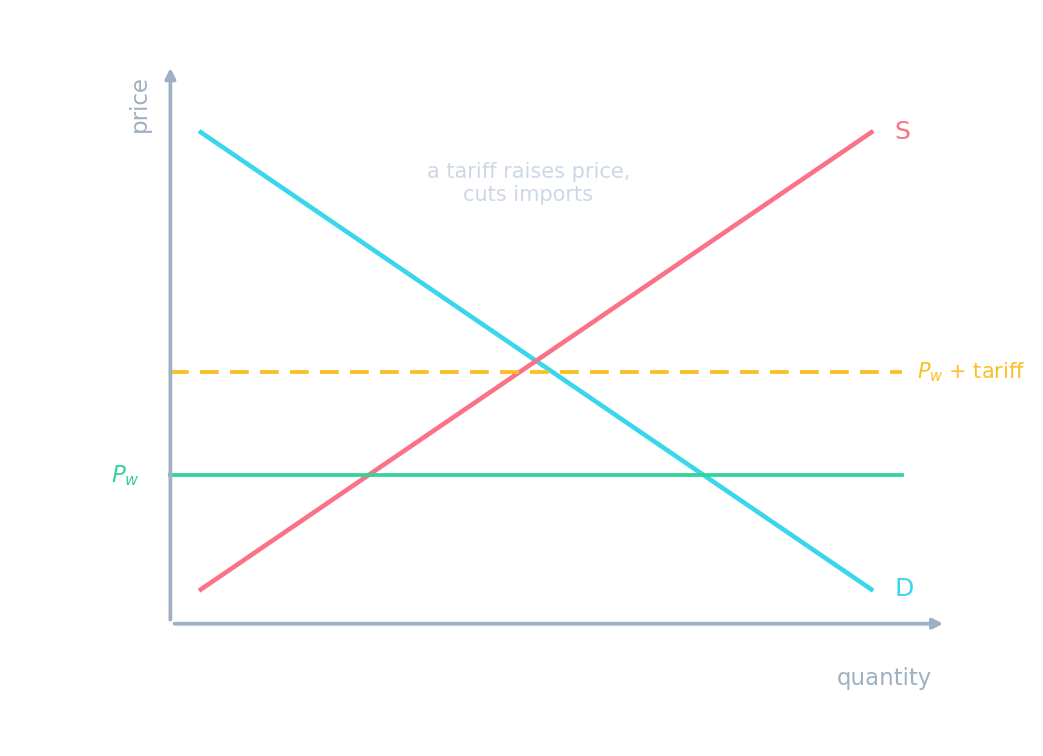
When the world price is below the domestic price, a country imports; a tariff lifts the price back up, cutting imports and creating a deadweight loss.
A country opens to trade and the world price is por debajo de its domestic price. It becomes an:
Dificultad 1/5 · 100 monedas + un pequeño bono en el primer intento de hoy
At the lower world price, buyers want more than domestic sellers supply, so the rest is imported.
Free trade raises total surplus for a country, even though it helps one side and hurts the other.
Dificultad 1/5 · 100 monedas + un pequeño bono en el primer intento de hoy
The winners gain more than the losers lose, so total surplus rises.
A country that does not trade at all is in a state of ______.
Dificultad 1/5 · 100 monedas + un pequeño bono en el primer intento de hoy
Under autarky the price is simply the domestic equilibrium price.
Domestic steel costs 800 per tonne; the world price is 600. Opening to trade, the country:
Dificultad 1/5 · 100 monedas + un pequeño bono en el primer intento de hoy
World price (600) is below domestic (800), so the country imports; buyers pay less and consumer surplus rises.
Tariffs and quotas
- A tariff 关税 is a tax on imports. It raises the price, cuts the quantity traded, and creates a deadweight loss 无谓损失 — but earns the government revenue.
- An import quota 进口配额 is a legal limit on the quantity imported. It raises the price and causes a deadweight loss too, but the government earns no revenue.
- Both shrink total surplus below the free-trade level.
Compared with a tariff, an import quota that raises the price by the same amount:
Dificultad 1/5 · 100 monedas + un pequeño bono en el primer intento de hoy
A quota raises price like a tariff but the government collects no revenue — it goes to licence holders.
Should a country restrict trade?
- Arguments for restrictions: protect new "infant" industries, save domestic jobs, and national security.
- Arguments against: higher prices for consumers, protection of inefficient firms, and lower total surplus.
- Economists usually conclude that free trade is better for society overall.
Select todos common arguments for trade restrictions.
Dificultad 2/5 · 140 monedas + un pequeño bono en el primer intento de hoy
Infant industry, jobs and security argue for restrictions; lower prices is an argument for free trade.
Worked example: a tariff on imported steel
At the world price of 400 dollars a tonne, a country consumes 100 million tonnes of steel and produces 40 million, importing 60 million. A 100-dollar tariff raises the domestic price to 500; consumption falls to 90 million and production rises to 55 million. Find the new imports and the tariff revenue.
- New imports = 90 − 55 = 35 million tonnes (down from 60). Tariff revenue = 100 dollars × 35 million = 3.5 billion dollars.
- Domestic producers gain surplus and the government gains revenue, but consumers lose more than both together. The difference is deadweight loss: inefficient domestic production plus purchases that no longer happen.
At the world price, domestic demand is 80 units and domestic supply is 30 units. How many units are imported?
Dificultad 2/5 · 140 monedas + un pequeño bono en el primer intento de hoy
80 − 30 = 50 units.
Who gains surplus when a tariff is placed on imports?
Dificultad 1/5 · 100 monedas + un pequeño bono en el primer intento de hoy
The higher price lets domestic producers sell more at a better price.
Opening to the world price makes a country an importer (world price lower) or exporter (world price higher); free trade raises total surplus. A tariff (tax, earns revenue) or quota (limit, no revenue) both raise price and create a deadweight loss.
Write from the data given
- Domestic steel costs 500 per tonne. The world price is 350.
- Say whether the country imports or exports, and the price gap.
Domestic steel costs 500 per tonne and the world price is 350. Does the country import or export when it opens to trade, and what is the price gap?
500 minus 350 is 150, and the lower world price means imports.
What does opening to trade do?
Dificultad 1/5 · 100 monedas + un pequeño bono en el primer intento de hoy
350 is below 500, so the country imports and the gap is 150.