Other Elasticities · Otras Elasticidades
| English | Español |
|---|---|
| cross-price elasticity of demand/krɒs praɪs ɪlæˈstɪsɪti ɒv dɪˈmænd/ | elasticidad cruzada de la demanda |
| substitutes/ˈsʌbstɪtjuːts/ | sustitutos |
| complements/ˈkɒmplɪmənts/ | complementarios |
| income elasticity of demand/ˈɪŋkʌm ɪlæˈstɪsɪti ɒv dɪˈmænd/ | elasticidad-ingreso de la demanda |
| normal good/ˈnɔːml ɡʊd/ | bien normal |
| inferior good/ɪnˈfɪərɪə ɡʊd/ | bien inferior |
What tea tells you about coffee
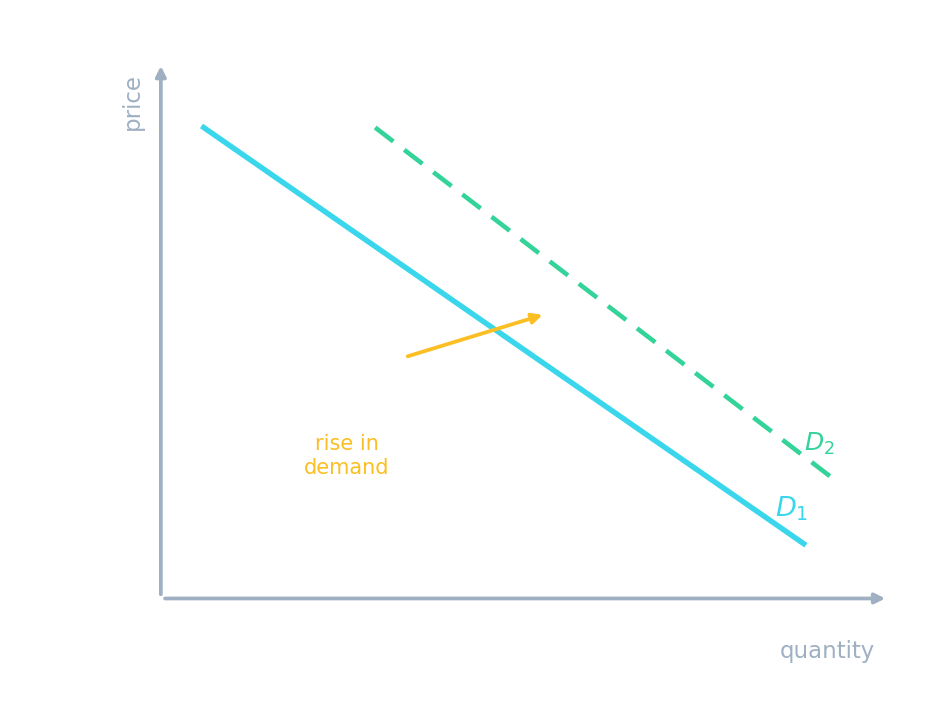
- When the price of tea jumps, something happens to coffee — its demand rises.
- When incomes rise, people buy more of some goods and less of others.
- Demand does not only react to a good's own price.
- Two more elasticities capture these other reactions.
Lo que el té te dice sobre el café
- Cuando el precio del té sube, ocurre algo con el café: su demanda aumenta.
- Cuando los ingresos aumentan, las personas compran más de algunos bienes y menos de otros.
- La demanda no solo reacciona al precio propio de un bien.
- Dos elasticidades más capturan estas otras reacciones.
Cross-price elasticity (XED)
- Cross-price elasticity of demand 交叉价格弹性 measures how demand for good X reacts to the price of good Y.
- Formula: $\text{XED} = \dfrac{\%\,\Delta\,Q_X}{\%\,\Delta\,P_Y}$.
- Positive XED → the goods are substitutes 替代品 (tea dearer → more coffee bought).
- Negative XED → the goods are complements 互补品 (printers dearer → less ink bought).
Elasticidad cruzada (XED)
- La elasticidad cruzada de la demanda mide cómo reacciona la demanda del bien X ante el cambio en el precio del bien Y.
- Fórmula: $\text{XED} = \dfrac{\%\,\Delta\,Q_X}{\%\,\Delta\,P_Y}$.
- XED positivo → los bienes son sustitutos (té más caro → se compra más café).
- XED negativo → los bienes son complementarios (impresoras más caras → se compra menos tinta).
Two goods have a positive · positiva cross-price elasticity. They are: · Dos bienes tienen una elasticidad cruzada positiva. Son:
Positive XED: a dearer Y sends buyers to X — the goods substitute for each other. · XED positiva: un bien Y más caro desvía a los compradores hacia X — los bienes se sustituyen entre sí.
Printers and ink are complements, so their cross-price elasticity is negative. · Las impresoras y la tinta son complementarios, por lo que su elasticidad cruzada es negativa.
A dearer printer lowers ink demand — a negative XED marks complements. · Una impresora más cara reduce la demanda de tinta — una XED negativa marca los bienes complementarios.
Income elasticity (YED)
- Income elasticity of demand 收入弹性 measures how demand reacts to a change in income.
- Formula: $\text{YED} = \dfrac{\%\,\Delta\,Q}{\%\,\Delta\,\text{income}}$.
- Positive YED → a normal good 正常商品 (buy more as income rises).
- Negative YED → an inferior good 低档商品 (buy less as income rises).
Elasticidad ingreso (YED)
- La elasticidad ingreso de la demanda mide cómo reacciona la demanda ante un cambio en los ingresos.
- Fórmula: $\text{YED} = \dfrac{\%\,\Delta\,Q}{\%\,\Delta\,\text{income}}$.
- YED positivo → un bien normal (se compra más a medida que aumentan los ingresos).
- YED negativo → un bien inferior (se compra menos a medida que aumentan los ingresos).
Read the sign · Lee el cartel
The sign of cross-price elasticity tells you substitutes (+) from complements (−); the sign of income elasticity tells you normal (+) from inferior (−) goods. · El signo de la elasticidad cruzada te indica los bienes sustitutos (+) frente a los complementarios (−); el signo de la elasticidad ingreso te indica los bienes normales (+) frente a los inferiores (−).
A good with a positive · positiva income elasticity of demand is a: · Un bien con una elasticidad-ingreso de la demanda positiva es un:
Positive YED: buyers want more as income rises — a normal good. · YED positiva: los compradores quieren más a medida que aumenta el ingreso — un bien normal.
A good you buy less of as your income rises is called an ______ good. · Un bien que compras menos a medida que aumenta tu ingreso se llama un bien ______.
An inferior good has a negative income elasticity of demand. · Un bien inferior tiene una elasticidad-ingreso de la demanda negativa.
Read the sign, not just the size
- Worked idea. Income rises 10% and quantity of bus tickets demanded falls 5%.
- Then $\text{YED} = \dfrac{-5\%}{10\%} = -0.5$.
- The sign is negative, so bus travel is an inferior good here — richer people switch to taxis or cars.
- With these elasticities, the sign classifies the relationship; the size shows how strong it is.
Lee el signo, no solo el tamaño
- Idea resuelta. Los ingresos aumentan 10 % y la cantidad demandada de boletos de autobús disminuye 5 %.
- Entonces $\text{YED} = \dfrac{-5\%}{10\%} = -0.5$.
- El signo es negativo, por lo que viajar en autobús es un bien inferior aquí: las personas con mayores ingresos cambian a taxis o autos.
- Con estas elasticidades, el signo clasifica la relación; el tamaño muestra qué tan fuerte es.
Income rises 10% and quantity of bus tickets demanded falls 5%. What is the income elasticity of demand (keep the sign)? · El ingreso aumenta un 10% y la cantidad demandada de billetes de autobús disminuye un 5%. ¿Cuál es la elasticidad-ingreso de la demanda (mantén el signo)?
$\text{YED} = -5\% \div 10\% = -0.5$; the negative sign means bus travel is an inferior good here. · $\text{YED} = -5\% \div 10\% = -0.5$; el signo negativo indica que viajar en autobús es un bien inferior en este caso.
Match each elasticity sign to what it tells you. · Asocia cada signo de elasticidad con lo que te indica.
The sign does the classifying: substitutes/complements for XED, normal/inferior for YED. · El signo realiza la clasificación: sustitutos/complementarios para XED, normal/inferior para YED.
XED = %ΔQ of X ÷ %ΔP of Y: positive → substitutes, negative → complements. YED = %ΔQ ÷ %Δincome: positive → normal good, negative → inferior good. Always read the sign first.
XED = %ΔQ de X ÷ %ΔP de Y: positivo → sustitutos, negativo → complementarios. YED = %ΔQ ÷ %Δingreso: positivo → bien normal, negativo → bien inferior. Siempre lee primero el signo.