Monetary Policy
Introducido| English | Significado |
|---|---|
| monetary policy/ˈmʌnɪtəri ˈpɒlɪsi/ | política monetaria |
| expansionary/ekˈspænʃənəri/ | expansionista |
| contractionary/kənˈtrækʃənəri/ | reccionista |
| open-market operations/ˈəʊpən ˈmɑːkɪt ˌɒpəˈreɪʃnz/ | operaciones de mercado abierto |
| reserve requirement/rɪˈzɜːv rɪˈkwaɪəmənt/ | requisito de reservas |
| discount rate/ˈdɪskaʊnt reɪt/ | tasa de descuento |
| investment/ɪnˈvestmənt/ | inversión |
| aggregate demand/ˈæɡrɪɡeɪt dɪˈmænd/ | Demanda agregada |
The central bank steers the economy
- The government's fiscal tools are spending and taxes.
- The central bank has a different lever: the money supply and interest rates.
- Pull it one way to fight a recession, the other to fight inflation.
- This is monetary policy 货币政策.
Two directions
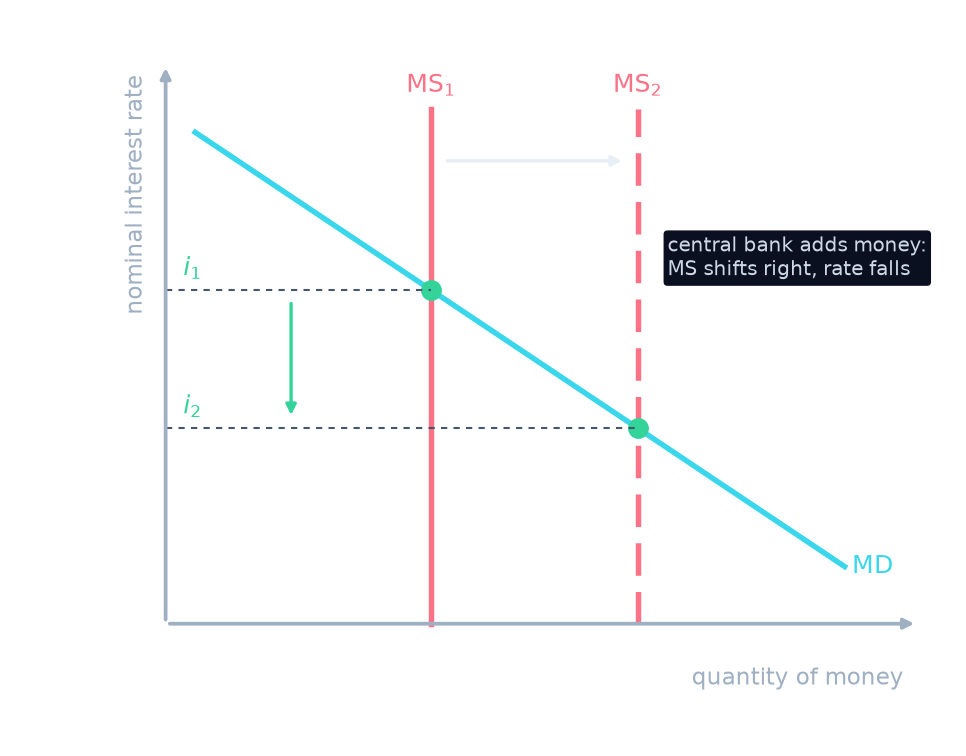
- Expansionary 扩张性 (easy) policy raises the money supply and lowers interest rates to fight a recession.
- Contractionary 紧缩性 (tight) policy lowers the money supply and raises interest rates to fight inflation.
Expansionary or contractionary?
Expansionary policy raises the money supply and lowers rates to fight recession; contractionary policy does the reverse to fight inflation.
Expansionary monetary policy, used to fight a recession:
Dificultad 1/5 · 100 monedas + un pequeño bono en el primer intento de hoy
More money and lower rates spur borrowing and spending, shifting AD right.
To fight inflation, the central bank buys bonds and lowers interest rates.
Dificultad 1/5 · 100 monedas + un pequeño bono en el primer intento de hoy
False. That is expansionary policy. To fight inflation the central bank sells bonds and raises rates, which cools borrowing and shifts AD left.
Three tools
- Open-market operations 公开市场操作: buying government bonds injects money (expansionary); selling drains it. This is the main everyday tool.
- The reserve requirement 准备金要求: lowering it lets banks lend more (expansionary).
- The discount rate 贴现率: the rate the central bank charges banks; a lower rate encourages lending.
To inject money (expansionary), the central bank's open-market operation is to:
Dificultad 1/5 · 100 monedas + un pequeño bono en el primer intento de hoy
Buying bonds pays banks in reserves, raising the money supply.
Select todos three main tools of monetary policy.
Dificultad 2/5 · 140 monedas + un pequeño bono en el primer intento de hoy
Open-market operations, reserve requirement and discount rate are monetary tools; income tax is fiscal.
How it reaches output
- The chain: a change in the money supply moves the interest rate, which changes investment 投资 and interest-sensitive spending, which shifts aggregate demand 总需求.
- Worked idea. In a recession the central bank buys bonds → reserves and the money supply rise → the interest rate falls from 5% to 3% → cheaper borrowing spurs investment → AD shifts right → output rises toward full employment.
A lower interest rate raises ______ and interest-sensitive spending, shifting AD right.
Dificultad 1/5 · 100 monedas + un pequeño bono en el primer intento de hoy
Cheaper borrowing spurs investment, so aggregate demand rises.
Put the expansionary monetary chain in order.
Dificultad 3/5 · 200 monedas + un pequeño bono en el primer intento de hoy
Money up → rate down → investment up → AD right → output up.
Worked example: the full chain for inflation
An economy has an inflationary gap. State an open-market operation the Fed should use and trace its effect through to real output and the price level.
- Sell government bonds. Bank reserves fall, so the money supply falls and the nominal interest rate rises.
- Higher rates reduce investment and interest-sensitive consumption, so AD shifts left. Real output falls toward potential and the price level falls (or rises more slowly), closing the inflationary gap.
To fight a recession with open-market operations, the central bank should:
Dificultad 1/5 · 100 monedas + un pequeño bono en el primer intento de hoy
Buying bonds adds reserves, raising the money supply and lowering interest rates.
Raising the discount rate is contractionary monetary policy.
Dificultad 1/5 · 100 monedas + un pequeño bono en el primer intento de hoy
Banks find borrowing reserves dearer, so they lend less.
Monetary policy uses the money supply and interest rates. Expansionary (more money, lower rates) fights recession; contractionary (less money, higher rates) fights inflation. The main tool is open-market operations; the chain runs money → interest rate → investment → aggregate demand.
Write from a bond purchase of 20 billion
- The central bank buys 20 billion of bonds to fight a recession.
- Say what happens to the money supply, the interest rate and aggregate demand.
To fight a recession, the central bank buys 20 billion of government bonds. What happens to the money supply, the interest rate and aggregate demand?
Paying for the bonds creates reserves, which supports more lending.
What does buying 20 billion of bonds do?
Dificultad 1/5 · 100 monedas + un pequeño bono en el primer intento de hoy
An open-market purchase is expansionary monetary policy.