The Loanable Funds Market
Introducido| English | Significado |
|---|---|
| saving/ˈseɪvɪŋ/ | ahorro |
| investment/ɪnˈvestmənt/ | inversión |
| loanable funds market/ˈləʊnəbl fʌndz ˈmɑːkɪt/ | mercado de fondos prestables |
| crowding out/ˈkraʊdɪŋ aʊt/ | efecto desplazamiento |
| equilibrium real interest rate/ˌiːkwɪˈlɪbrɪəm rɪəl ˈɪntrest reɪt/ | tasa real de interés de equilibrio |
Where the real interest rate is set
- The money market sets the nominal rate right now.
- But borrowing and lending over time need a real rate.
- That comes from a separate market for saving and investment.
- It is the loanable funds market 可贷资金市场.
Saving supplies, investment demands
- The supply of loanable funds comes from saving 储蓄 — more saving at a higher real rate.
- The demand comes from borrowing for investment 投资 — more borrowing at a lower real rate.
- Where they cross is the equilibrium real interest rate 均衡实际利率.
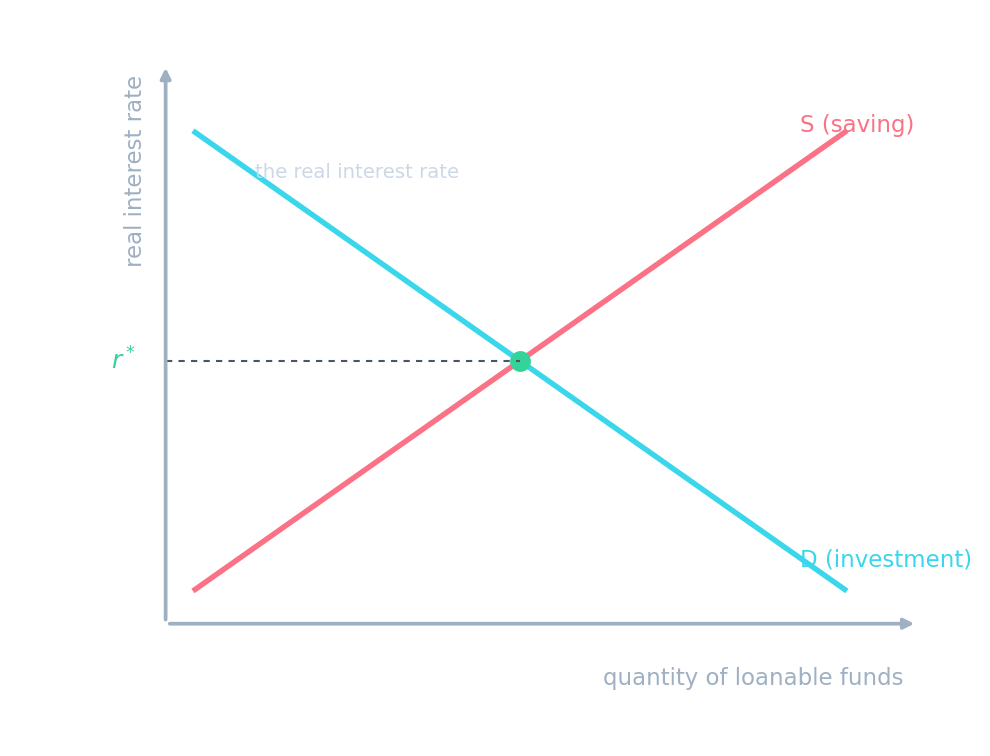
Which way does the real rate move?
Government borrowing raises demand for funds and pushes the real rate up (crowding out); more saving shifts supply right and lowers it.
The supply of loanable funds comes from:
Dificultad 1/5 · 100 monedas + un pequeño bono en el primer intento de hoy
Saving supplies funds; borrowing for investment demands them.
The loanable funds market sets the ______ interest rate.
Dificultad 1/5 · 100 monedas + un pequeño bono en el primer intento de hoy
It sets the real rate for borrowing and lending over time.
The demand for loanable funds comes mainly from:
Dificultad 1/5 · 100 monedas + un pequeño bono en el primer intento de hoy
Firms and governments borrow to invest, demanding loanable funds.
Crowding out
- More government borrowing (a budget deficit) raises the demand for funds, pushing the real rate up.
- A higher real rate reduces private investment — an effect called crowding out 挤出效应.
- More household saving instead shifts supply right and lowers the real rate.
Heavy government borrowing raises the real interest rate and reduces private investment. This is called:
Dificultad 1/5 · 100 monedas + un pequeño bono en el primer intento de hoy
The higher real rate "crowds out" investment projects that no longer pay.
More household saving shifts the supply of loanable funds left and raises the real interest rate.
Dificultad 1/5 · 100 monedas + un pequeño bono en el primer intento de hoy
False. More saving adds to the supply of loanable funds, shifting it right and lowering the real interest rate.
A worked case
- Worked idea. A government runs a large deficit and borrows heavily.
- The demand for loanable funds shifts right, so the real interest rate rises from 3% to 5%.
- At that higher rate, some firms cancel investment projects that no longer pay.
- Government borrowing has "crowded out" private investment — the key long-run worry about deficits.
Government borrowing pushes the real rate from 3% to 5%. By how many percentage points did it rise?
Dificultad 2/5 · 140 monedas + un pequeño bono en el primer intento de hoy
The real rate rose by 5 − 3 = 2 percentage points, crowding out some investment.
Worked example: a deficit and long-run growth
The government runs a larger budget deficit financed by borrowing. Show the effect in the loanable funds market and explain why it might slow long-run growth.
- The government's borrowing increases demand for loanable funds (shift right), so the real interest rate rises and the quantity of loanable funds rises.
- At the higher real rate, firms invest less: crowding out. Less investment means a smaller capital stock in the future, so LRAS grows more slowly than it would have.
Households decide to save more of their income. In the loanable funds market:
Dificultad 1/5 · 100 monedas + un pequeño bono en el primer intento de hoy
More saving means more funds available to lend.
The loanable funds market determines the real interest rate, while the money market determines the nominal rate.
Dificultad 1/5 · 100 monedas + un pequeño bono en el primer intento de hoy
This is the usual AP distinction between the two graphs.
The loanable funds market sets the real interest rate where saving (supply) meets investment (demand). Government borrowing raises demand and pushes the real rate up, reducing private investment — crowding out. More saving shifts supply right and lowers the real rate.
Write from the data given
- Government borrowing moves the real interest rate from 4 percent to 7 percent.
- Find the rise and name the effect on private investment.
Government borrowing pushes the real interest rate from 4 percent to 7 percent. By how many percentage points did it rise, and what happens to private investment?
7 minus 4 is 3.
By how many percentage points did the real rate rise?
Dificultad 1/5 · 100 monedas + un pequeño bono en el primer intento de hoy
7 percent minus 4 percent is a rise of 3 percentage points. Other options — 2 (the lesson rise); 7 (the new rate).