Short-Run Aggregate Supply (SRAS)
Introducido| English | Significado |
|---|---|
| aggregate supply/ˈæɡrɪɡeɪt səˈplaɪ/ | oferta agregada |
| short-run aggregate supply/ʃɔːt rʌn ˈæɡrɪɡeɪt səˈplaɪ/ | oferta agregada a corto plazo |
| sticky/ˈstɪki/ | rígido |
| nominal wages/ˈnɒmɪnl ˈweɪdʒɪz/ | salarios nominales |
| input prices/ˈɪnpʊt ˈpraɪsɪz/ | precios de los insumos |
| productivity/ˌprɒdəkˈtɪvɪti/ | productividad |
| supply shocks/səˈplaɪ ʃɒks/ | choques de oferta |
| inflationary expectations/ɪnˈfleɪʃənəri ekspɪkˈteɪʃnz/ | expectativas inflacionarias |
| negative supply shock/ˈneɡətɪv səˈplaɪ ʃɒk/ | choque negativo de oferta |
What firms will produce — for now
- Aggregate demand is only half the picture; supply is the other half.
- Aggregate supply 总供给 is how much output firms will make at each price level.
- In the short run, it slopes upward — a higher price level brings more output.
- This is the short-run aggregate supply 短期总供给 (SRAS) curve.
Why SRAS slopes up: sticky wages
- In the short run, some costs are sticky 粘性 — fixed by contracts and slow to change.
- The clearest is nominal wages 名义工资, the dollar wages set in labour contracts.
- When the price level rises but wages stay locked in, profit per unit rises — so firms produce more.
- A higher price level therefore brings more output: an upward slope.
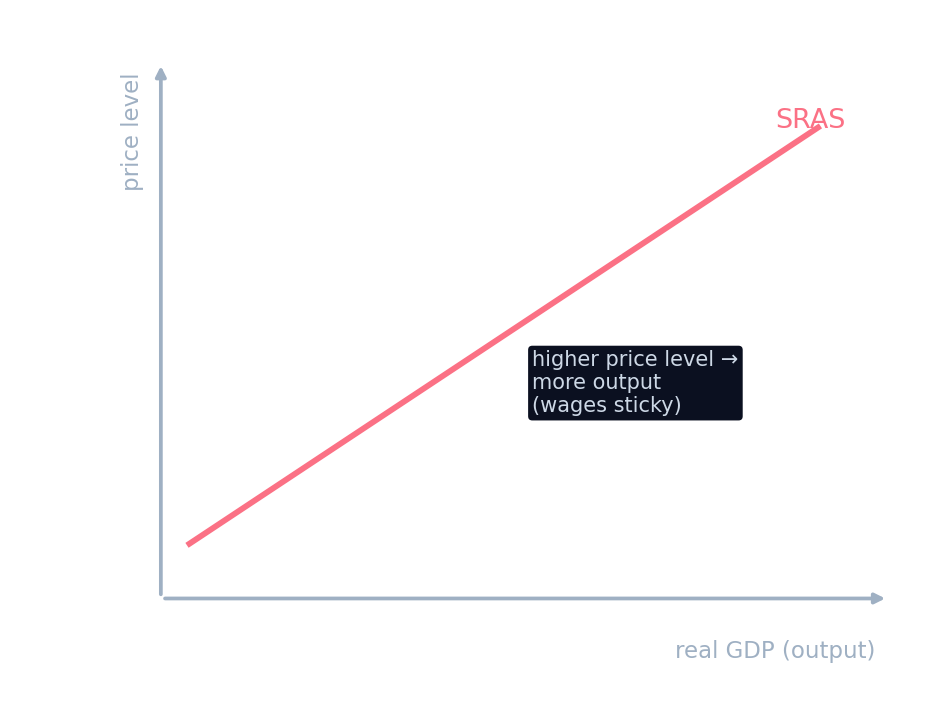
The AD-AS model
SRAS slopes up because wages are sticky in the short run. Dearer inputs shift it left (raising prices, cutting output); better productivity shifts it right.
SRAS slopes upward mainly because, in the short run:
Dificultad 1/5 · 100 monedas + un pequeño bono en el primer intento de hoy
With wages locked in, a higher price level means more profit per unit, so firms produce more.
Costs that are fixed by contracts and slow to change in the short run are called ______.
Dificultad 1/5 · 100 monedas + un pequeño bono en el primer intento de hoy
Sticky nominal wages are the key reason SRAS slopes upward.
What shifts SRAS
- Input prices 投入品价格 (wages, energy, raw materials): higher input prices shift SRAS left.
- Productivity 生产率: higher output per worker shifts SRAS right.
- Supply shocks 供给冲击 and inflationary expectations 通货膨胀预期 shift it too.
A rise in input prices (like energy) shifts SRAS:
Dificultad 1/5 · 100 monedas + un pequeño bono en el primer intento de hoy
Dearer inputs make production costlier at every price level, shifting SRAS left.
Select todos that shift SRAS to the derecha.
Dificultad 2/5 · 140 monedas + un pequeño bono en el primer intento de hoy
Cheaper inputs, higher productivity and positive shocks raise SRAS; dearer oil shifts it left.
Higher productivity lowers the cost of each unit and shifts SRAS right.
Dificultad 1/5 · 100 monedas + un pequeño bono en el primer intento de hoy
More output per worker means cheaper production, so firms supply more at every price level.
A supply shock
- Worked idea. World oil prices double. Oil is an input for transport, plastics, and power, so costs rise across the whole economy — a negative supply shock 负面供给冲击.
- SRAS shifts left: less output is supplied at every price level.
- The price level rises and output falls at the same time.
- A positive shock (cheaper inputs) does the reverse, shifting SRAS right.
A negative supply shock (say, oil prices double) causes:
Dificultad 1/5 · 100 monedas + un pequeño bono en el primer intento de hoy
SRAS shifts left, so along AD the price level rises while output falls — a preview of stagflation.
Worked example: three shocks to SRAS
State the direction SRAS shifts and why: (a) a new law raises the minimum wage across the economy; (b) businesses adopt faster software, raising output per worker; (c) workers come to expect higher inflation next year.
- (a) Higher wages are a higher input price: SRAS shifts left. (b) Higher productivity lowers cost per unit: SRAS shifts right.
- (c) Workers demand higher nominal wages now to protect their real pay, so costs rise: SRAS shifts left. A change in the price level alone would not shift SRAS; it would be a movement along it.
The government gives all firms a subsidy on energy costs. SRAS:
Dificultad 1/5 · 100 monedas + un pequeño bono en el primer intento de hoy
Lower input costs mean more output at each price level.
SRAS slopes upward partly because nominal wages are slow to adjust.
Dificultad 1/5 · 100 monedas + un pequeño bono en el primer intento de hoy
With wages fixed, a higher price level raises profit per unit, so firms produce more.
SRAS slopes up because nominal wages are sticky — a higher price level lifts profit per unit, so firms produce more. It shifts with input prices, productivity, and supply shocks: a negative shock (dearer inputs) shifts SRAS left, raising prices while cutting output.
Write from output falling to 840
- Oil prices jump. Short-run output falls from 900 to 840 while the price level rises.
- Name the shift.
A jump in oil prices cuts short-run output from 900 to 840 and raises the price level. Which curve shifted, and which way?
900 minus 840 is 60 less output when costs jump.
What does the oil jump do?
Dificultad 1/5 · 100 monedas + un pequeño bono en el primer intento de hoy
Higher input costs shift short-run supply left.