Long-Run Aggregate Supply (LRAS)
Introducido| English | Significado |
|---|---|
| long-run aggregate supply/lɒŋ rʌn ˈæɡrɪɡeɪt səˈplaɪ/ | oferta agregada a largo plazo |
| full-employment output/fʊl emˈplɔɪmənt ˈaʊtpʊt/ | producción al pleno empleo |
| frictional/ˈfrɪkʃənl/ | desempleo friccional |
| structural/ˈstrʌktʃərəl/ | desempleo estructural |
| natural rate of unemployment/ˈnætʃərəl reɪt ɒv ʌnemˈplɔɪmənt/ | tasa natural de desempleo |
| potential GDP/pəˈtenʃl ˌdʒiː diː ˈpiː/ | PIB potencial |
| fully flexible/ˈfʊli ˈfleksɪbl/ | totalmente flexible |
| capacity/kəˈpæsɪti/ | capacidad productiva |
| capital stock/ˈkæpɪtl stɒk/ | stock de capital |
| technology/tekˈnɒlədʒi/ | tecnología |
| economic growth/ˌiːkəˈnɒmɪk ɡrəʊθ/ | crecimiento económico |
The economy's real ceiling
- Contracts don't stay fixed forever — given time, every wage and price adjusts.
- In that long run, the sticky-wage story disappears.
- Aggregate supply then looks completely different.
- It becomes the long-run aggregate supply 长期总供给 (LRAS) curve — and it is vertical.
Vertical at full-employment output
- LRAS is a vertical line at the economy's full-employment output 充分就业产出.
- This is not zero unemployment — only frictional 摩擦性失业 and structural 结构性失业 remain, at the natural rate of unemployment 自然失业率.
- Its position marks the economy's potential GDP 潜在GDP — the maximum sustainable output.
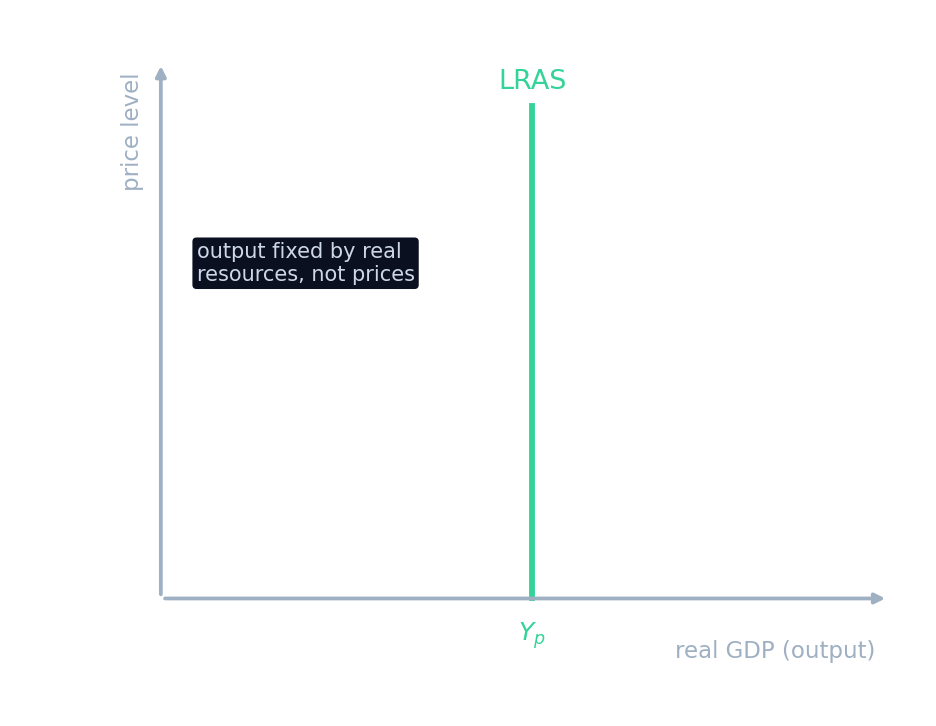
The AD-AS model
LRAS is vertical at potential output, because in the long run wages and prices are flexible. Economic growth shifts it right.
The long-run aggregate supply curve is:
Dificultad 1/5 · 100 monedas + un pequeño bono en el primer intento de hoy
In the long run output depends on real resources, not the price level, so LRAS is vertical.
LRAS sits at the economy's maximum sustainable output, called potential ______.
Dificultad 1/5 · 100 monedas + un pequeño bono en el primer intento de hoy
Potential GDP is the output at full employment, at the natural rate of unemployment.
Full-employment output means zero unemployment.
Dificultad 1/5 · 100 monedas + un pequeño bono en el primer intento de hoy
Some frictional and structural unemployment always remain — the natural rate.
Why it's independent of the price level
- In the long run, wages and prices are fully flexible 完全灵活.
- If the price level doubles, wages eventually double too, so firms have no lasting reason to change output.
- Real output settles back to what the economy's real resources can make.
- That does not depend on how high the price tags are — so LRAS is vertical.
LRAS is independent of the price level because, in the long run:
Dificultad 1/5 · 100 monedas + un pequeño bono en el primer intento de hoy
If the price level doubles, wages eventually double too, leaving real output unchanged.
Growth shifts LRAS right
- LRAS moves only when real productive capacity 生产能力 changes.
- More or better resources, a bigger capital stock 资本存量, or new technology 技术 all shift LRAS right.
- That rightward shift is long-run economic growth 经济增长.
- Worked idea. A decade of investment in schools and factories raises potential output — LRAS shifts right.
A country invests heavily in education and new factories for a decade. LRAS:
Dificultad 1/5 · 100 monedas + un pequeño bono en el primer intento de hoy
More capital and a more skilled workforce raise potential output, shifting LRAS right.
Select todos that shift LRAS to the derecha.
Dificultad 2/5 · 140 monedas + un pequeño bono en el primer intento de hoy
Real resources and technology grow potential output; a price-level change does not move LRAS.
Worked example: what moves LRAS?
Which of these shift LRAS, and which way? (a) Oil prices rise for six months. (b) A large wave of skilled immigrants joins the workforce. (c) A war destroys many factories.
- (a) A temporary input-price change shifts SRAS, not LRAS: the economy's long-run capacity is unchanged.
- (b) More labor raises potential output: LRAS shifts right. (c) Less capital stock cuts potential output: LRAS shifts left. On a PPC, (b) moves the curve outward and (c) inward.
A breakthrough in battery technology raises productivity in every industry for good. LRAS:
Dificultad 1/5 · 100 monedas + un pequeño bono en el primer intento de hoy
A lasting rise in productive capacity is long-run growth.
A higher price level shifts LRAS to the right.
Dificultad 1/5 · 100 monedas + un pequeño bono en el primer intento de hoy
LRAS is vertical: potential output does not depend on the price level.
LRAS is vertical at full-employment output (potential GDP), because wages and prices are fully flexible in the long run — real output depends on real resources, not the price level. Economic growth shifts LRAS right.
Write from a new potential output of 1100
- A decade of schooling and new factories raises potential output from 1000 to 1100.
- Say what happens to long-run aggregate supply.
Schooling and new factories raise potential output from 1000 to 1100. What happens to the long-run aggregate supply curve, and why does the price level not set that output?
More capital and skills raise what the economy can produce.
What happens to long-run aggregate supply?
Dificultad 1/5 · 100 monedas + un pequeño bono en el primer intento de hoy
Potential output rose from 1000 to 1100, a rightward shift.