Maintaining the Order
Introducido| English | Significado |
|---|---|
| conservatism/kənˈsɜːvətɪzəm/ | The ideology defending tradition, monarchy, church and gradual change. |
| intervention/ˌɪntəˈvenʃn/ | The use of military or political force by one state in the internal affairs of another. |
A murder and a crackdown, 1819
- In March 1819, a German student named Karl Sand stabbed to death the writer August von Kotzebue, whom students saw as a spy for the Russian tsar. Austria's chancellor Metternich used the murder to persuade the German states to pass the Carlsbad Decrees: universities were watched, student societies banned and newspapers censored.
- After 1815, conservative governments tried to preserve the old order against liberalism and nationalism.
What did the Carlsbad Decrees do?
Dificultad 2/5 · 140 monedas + un pequeño bono en el primer intento de hoy
Repression after 1819.
Conservatism as an ideology
- Conservatism 保守主义 defended tradition, monarchy, the established Church and social hierarchy. It argued that sudden change, as in 1789, led to chaos.
- Writers such as Joseph de Maistre argued that monarchy and religion held society together.
What did conservatism defend?
Dificultad 1/5 · 100 monedas + un pequeño bono en el primer intento de hoy
The old order.
The Concert of Europe
- The great powers agreed to meet to deal with threats to peace and order.
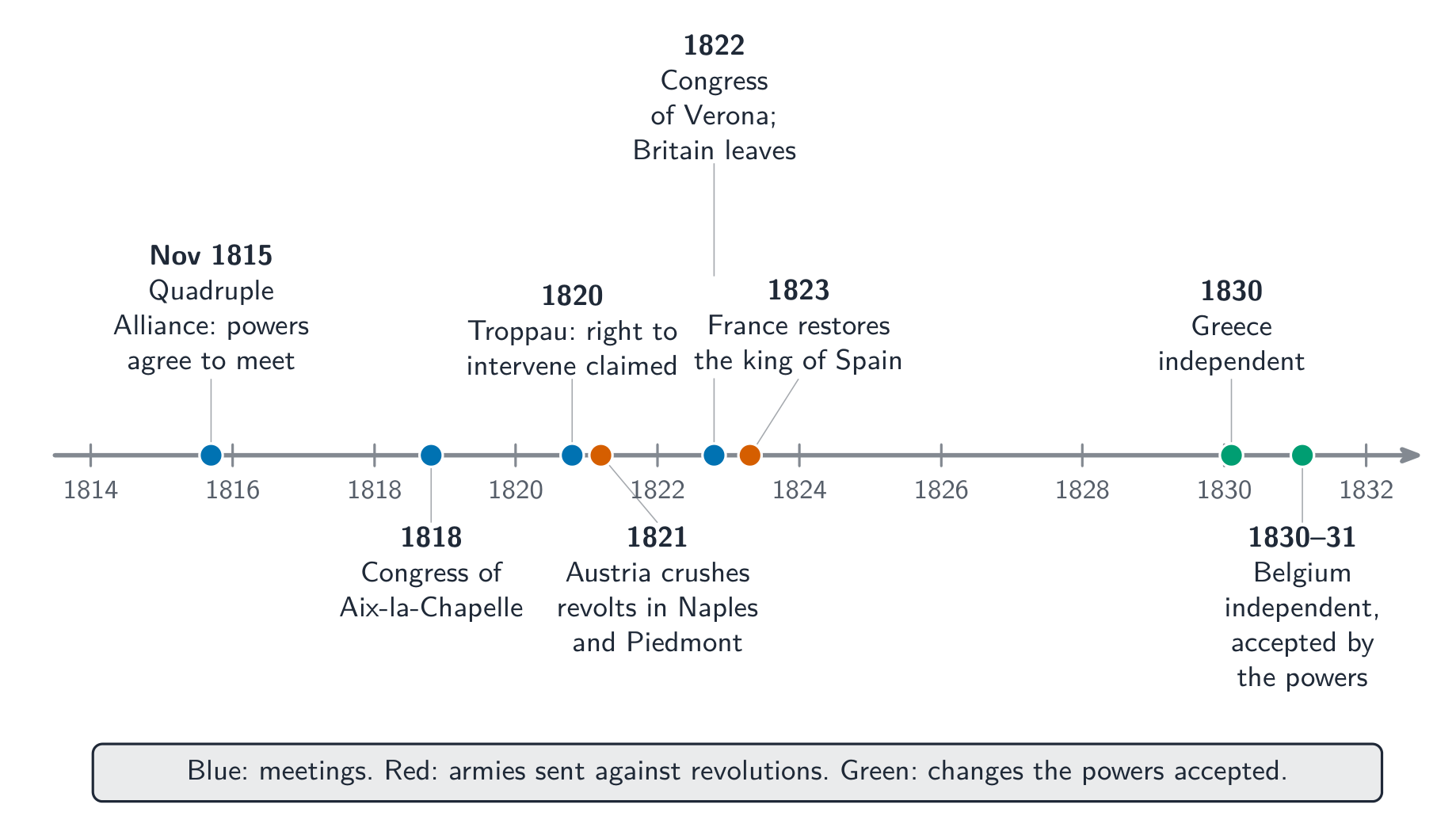
- At Troppau (1820), Austria, Prussia and Russia claimed the right to intervene against revolutions in other states.
The argument, the institution, or the method?
Sort each element of how the order was maintained.
Worked example: intervention in practice
- Italy, 1821: Austrian troops crushed liberal revolts in Naples and Piedmont.
- Spain, 1823: a French army restored King Ferdinand VII to absolute power.
- Poland, 1830–31: Russia crushed a Polish revolt. These interventions 干涉 show conservatism working through armies as well as ideas.
Match each intervention to the power that carried it out.
Dificultad 2/5 · 140 monedas + un pequeño bono en el primer intento de hoy
Order by force.
Challenged as well as maintained
- The powers supported Greek independence from the Ottoman Empire (1830), because it was Christian against Muslim rule.
- Belgium broke from the Netherlands in 1830–31, and Britain refused to join interventions after the early 1820s.
The great powers supported Greek independence.
Dificultad 1/5 · 100 monedas + un pequeño bono en el primer intento de hoy
Christians against Ottoman rule.
Order held — for a time
- Austria, Prussia and Russia kept censorship and secret police. Russia's Nicholas I crushed the Decembrist revolt of 1825.
- But the revolutions of 1848 showed the order could not hold everywhere.
Put these events in order.
Dificultad 3/5 · 200 monedas + un pequeño bono en el primer intento de hoy
1819, 1820, 1825, 1830.
The conservative order was not unchanged. It was both maintained and challenged: Greece and Belgium won independence, and Britain withdrew from intervention. Show both sides.
The conservative order of 1815 was never challenged before 1848.
Dificultad 1/5 · 100 monedas + un pequeño bono en el primer intento de hoy
Greece and Belgium.
After 1815, conservatives defended monarchy, Church and hierarchy. Metternich's Carlsbad Decrees and the Concert of Europe's interventions in Italy, Spain and Poland maintained order, but Greek and Belgian independence and the revolutions of 1848 showed its limits.
To what extent did the Concert of Europe maintain the conservative order between 1815 and 1848?
Extent.