Classes, Cities and Families
Introducido| English | Significado |
|---|---|
| working class | The class of people who sell their labour for wages. |
| middle class/ˈmɪdl klæs/ | A social group between the wealthiest and poorest groups, often associated with professional, managerial or business occupations. |
| urbanization/ˌɜːbənaɪˈzeɪʃn/ | The growth of towns and cities as people move from the countryside. |
A young German in Manchester, 1845
- In 1845, the 24-year-old Friedrich Engels, son of a German factory owner, published The Condition of the Working Class in England. He described Manchester's workers living in damp cellars, beside rivers black with waste, while factory owners lived in clean suburbs. Manchester, he wrote, was built so the rich never had to see the poor.
- Industrialization divided society into new classes and changed cities and families.
What did Engels observe in Manchester?
Dificultad 1/5 · 100 monedas + un pequeño bono en el primer intento de hoy
The Condition of the Working Class, 1845.
New classes
- Factory owners, bankers and professionals formed the middle class 中产阶级, or bourgeoisie. Factory and mine workers formed the working class 工人阶级, or proletariat.
- Class depended on how a person earned a living — owning businesses or selling labour for wages.
Match each person to their class.
Dificultad 2/5 · 140 monedas + un pequeño bono en el primer intento de hoy
Class by how one earned a living.
Building an identity
- Middle-class families showed their status through respectable behaviour, education, clubs and church.
- Workers formed trade unions, friendly societies (for sickness and funerals) and later their own political parties.
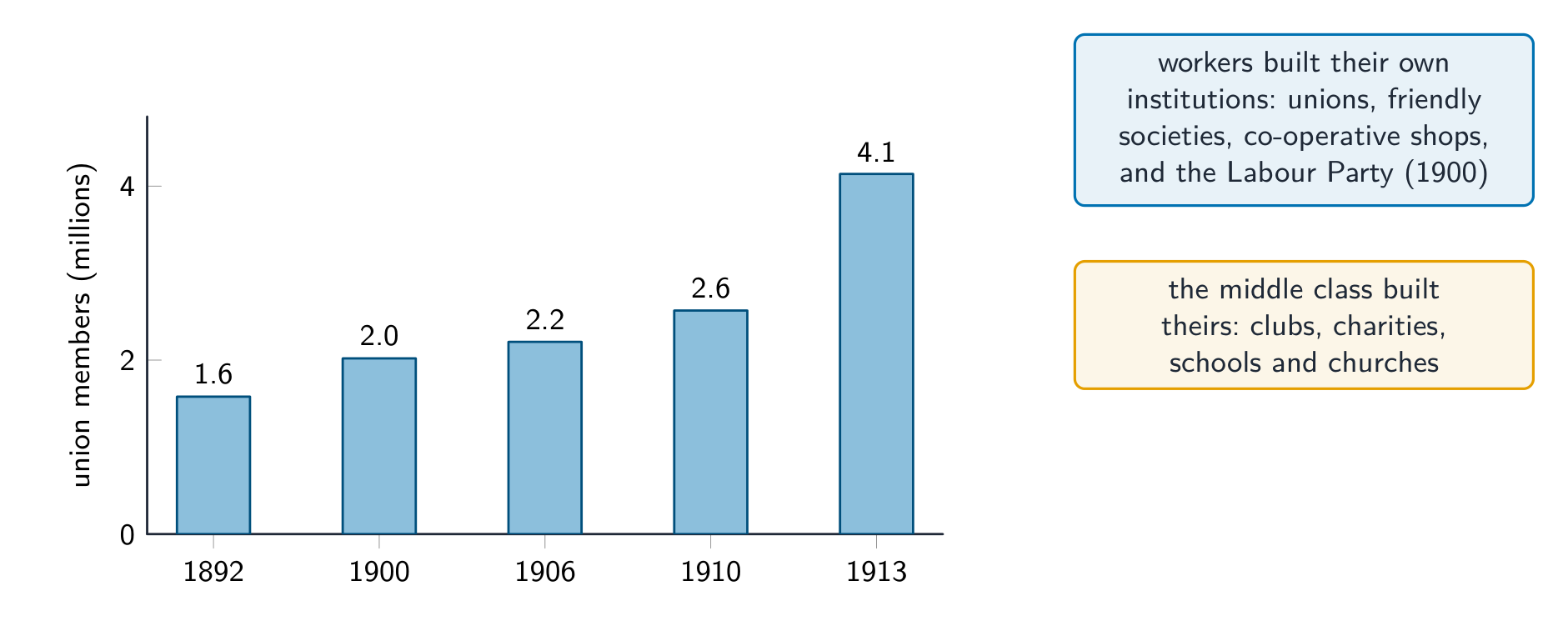
Class formation, urban and rural change, or family life?
Sort each social development.
Worked example: cities grow, the countryside empties
- Growth: London grew from about 1 million people in 1801 to about 6.5 million in 1901; Manchester from about 75 000 to over 500 000.
- Problems: overcrowding, dirty water and cholera. In 1854, John Snow traced a London cholera outbreak to one water pump on Broad Street.
- The countryside: farm workers moved to cities or emigrated, and many rural areas lost population — urbanization 城市化.
London grew from about 1 million in 1801 to about 6.5 million in 1901. By how many times did it grow?
Dificultad 2/5 · 140 monedas + un pequeño bono en el primer intento de hoy
6.5 ÷ 1.
What did John Snow show in 1854?
Dificultad 1/5 · 100 monedas + un pequeño bono en el primer intento de hoy
Broad Street pump.
The family reorganized
- Work moved out of the home and into factories. Middle-class women were expected to stay at home; working-class women and children often worked in mills.
- Britain's Factory Act of 1833 banned children under 9 from textile mills.
The 1833 Factory Act banned children under 9 from textile mills.
Dificultad 1/5 · 100 monedas + un pequeño bono en el primer intento de hoy
In Britain.
Conditions improved — slowly
- After 1850, real wages rose, sewers and clean water were built, and death rates in cities began to fall.
- These improvements came from public health laws, workers' campaigns and growing wealth.
Industrialization did not make life worse for everyone, or forever. Conditions were very bad in early industrial cities, but wages and health improved in the second half of the century. Show change over time.
Living conditions got steadily worse throughout the nineteenth century.
Dificultad 1/5 · 100 monedas + un pequeño bono en el primer intento de hoy
They improved after 1850.
Industrialization created a middle class of owners and professionals and a working class of wage labourers, each building its own identity. Cities grew rapidly and were unhealthy at first; family life changed as work left the home; and conditions improved after 1850 through reform and rising wages.
Explain how industrialization changed European society.
Social change.