Three Pressures Meet
Introducido| English | Significado |
|---|---|
| Estates-General | France's assembly of clergy, nobles and commoners, called in 1789 for the first time since 1614. |
| consent/kənˈsent/ | consent |
| bourgeoisie | bourgeoisie |
| parlements | parlements |
| enlightened absolutism/enˈlaɪtnd ˈæbsəluːtɪzəm/ | Rule by an absolute monarch who adopts selected Enlightenment reforms while retaining supreme authority. |
The Estates-General meets, May 1789
- On 5 May 1789, about 1200 deputies met at Versailles for the first Estates-General 三级会议 since 1614: clergy, nobles and the Third Estate, everyone else. King Louis XVI had called them for one reason: the treasury was empty.
- Debt, new ideas and a changing society had been building up for decades. In 1789 they met in one room.
Before 1789, the Estates-General had last met in ____.
Dificultad 1/5 · 100 monedas + un pequeño bono en el primer intento de hoy
175 years earlier.
Pressure 1: debt
- France fought expensive wars: the Seven Years' War (1756–63) and the American War of Independence (1778–83), which it paid for mostly with loans.
- By 1788, about half of royal spending went on interest on old debts. Nobles and clergy paid little tax, so new taxes fell on those least able to pay.
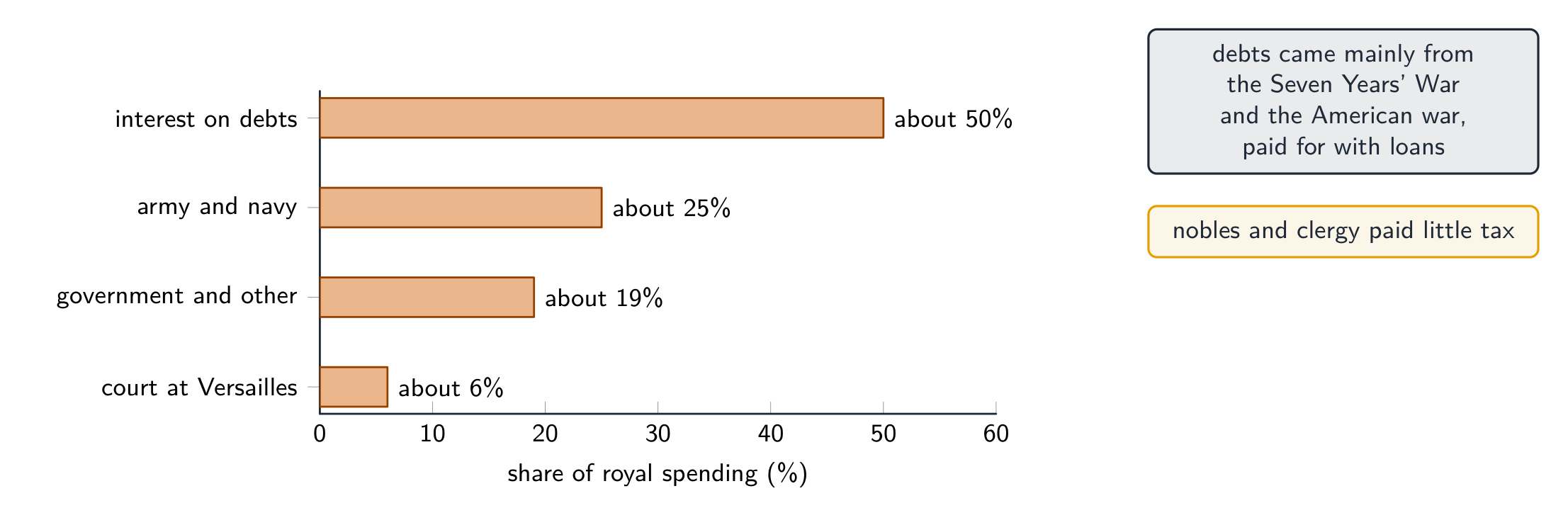
About what share of French royal spending went on debt interest in 1788?
Dificultad 1/5 · 100 monedas + un pequeño bono en el primer intento de hoy
The wars had been paid for with loans.
Pressure 2: ideas
- Enlightenment writers argued that government should rest on the consent 同意 of the people and protect natural rights. Rousseau's The Social Contract (1762) said that sovereignty belongs to the people.
- Thousands of French soldiers and sailors had helped the Americans win a war fought in the name of these ideas, and the American Declaration of Independence (1776) was widely read in France.
Rousseau argued that sovereignty belongs to the king alone.
Dificultad 1/5 · 100 monedas + un pequeño bono en el primer intento de hoy
He said it belongs to the people.
Pressure 3: a changing society
- Atlantic trade made port cities such as Bordeaux and Nantes rich. A growing bourgeoisie 资产阶级 — merchants, lawyers and officials — had money and education.
- But noble birth still decided who became a bishop, an army officer or a judge, and nobles were free from most taxes. Many rich commoners felt the system was unfair.
Who belonged to the bourgeoisie?
Dificultad 2/5 · 140 monedas + un pequeño bono en el primer intento de hoy
Bishops were usually nobles.
Worked example: why reform failed. In 1786 the finance minister Calonne proposed a land tax that everyone, nobles included, would pay. In 1787 an Assembly of Notables, made up mostly of nobles and bishops, refused. The parlements 高等法院 — powerful law courts run by nobles — said only the Estates-General could approve new taxes. So the privileged blocked reform and forced the king to call the meeting that began the Revolution.
Who blocked Calonne's land tax in 1787?
Dificultad 1/5 · 100 monedas + un pequeño bono en el primer intento de hoy
The privileged refused to pay.
Elsewhere: enlightened absolutism
- Some rulers tried reform from above. Frederick II of Prussia (1740–86) allowed religious toleration; Joseph II of Austria ended serfdom in 1781, though nobles forced his successor to reverse much of it.
- This enlightened absolutism 开明专制 used reason to make states stronger, not to share power. Catherine II of Russia read Voltaire but made serfdom harsher.
Which pressure?
Sort each development into the pressure it belongs to.
Match each ruler to a reform or policy.
Dificultad 2/5 · 140 monedas + un pequeño bono en el primer intento de hoy
Enlightened absolutism strengthened states without sharing power.
Do not say the Enlightenment caused the Revolution by itself. Ideas gave people a language to judge the government, but it was debt that forced the king to call the Estates-General, and noble resistance that blocked reform. A good answer connects the three pressures.
Debt, not ideas alone, forced the king to call the Estates-General.
Dificultad 1/5 · 100 monedas + un pequeño bono en el primer intento de hoy
Ideas mattered, but the empty treasury forced the decision.
By 1789 three pressures met in France: a debt from wars that took about half of royal spending, Enlightenment ideas that government needs consent, and a rich bourgeoisie shut out by noble privilege. When nobles blocked tax reform in 1787, the king had to call the Estates-General. Elsewhere, enlightened absolutists reformed from above without sharing power.
Explain the context in which the French Revolution began in 1789.
Connect the pressures to the decision of 1788-89.