Maritime Competition
Introducido| English | Significado |
|---|---|
| mercantilism/ˈmɜːkæntəlɪzəm/ | A policy of seeking national wealth through a favourable trade balance and state control. |
| national debt/ˈnæʃənl det/ | The total amount of money a government owes to its lenders. |
| fiscal-military state | fiscal-military state |
Trafalgar, 21 October 1805
- Off the coast of Spain, 27 British warships under Admiral Nelson attacked 33 French and Spanish ships. By evening 22 enemy ships had been taken or destroyed; Britain lost none, though Nelson himself was killed.
- After Trafalgar no state challenged Britain at sea for a century. It was the end of more than a hundred years of competition for the oceans.
What happened at Trafalgar in 1805?
Dificultad 1/5 · 100 monedas + un pequeño bono en el primer intento de hoy
Britain lost no ships, but Nelson was killed.
Why states competed at sea
- Under mercantilism 重商主义, rulers believed that world trade was limited, so one state's gain was another's loss. Colonies, sugar islands, slave-trading posts and Asian trade were prizes to be won.
- Chartered trading companies — the English East India Company (1600), the Dutch VOC (1602) and the French company (1664) — had their own ships and soldiers.
The belief that world trade is limited, so one state's gain is another's loss, is called ____.
Dificultad 1/5 · 100 monedas + un pequeño bono en el primer intento de hoy
It made trade a matter of state power.
From the Dutch to the French
- In the 1600s England fought three wars against the Dutch (1652–74), mostly over trade and shipping.
- After 1688, Britain and France became the main rivals. They fought seven major wars between 1689 and 1815, in Europe, North America, the Caribbean and India.
After 1688, Britain's main rival at sea was France.
Dificultad 1/5 · 100 monedas + un pequeño bono en el primer intento de hoy
They fought seven major wars between 1689 and 1815.
Paying for the fleets
- Warships were the most expensive machines of the age. A large one, such as Nelson's HMS Victory, needed thousands of oak trees and a crew of about 800.
- Britain paid with taxes approved by Parliament and with loans from a national debt 国债 that investors trusted. A state that could borrow and tax for war in this way is called a fiscal-military state 财政-军事国家.
How did Britain pay for its navy?
Dificultad 2/5 · 140 monedas + un pequeño bono en el primer intento de hoy
This made Britain a fiscal-military state.
Worked example: winning the Seven Years' War (1756–63). Britain's navy blockaded French ports and cut France off from its colonies. By the Treaty of Paris (1763), Britain gained Canada, and after Plassey (1757) the British East India Company dominated Bengal. But the war almost doubled Britain's national debt, from about £76 million to about £133 million. Trying to make the American colonists pay part of it led to the American Revolution.
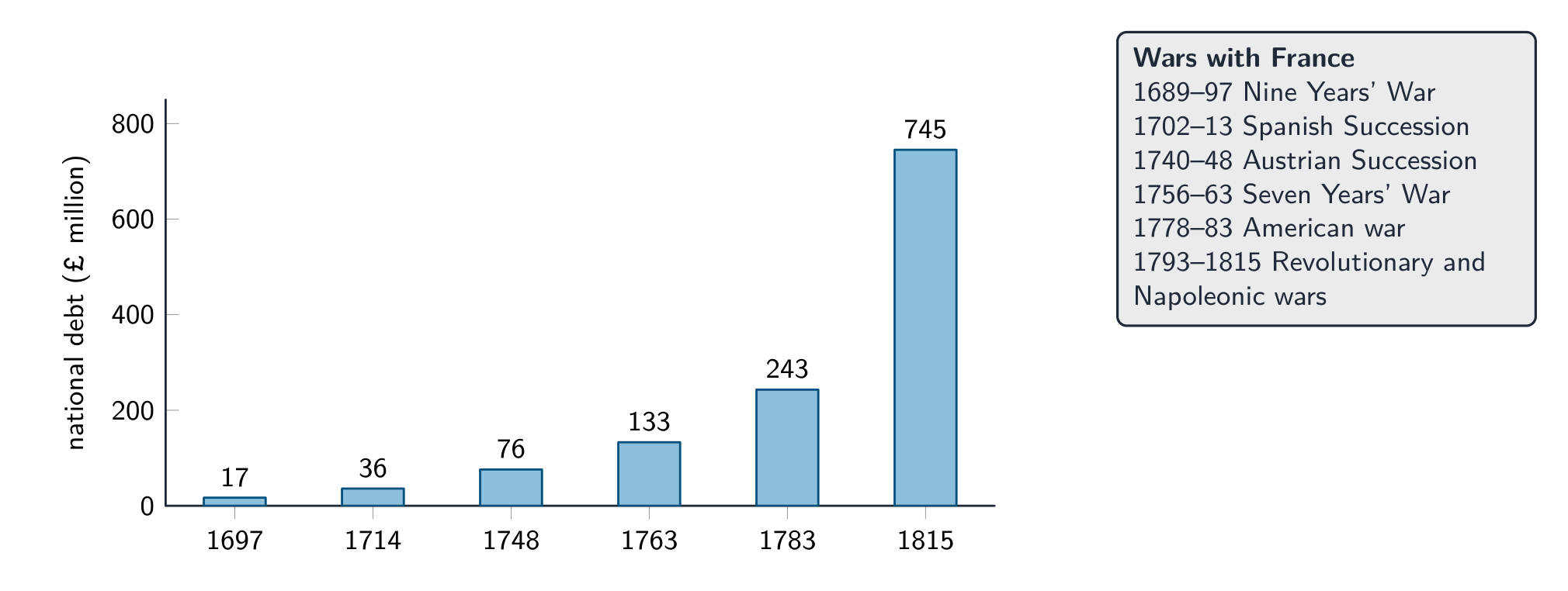
What happened to Britain's national debt during the Seven Years' War?
Dificultad 1/5 · 100 monedas + un pequeño bono en el primer intento de hoy
From about £76 million to about £133 million.
Consequences
- Britain became the leading sea power and built an empire across the world. The Dutch and Spanish lost ground; France lost most of its first empire.
- Competition also built lasting skills and institutions: shipbuilding, map-making, insurance at Lloyd's of London and banking. France's debts from these wars helped cause the crisis of 1789.
Cause or consequence?
Sort each item as a cause or a consequence of competition at sea.
Put these in order.
Dificultad 3/5 · 200 monedas + un pequeño bono en el primer intento de hoy
1600, 1757, 1763, 1805.
Do not treat the wars overseas as a separate story. The same wars were fought in Europe and in the colonies, and they were paid for by the same taxes and loans. A defeat at sea was a financial event as well as a military one.
The wars overseas were paid for by the same taxes and loans as the wars in Europe.
Dificultad 1/5 · 100 monedas + un pequeño bono en el primer intento de hoy
That is why a defeat at sea was also a financial event.
From the 1650s to 1815 European states competed for trade and colonies, believing one state's gain was another's loss. Britain fought the Dutch and then France in seven wars, paying for its navy with taxes and a trusted national debt. Britain won, gaining Canada and India by 1763 and the seas after Trafalgar (1805), while France's war debts helped bring on revolution.
Explain the causes and consequences of maritime competition between European states, 1650-1815.
Give both causes and consequences.