How Far Did Reason Reach?
Introducido| English | Significado |
|---|---|
| Methodism/ˈmeθəʊdɪzəm/ | A Protestant movement begun by John Wesley in eighteenth-century England, stressing personal, emotional faith. |
"Dare to know", 1784
- In December 1784, the German philosopher Immanuel Kant answered a question in a Berlin magazine: "What is Enlightenment?" His answer: humanity's escape from immaturity — from the habit of letting others think for us. Its motto, he wrote, was Sapere aude: "Dare to know." Yet Kant also wrote that he lived in an age of enlightenment, not yet an enlightened age.
- By the end of the eighteenth century, reason had challenged many old authorities — but its reach had clear limits.
What did Kant say Enlightenment meant?
Dificultad 1/5 · 100 monedas + un pequeño bono en el primer intento de hoy
Sapere aude.
Four things challenged
- Church authority: deists and sceptics questioned miracles and religious persecution. Absolute monarchy: Locke, Montesquieu and Rousseau proposed limits on power.
- The economy: Adam Smith challenged mercantilism. Superstition: the last legal execution for witchcraft in Europe took place in Switzerland in 1782.
Match each authority to its challenger.
Dificultad 2/5 · 140 monedas + un pequeño bono en el primer intento de hoy
Reason applied.
In what year was the last legal execution for witchcraft in Europe?
Dificultad 2/5 · 140 monedas + un pequeño bono en el primer intento de hoy
In Switzerland.
The same method everywhere
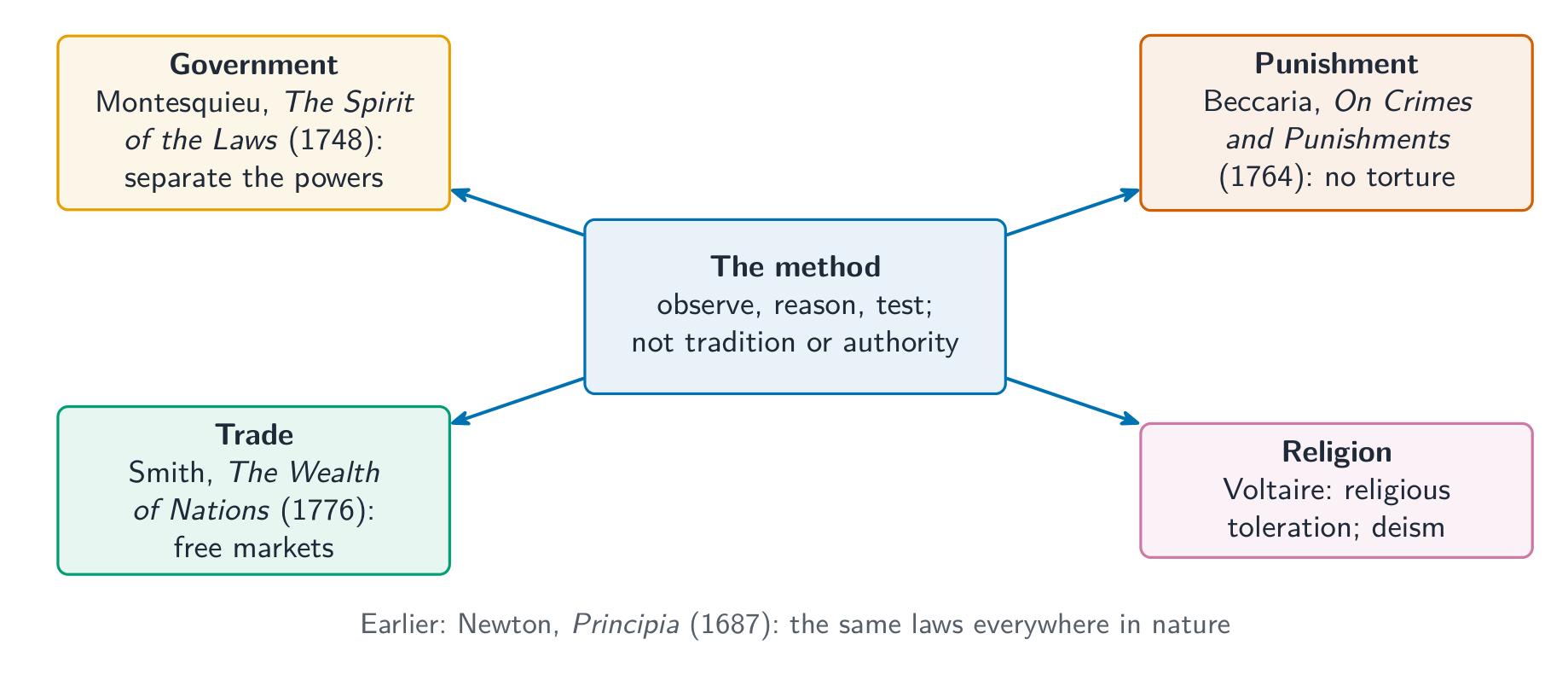
- The method of the Scientific Revolution — observation, reason and testing — was turned on law, government, religion and society.
- Beccaria applied it to punishment, Smith to trade and Montesquieu to constitutions.
An order challenged, a limit, or everyday life?
Sort each item in a unit-review answer.
Worked example: the limits
- Women: most thinkers did not extend equal rights to women; Rousseau wanted girls educated to please men.
- Slavery: the Atlantic slave trade reached its peak in the late eighteenth century. Some thinkers, such as Raynal and Condorcet, condemned slavery; others ignored it, and Locke had invested in a slave-trading company.
- The people: most Europeans were peasants who could not read, and enlightened rulers kept serfdom.
Who was largely left out of the Enlightenment's gains?
Dificultad 2/5 · 140 monedas + un pequeño bono en el primer intento de hoy
The limits.
Religion did not disappear
- Religious revival grew at the same time: John Wesley's Methodism 卫理公会 drew huge crowds in Britain, and Pietism spread in Germany.
- Most Europeans remained believers.
Methodism grew at the same time as the Enlightenment.
Dificultad 1/5 · 100 monedas + un pequeño bono en el primer intento de hoy
Religion did not disappear.
Everyday life
- Reading, coffeehouses and consumer goods changed life for the middle classes in cities.
- For most peasants, daily life — farming, the church, the village — changed little before 1789.
Do not exaggerate the Enlightenment's reach. It changed ideas among educated elites, but women, enslaved people and most peasants were largely left out.
The Enlightenment changed the daily lives of most European peasants.
Dificultad 1/5 · 100 monedas + un pequeño bono en el primer intento de hoy
Little changed before 1789.
Reason challenged the Church, absolute monarchy, mercantilism and superstition, using the method of the Scientific Revolution. But its reach was limited: women, enslaved Africans and most peasants gained little, and religion and traditional life continued alongside new ideas.
To what extent did Enlightenment ideas change European society in the eighteenth century?
Extent.