Foil Characters
Introducido| English | Significado |
|---|---|
| foil | a character who shares a situation with another so that their differences stand out |
Two sons, two dead fathers, c. 1600
- In Shakespeare's Hamlet, Hamlet's father has been murdered, and Hamlet delays his revenge for most of the play. Laertes's father, Polonius, is killed by Hamlet — and Laertes rushes home at once, raises a mob and swears to "be revenged / Most thoroughly for my father".
- Hamlet himself says of Laertes: "by the image of my cause I see / The portraiture of his". Laertes is a foil 衬托人物: a character who shares something with another so that their difference stands out.
What does Hamlet say about Laertes?
Dificultad 1/5 · 100 monedas + un pequeño bono en el primer intento de hoy
Hamlet sees his own situation in Laertes.
The shared half first
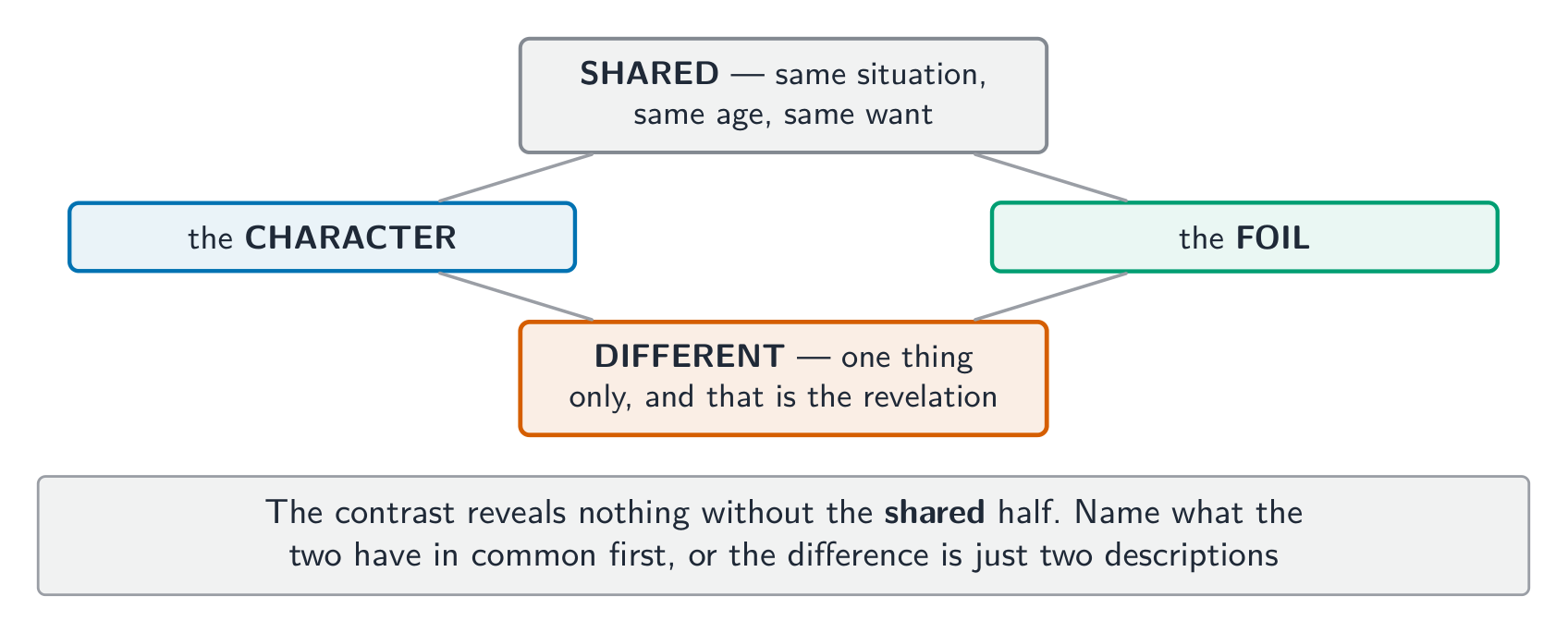
- A foil works only because of what the two characters share: both are sons, both lose fathers to murder, both seek revenge.
- Name the shared situation first; then the difference becomes meaningful.
What do Hamlet and Laertes share?
Dificultad 2/5 · 140 monedas + un pequeño bono en el primer intento de hoy
The shared half makes the contrast meaningful.
What the difference reveals
- Laertes acts without thinking; Hamlet thinks without acting. Each makes the other's quality clearer.
- Ask what the foil reveals about the main character — and about the work's question.
Is this a working foil analysis?
Sort each statement by how far it goes.
Match each character to his approach.
Dificultad 2/5 · 140 monedas + un pequeño bono en el primer intento de hoy
Each makes the other's quality clearer.
Worked example: Laertes and Hamlet
- Shared: both are young men whose fathers are killed; both are urged to revenge.
- Difference: Laertes says he would cut Hamlet's throat "i' the church"; he agrees at once to Claudius's plot with a poisoned sword. Hamlet, by contrast, refuses to kill Claudius at prayer and questions whether the Ghost can be trusted.
- Interpretation: Laertes's speed shows that Hamlet's delay is not cowardice but conscience — and also shows its cost. Laertes's quick revenge makes him Claudius's tool and kills them both; Hamlet's slow revenge costs many lives too. The foil turns the play's question into a choice with no safe answer.
Where does Laertes say he would cut Hamlet's throat?
Dificultad 1/5 · 100 monedas + un pequeño bono en el primer intento de hoy
His willingness contrasts with Hamlet sparing Claudius at prayer.
The foil suggests Hamlet's delay is conscience rather than simple cowardice.
Dificultad 1/5 · 100 monedas + un pequeño bono en el primer intento de hoy
Laertes's speed shows the alternative.
Other foils
- In Hamlet, Fortinbras is a third son avenging a father, who acts with an army — and ends the play holding Denmark.
- One main character can have several foils, each showing a different side.
Which other character is a foil to Hamlet as a son avenging a father?
Dificultad 1/5 · 100 monedas + un pequeño bono en el primer intento de hoy
He acts with an army and ends holding Denmark.
Writing about foils
- State the shared situation, the key difference with evidence from both characters, and what the difference reveals about the main character and theme.
- Avoid simple praise of one side: foils often show the cost of both choices.
Contrast without a shared base reveals little. "Laertes is hot-headed and Hamlet is thoughtful" is a list of traits. Show the shared situation that makes the comparison meaningful.
A list of contrasting traits without a shared situation is a strong foil analysis.
Dificultad 1/5 · 100 monedas + un pequeño bono en el primer intento de hoy
Name the shared base first.
A foil shares a situation with a main character so their difference stands out. Name the shared half first, show the difference with evidence from both, and explain what it reveals about the main character and the work's central question — including the cost of each choice.
Analyse a foil pair from a work you know — shared half, difference, and what it reveals.
Shared, difference, meaning.