A Thesis for a Given Prompt
Introducido| English | Significado |
|---|---|
| thesis/ˈθiːsɪs/ | The main claim that an essay or argument develops and supports. |
"Fog everywhere", 1853
- Charles Dickens's Bleak House opens in London: "Fog everywhere. Fog up the river, where it flows among green aits and meadows; fog down the river, where it rolls defiled among the tiers of shipping and the waterside pollutions of a great (and dirty) city."
- At its centre, "at the very heart of the fog, sits the Lord High Chancellor in his High Court of Chancery". The fog leads to a law court.
Who sits "at the very heart of the fog"?
Dificultad 1/5 · 100 monedas + un pequeño bono en el primer intento de hoy
The fog leads to the law court.
Read the prompt's task
- An AP prose prompt asks you to analyse how a writer uses literary elements and techniques to convey something specific, for example "the setting and its connection to the law court".
- Your thesis 论点 must answer that task, not a different one you prefer.
A thesis may answer a different question from the prompt if it is interesting.
Dificultad 1/5 · 100 monedas + un pequeño bono en el primer intento de hoy
Answer the prompt's task.
Map prompt to thesis
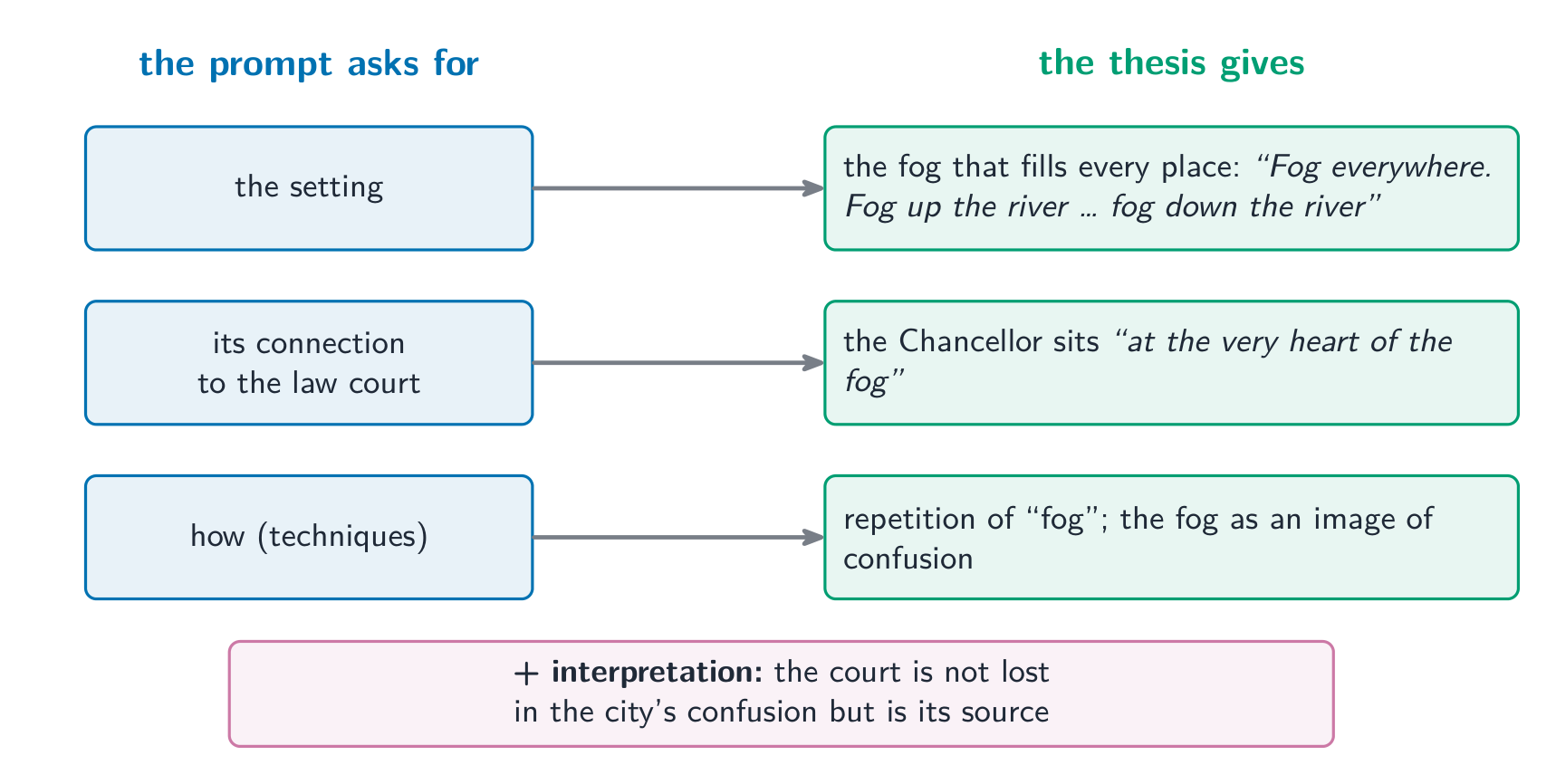
- Underline what the prompt asks for. Each part needs a place in your thesis: the subject (the setting), the connection (the law court) and the "how" (the techniques that matter).
- Then add your interpretation: what the passage suggests about the subject.
Thesis, restatement, or off-prompt?
Sort each opening for a prompt about a speaker's attitude to her childhood home.
Match each part of the prompt to its place in the thesis.
Dificultad 2/5 · 140 monedas + un pequeño bono en el primer intento de hoy
Every part needs a place.
Worked example: three theses
- Off the task: Dickens shows that Victorian London was very polluted.
- On the task, no interpretation: Dickens uses repetition and imagery to describe the fog and the court.
- On the task, with interpretation: by repeating "fog" until it fills every place and then placing the Chancellor "at the very heart of the fog", Dickens suggests that the court is not lost in the city's confusion but is its source.
Which thesis is on the task and makes an interpretation?
Dificultad 1/5 · 100 monedas + un pequeño bono en el primer intento de hoy
It answers the task and can be argued with.
Check the thesis against the prompt
- Does it answer every part of the task? Does it name only the techniques you will actually discuss?
- Does it make a claim someone could disagree with?
A thesis should name only the techniques you will actually discuss.
Dificultad 1/5 · 100 monedas + un pequeño bono en el primer intento de hoy
It is a promise to the reader.
Write it in the first minutes
- Read the passage once for meaning, again with the prompt in mind, then write a thesis before your first body paragraph.
- A thesis written first keeps the essay on the task.
Do not repeat the prompt as your thesis. "Dickens uses literary elements to portray the setting" adds nothing. Say what the setting suggests and how.
"Dickens uses literary elements to portray the setting" is a strong thesis.
Dificultad 1/5 · 100 monedas + un pequeño bono en el primer intento de hoy
It repeats the prompt.
A thesis for a given prompt answers the prompt's exact task: name the subject, the connection it asks about and the key techniques, and add an interpretation someone could disagree with.
Write a thesis for this task: analyse how Shelley uses the setting of "Ozymandias" to convey an attitude to power.
Task, technique, interpretation.