A Claim About a Long Text
Introducido| English | Significado |
|---|---|
| development/dɪˈveləpmənt/ | A process of growth, change or increasing complexity over time. |
"Reader, I married him", 1847
- Charlotte Brontë's Jane Eyre follows Jane from an unhappy childhood to marriage across 38 chapters. Its last chapter begins: "Reader, I married him."
- A claim about a novel this long must be true of the whole book, not just one scene.
How does the last chapter of Jane Eyre begin?
Dificultad 1/5 · 100 monedas + un pequeño bono en el primer intento de hoy
Jane addresses the reader directly.
A claim for the whole work
- A claim about a long text should cover its development 发展: how something changes or is tested from beginning to end.
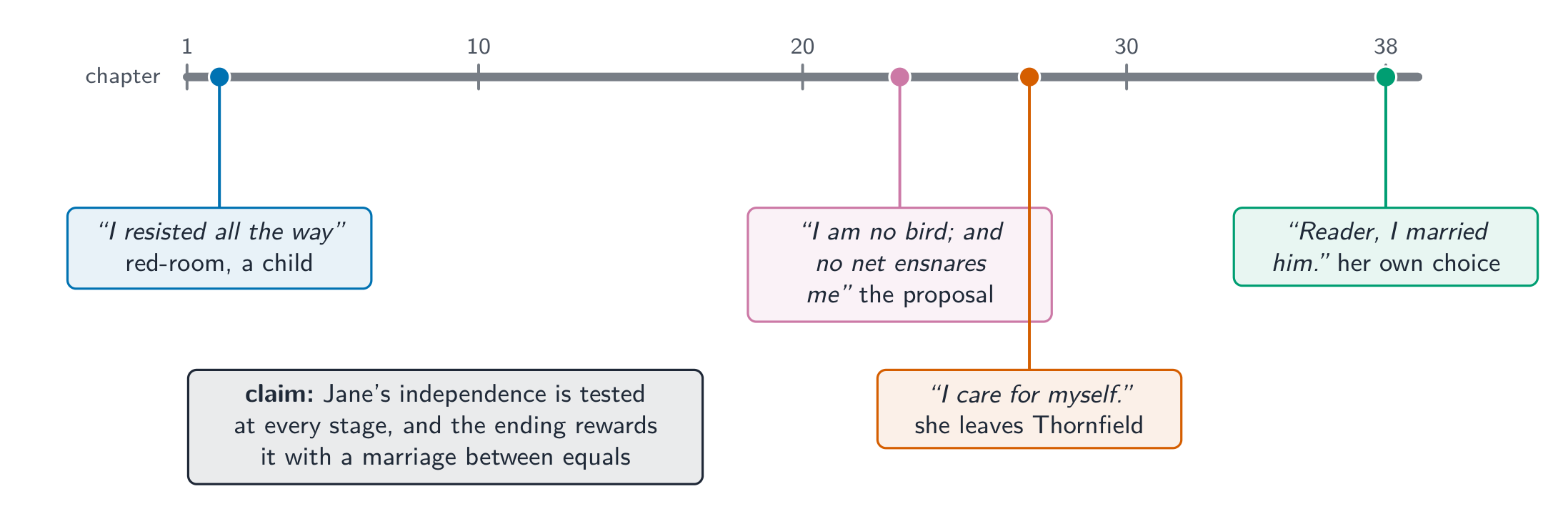
- Claim: "Jane's independence is tested at every stage of the novel, and the ending rewards it with a marriage between equals."
A claim about a long text should say how something develops from beginning to end.
Dificultad 1/5 · 100 monedas + un pequeño bono en el primer intento de hoy
Development is what a whole-work claim tracks.
Spread the evidence
- Evidence from one chapter cannot prove a claim about the whole book. Choose moments from the beginning, middle and end.
- For Jane: the red-room in chapter 2, Rochester's proposal in chapter 23, her flight from Thornfield in chapter 27 and the marriage in chapter 38.
Is this evidence choice strong for a long text?
Sort each pairing by what it can actually prove.
Worked example: four moments
- Chapter 2: locked in the red-room as a child, Jane begins: "I resisted all the way: a new thing for me".
- Chapter 23: she tells Rochester, "I am no bird; and no net ensnares me: I am a free human being with an independent will".
- Chapter 27: when she learns he is already married, she leaves him: "I care for myself."
- Chapter 38: she returns with money and family of her own, and the choice is hers: "Reader, I married him." Each step tests the same quality, so the claim holds for the whole novel.
Put Jane's four moments in the order of the novel.
Dificultad 3/5 · 200 monedas + un pequeño bono en el primer intento de hoy
Chapters 2, 23, 27 and 38.
Show the change, not just the pattern
- Repetition alone is weak. Explain how each moment raises the stakes: a child's resistance, a lover's demand for equality, a sacrifice, a free choice.
- Development is what makes the claim worth reading.
What makes the four moments stronger than one quotation repeated?
Dificultad 1/5 · 100 monedas + un pequeño bono en el primer intento de hoy
Show the change, not just the pattern.
Choose a claim the book can carry
- If you cannot find evidence in at least three parts of the text, your claim may be about one episode, not the work.
- Test it against the ending: does the last chapter support it or complicate it?
If you can find evidence for a claim only in one episode, it may not be a claim about the whole work.
Dificultad 1/5 · 100 monedas + un pequeño bono en el primer intento de hoy
Look for evidence in at least three parts.
One famous quotation is not enough. "I am no bird" proves something about chapter 23. A claim about the novel needs evidence from its beginning, middle and end.
What does "I am no bird" prove by itself?
Dificultad 1/5 · 100 monedas + un pequeño bono en el primer intento de hoy
One quotation proves one moment.
A claim about a long text must hold across the whole work. Spread your evidence across beginning, middle and end, and explain how each moment develops the claim, not only that it repeats.
Write a claim about a novel you know, then name evidence from its beginning, middle and end.
Whole work, spread evidence.