A Speaker Gives Themselves Away
Introducido| English | Significado |
|---|---|
| speaker/ˈspiːkə/ | The voice that speaks in a poem, not necessarily the poet. |
| dramatic monologue | a poem spoken by one character to a silent listener |
"That's my last Duchess painted on the wall", 1842
- Robert Browning's poem "My Last Duchess" is spoken by a duke showing a visitor a portrait of his dead wife. The visitor has come to arrange the duke's next marriage.
- The duke wants to look powerful and refined. Without meaning to, he tells us that he had his wife killed.
Who is the duke speaking to in "My Last Duchess"?
Dificultad 1/5 · 100 monedas + un pequeño bono en el primer intento de hoy
That makes what he reveals even more alarming.
The speaker is a character
- The speaker 说话者 is the voice of a poem. It is not the poet: Browning was not a murderous duke.
- A poem spoken by one character to a silent listener is a dramatic monologue 戏剧独白. We judge the speaker from what he chooses to say, and from what slips out.
The speaker of a poem is always the poet.
Dificultad 1/5 · 100 monedas + un pequeño bono en el primer intento de hoy
The speaker is a voice the poet creates.
A poem spoken by one character to a silent listener is a dramatic ____.
Dificultad 1/5 · 100 monedas + un pequeño bono en el primer intento de hoy
Dramatic monologue.
What the duke gives away
- He complains that his wife had "A heart—how shall I say?—too soon made glad, / Too easily impressed". She smiled at everyone, and he could not bear it.
- Then: "I gave commands; / Then all smiles stopped together." He never says what the commands were. The gap tells us.
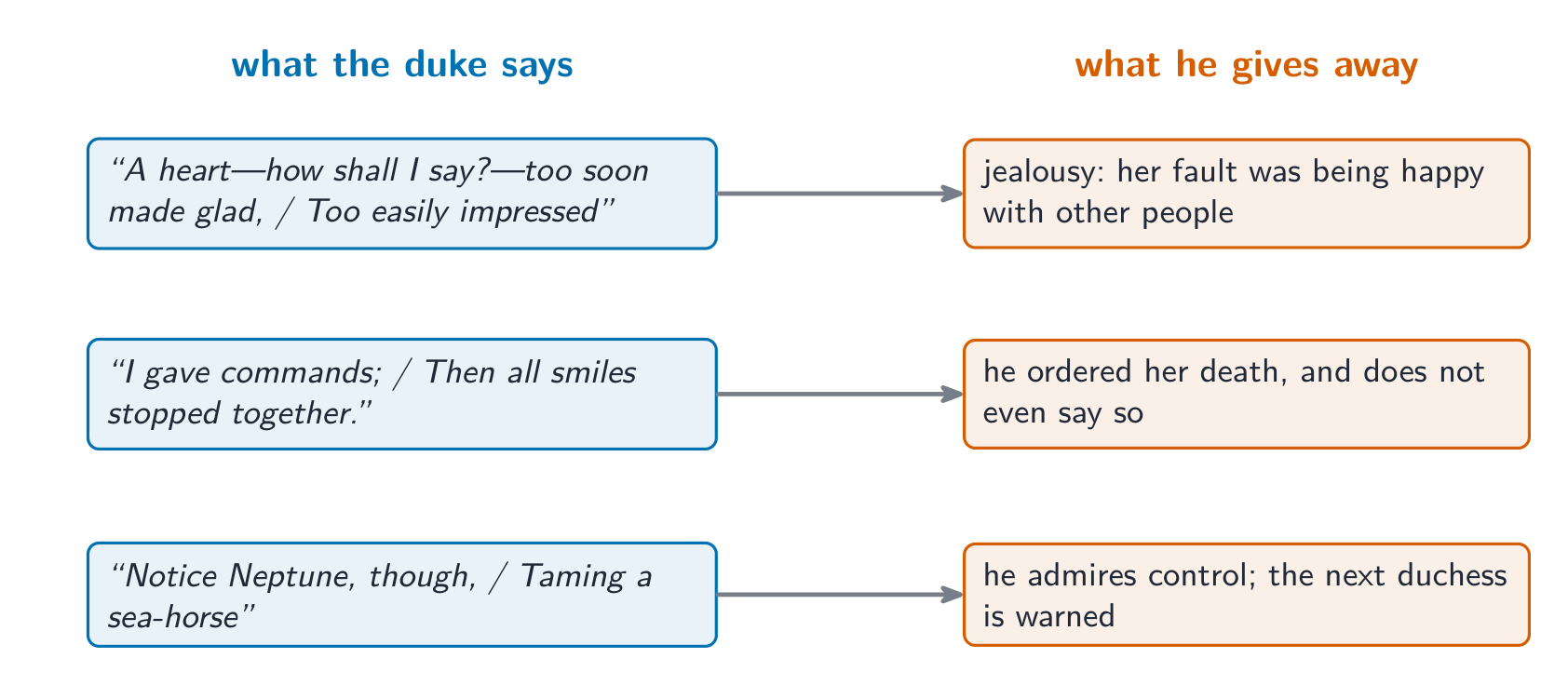
Which channel is this evidence?
Sort each observation by the channel the CED names.
What does "I gave commands; / Then all smiles stopped together" suggest?
Dificultad 1/5 · 100 monedas + un pequeño bono en el primer intento de hoy
The gap the duke leaves tells us what he will not say.
Worked example: the pause
- Line: "A heart—how shall I say?—too soon made glad".
- What it shows: the duke pretends to search politely for the right word, but the pause is a performance of control: he wants the listener to admire his taste.
- What it gives away: the "fault" he finally names is that she was happy. The poem shows a man who treated his wife's joy as an insult to him.
Watch the last image
- The poem ends with another work of art: "Notice Neptune, though, / Taming a sea-horse". The duke points to a statue of a god controlling an animal.
- The image fits what he did to his wife, and what he expects of the next one.
Why is the statue of Neptune "Taming a sea-horse" a fitting last image?
Dificultad 1/5 · 100 monedas + un pequeño bono en el primer intento de hoy
A god controlling an animal mirrors the duke and his wife.
Words and the gaps between them
- Look for pauses, sudden changes of subject and things the speaker refuses to explain. These are where speakers give themselves away.
- Compare what the speaker wants the listener to think with what the reader concludes.
Select todos the places where a speaker may give himself away.
Dificultad 2/5 · 140 monedas + un pequeño bono en el primer intento de hoy
Titles are not part of the speaker's voice.
Do not confuse the speaker with the poet. Write "the duke" or "the speaker", not "Browning", when you discuss the voice of the poem.
The speaker is a character created by the poet. In a dramatic monologue we judge the speaker by what he says and by what slips out: pauses, gaps and changes of subject show more than he means to tell.
Write two sentences about what the duke wants the visitor to think and what the reader concludes instead.
Intention against revelation.