Métodos: Cómo Escribirlos
Introducido| English | Significado |
|---|---|
| accessor/əkˈsesə/ | accesor |
| mutator/mjuːˈteɪtə/ | mutator |
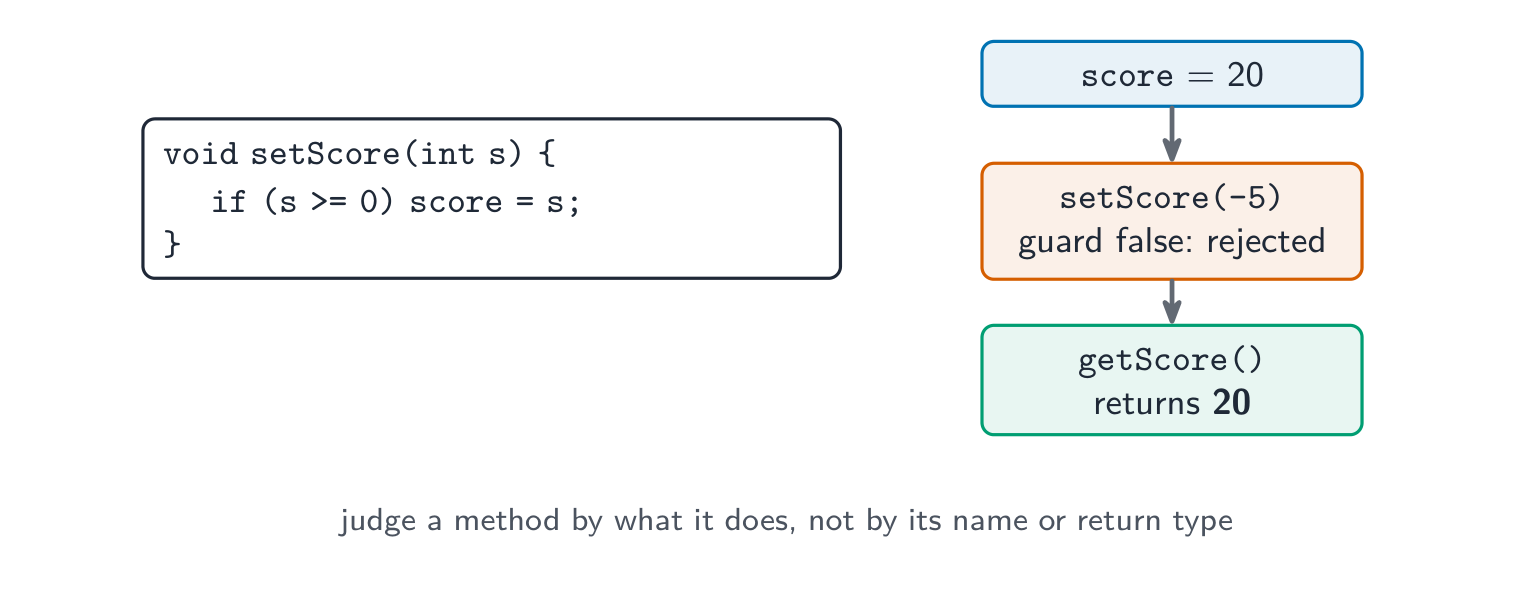
A rejected update leaves the previous state intact
- A score starts at 20. setScore(s) assigns only when s >= 0; the call setScore(-5) leaves score at 20.
- The guard prevents an invalid update. A later getScore() returns the existing state rather than the rejected argument.
Writing a method
- A method has a header and a body. Header:
public void addScore(int s)— access, return type, name, parameters. - Body: the statements in
{ }that do the work. The method can read and change the object's instance variables.
Return values
- A method's return type says what it hands back; use
return value;to send it.public int getScore() { return score; }returns the current score. - A
voidmethod returns nothing — it just does its job (e.g. printing). The returned value must be assignment-compatible with the declared return type; for example, anintvalue can be widened and returned by adoublemethod.
El método public double result() { return 3; } puede compilar aunque 3 sea un literal int.
Dificultad 1/5 · 100 monedas + un pequeño bono en el primer intento de hoy
Java amplía el resultado int a double; los valores de retorno deben ser compatibles, no necesariamente escritos con un tipo idéntico.
Accessors and mutators
- An accessor (getter) 访问方法 returns information without changing the object:
getScore(). A mutator (setter) 修改方法 changes the object's state:addScore(s)orsetName(n). - Getters are usually
int/String-returning; setters are usuallyvoid. Together they form the object's public interface over its private data.
Un accesor returns un valor
Comenzando con score 20, setScore(-5) rechaza la actualización; getScore devuelve 20.
Un método que devuelve información sin cambiar el objeto es un(a)...
Dificultad 1/5 · 100 monedas + un pequeño bono en el primer intento de hoy
Los accesores leen y devuelven; los mutadores cambian el estado.
Un método void...
Dificultad 1/5 · 100 monedas + un pequeño bono en el primer intento de hoy
void = sin valor de retorno; simplemente realiza una acción.
A non-void method may reach its closing brace and complete normally without returning a value.
Dificultad 1/5 · 100 monedas + un pequeño bono en el primer intento de hoy
A path completing normally must return a compatible value. A path that throws an exception is a different case.
¿Qué método puede validar su entrada antes de cambiar el estado?
Dificultad 1/5 · 100 monedas + un pequeño bono en el primer intento de hoy
Un setter puede verificar (ej. rechazar negativos) antes de asignar.
Escribir valor de retorno; dentro de un método void compila bien.
Dificultad 1/5 · 100 monedas + un pequeño bono en el primer intento de hoy
Un método void no puede devolver un valor — eso no compilará.
Methods can validate
- Because outside code goes through methods, a method can check before it acts.
public void setScore(int s) { if (s >= 0) score = s; }rejects a negative score. - Private access prevents unrelated code from directly assigning the field. Constructors and every class method that writes it must still preserve the intended rule; the guarded setter cannot repair an invalid initial score by itself.
A non-void method must return a compatible value on every path that completes normally. A path may instead throw an exception. If an int method reaches its end without returning, compilation fails. A void method returns nothing, so return; (or no return) is correct there; writing return value; in a void method won't compile.
For the stated guarded setter, what does getScore() return after setScore(-5)?
Dificultad 2/5 · 140 monedas + un pequeño bono en el primer intento de hoy
The condition fails, so no assignment occurs and the old score remains 20.
Comenzando con score 20, replaceScore(30) guarda el puntaje antiguo, asigna 30, y luego devuelve el puntaje antiguo. ¿Qué valor devuelve la llamada?
Dificultad 2/5 · 140 monedas + un pequeño bono en el primer intento de hoy
El puntaje antiguo devuelto es 20; el nuevo puntaje almacenado es 30. Devolver un valor no impide la mutación.
An accessor and a mutator:
- Accessor:
public int getScore() { return score; }— reads, returnsint. - Mutator:
public void addScore(int s) { score += s; }— changes state, returns nothing. student.addScore(10); int now = student.getScore();
Carry the reasoning to a new case
- Consider
public int replaceScore(int s) { int old = score; score = s; return old; }. It is a mutator even though it returns a value: starting at 20, replaceScore(30) returns 20 and leaves the score at 30. - Judge behavior rather than names or return types. A method called getScore that increments the score is not a pure accessor, and a void method that merely prints a message need not mutate the object.
A method has a header (access, return type, name, parameters) and a body. A non-void method must return an assignment-compatible value on every normally completing path; a void method returns nothing. Accessors (getters) return state without changing it; mutators (setters) change state and can validate the new value.