Pasar y Devolver Referencias
Introducido| English | Significado |
|---|---|
| NullPointerException/nʌl ˈpɔɪntə ekˈsepʃn/ | NullPointerException |
Mutating an object differs from reassigning a parameter
- A caller refers to a Student with score 10. The method executes s.addScore(5); then s = new Student("Other");
- The score of the original shared object becomes 15. Reassigning the local parameter does not change the caller variable, because Java copies the reference value into the parameter.
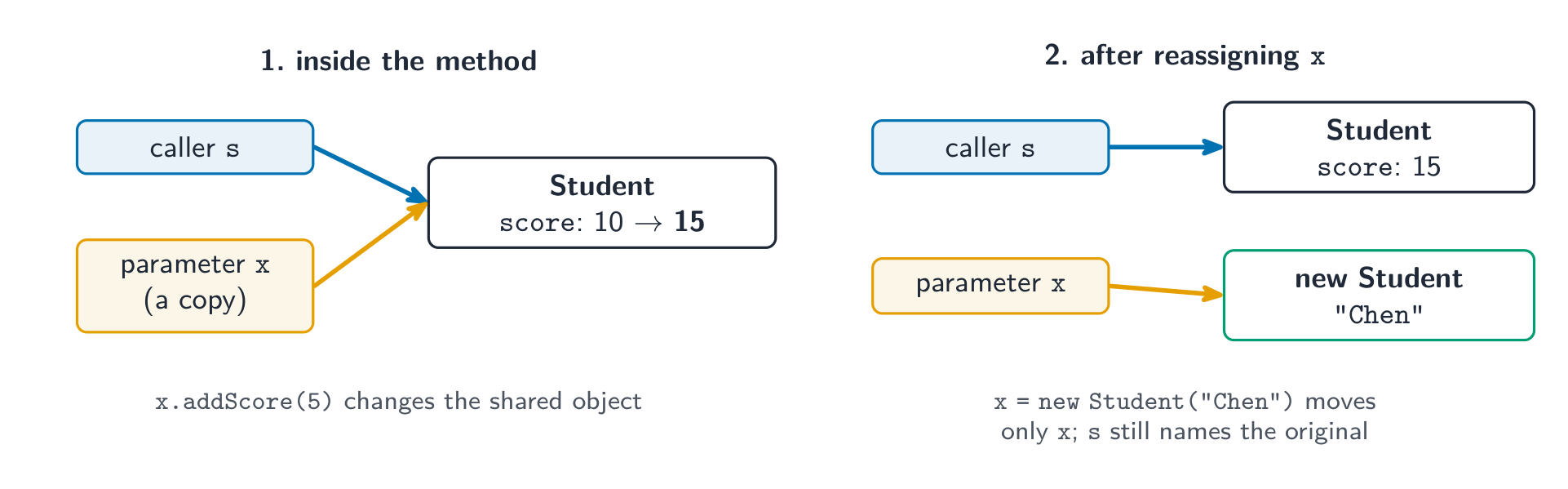
Passing an object to a method
- Java copies the reference value into the method parameter; it does not copy the object. The method's parameter points at the same object as the caller's variable.
- So changes the method makes to the object are visible to the caller. Both primitive and reference arguments are passed by value; the copied reference can still reach a shared object.
Primitives vs. objects as arguments
- A primitive argument is copied — the method can't change the caller's variable. For an object argument, the copied reference reaches the same object — the method can mutate that object.
changeInt(x)can't alterx;student.addScore(10)does change that student. Ask whether the method mutates the shared object or reassigns only its local parameter.
Returning an object
- A method can return a reference to an object — the caller then shares it.
public Student topStudent() { return best; }hands back a reference tobest. - Returning
bestshares an existing object. In contrast,return new Student("Copy");constructs a new object and returns its reference; a method can also returnnull. Read the return expression before deciding whether state is shared.
Referencia copiada, objeto compartido; primitivo copiado
La puntuación del objeto cambia; el primitivo x no.
Cuando pasas un objeto a un método, el método recibe...
Dificultad 1/5 · 100 monedas + un pequeño bono en el primer intento de hoy
Java copia el valor de referencia en una variable de parámetro separada. Las dos referencias pueden alcanzar el mismo objeto; la reasignación del parámetro no reemplaza la variable del invocante.
Un método puede cambiar la variable int del invocador modificando su parámetro.
Dificultad 1/5 · 100 monedas + un pequeño bono en el primer intento de hoy
Los primitivos se copian: el int del invocador permanece intacto.
Llamar a un método de instancia a través de una referencia nula lanza...
Dificultad 1/5 · 100 monedas + un pequeño bono en el primer intento de hoy
null no apunta a ningún objeto, por lo que no hay nada sobre lo cual llamar al método.
Un método puede devolver una referencia a un objeto, que luego comparte el invocador.
Dificultad 1/5 · 100 monedas + un pequeño bono en el primer intento de hoy
Un método puede devolver una referencia de objeto existente y compartir su objeto con el invocante. Un método diferente puede construir y devolver un objeto nuevo.
Para usar con seguridad una referencia que podría ser nula, primero debes verificar...
Dificultad 1/5 · 100 monedas + un pequeño bono en el primer intento de hoy
Protege contra null antes de llamar a un método sobre ella.
Todo método que devuelve una referencia de Student debe devolver un objeto preexistente.
Dificultad 1/5 · 100 monedas + un pequeño bono en el primer intento de hoy
Falso: return new Student("Other"); construye y devuelve un objeto nuevo.
The null reference
- A reference that points at no object is
null. Calling an instance method throughnullthrows a NullPointerException 空指针异常. - Returning
null(e.g. "not found") is common — the caller must check for it. Guard withif (s != null) { s.addScore(10); }before using a possibly-null reference.
Passing an object copies a reference value — the method can change the caller's object; passing a primitive copies the value — it can't. So student.addScore(10) mutates the caller's object, but changeInt(x) leaves the caller's x untouched. And calling an instance method through a null reference throws a NullPointerException — check != null first when a reference might be null.
After the two statements, what is the original caller-referenced Student score?
Dificultad 2/5 · 140 monedas + un pequeño bono en el primer intento de hoy
The first statement mutates the original object to 15. The later local reassignment does not replace the caller reference.
Un método devuelve new Student("Otro"); pero el invocador ignora el resultado. ¿Qué sucede con la variable Student existente del invocador?
Dificultad 1/5 · 100 monedas + un pequeño bono en el primer intento de hoy
Devolver una referencia no la asigna a la variable del invocador. La variable existente todavía apunta a su objeto original.
Reference vs. value:
void addTen(Student s) { s.addScore(10); }— changes the passed object (shared reference).void addTen(int x) { x += 10; }— the caller'sintis unchanged (copied value).- Both parameter values are copied; only the copied reference reaches shared mutable state.
Carry the reasoning to a new case
- Compare
return s;withreturn new Student("Other");: the first returns the supplied reference; the second returns a newly constructed object. Neither return changes the caller's variable until the caller assigns the result. - To predict a change, draw the caller and parameter as separate reference variables pointing to objects. Update the object for a mutator call, and update only the parameter arrow for parameter reassignment.
Passing an object reference copies its value into the parameter, so the method can change the caller's object; passing a primitive copies the value, so it can't. A method can return a reference to an object. A reference to no object is null — calling an instance method through it throws a NullPointerException, so check first.