Calculating the Equilibrium Constant
Introducido| English | Significado |
|---|---|
| equilibrium concentrations | The concentrations present once a reaction has reached equilibrium; these are the values used in K. |
| ICE table/aɪs ˈteɪbl/ | tabla ICE |
Same K, whatever the start
- Three flasks of $\text{H}_2$, $\text{I}_2$ and HI start with different amounts. After they settle at $445^\circ\text{C}$, the equilibrium amounts are all different, but the ratio $\dfrac{[\text{HI}]^2}{[\text{H}_2][\text{I}_2]}$ comes out near $50$ every time.
- That fixed value is $K$. To find it, you need the equilibrium concentrations 平衡浓度, not the starting ones.
To calculate $K$, you can use the initial concentrations of a reaction mixture.
Dificultad 1/5 · 100 monedas + un pequeño bono en el primer intento de hoy
$K$ uses equilibrium concentrations only. Initial values give $Q$ at the start, not $K$.
Method 1: all equilibrium values are given
- Write the $K$ expression first, with each concentration raised to its coefficient.
- Substitute the equilibrium values and calculate. $K$ is written without units.
$\text{N}_2(g)+3\text{H}_2(g)\rightleftharpoons2\text{NH}_3(g)$. At equilibrium: $[\text{N}_2]=0.50\ \text{M}$, $[\text{H}_2]=0.20\ \text{M}$, $[\text{NH}_3]=0.10\ \text{M}$. Find $K_c$.
- $K_c=\dfrac{[\text{NH}_3]^2}{[\text{N}_2][\text{H}_2]^3}$
- $K_c=\dfrac{(0.10)^2}{(0.50)(0.20)^3}=\dfrac{0.010}{(0.50)(0.0080)}=\dfrac{0.010}{0.0040}=2.5$
A favor $\text{H}_2(g)+\text{I}_2(g)\rightleftharpoons2\text{HI}(g)$, the equilibrium concentrations are $[\text{H}_2]=0.020$, $[\text{I}_2]=0.020$ y $[\text{HI}]=0.14\ \text{M}$. Calculate $K_c$.
Dificultad 2/5 · 140 monedas + un pequeño bono en el primer intento de hoy
$K_c=\dfrac{(0.14)^2}{(0.020)(0.020)}=\dfrac{0.0196}{0.00040}=49$.
Method 2: only one equilibrium value is measured
- Often you know the starting amounts and only one equilibrium concentration. Build an ICE table 三段式表 (Initial, Change, Equilibrium).
- The measured value tells you $x$. Then every other equilibrium value follows from the change row, using the coefficients.
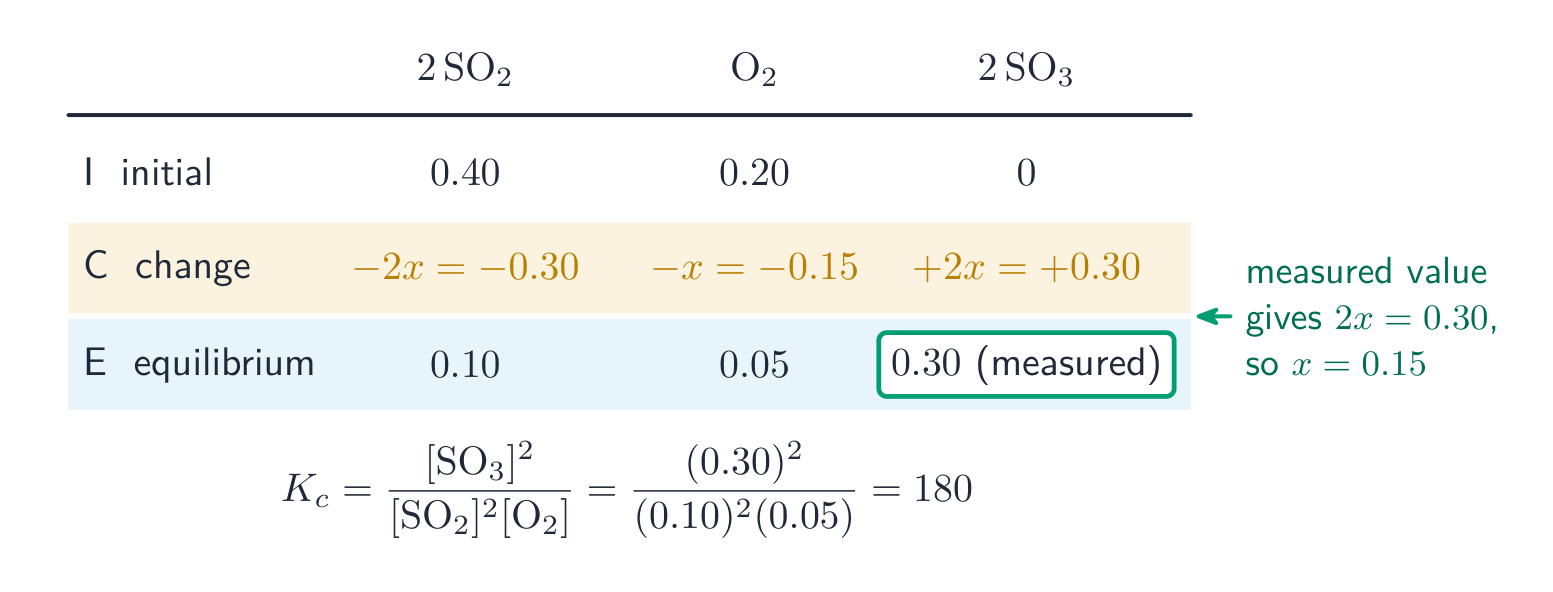
$0.40\ \text{M}\ \text{SO}_2$ and $0.20\ \text{M}\ \text{O}_2$ react: $2\text{SO}_2(g)+\text{O}_2(g)\rightleftharpoons2\text{SO}_3(g)$. At equilibrium $[\text{SO}_3]=0.30\ \text{M}$. Find $K_c$.
- Change row: $-2x,\ -x,\ +2x$. The product went from $0$ to $0.30$, so $2x=0.30$ and $x=0.15$.
- Equilibrium: $[\text{SO}_2]=0.40-0.30=0.10$, $[\text{O}_2]=0.20-0.15=0.05$, $[\text{SO}_3]=0.30$.
- $K_c=\dfrac{(0.30)^2}{(0.10)^2(0.05)}=\dfrac{0.090}{0.00050}=180$
Build an ICE table
An ICE table organises the amounts before and at equilibrium.
$\text{N}_2+3\text{H}_2\rightleftharpoons2\text{NH}_3$ starts with no $\text{NH}_3$. At equilibrium $[\text{NH}_3]=0.40\ \text{M}$. By how much did $[\text{H}_2]$ fall, in M?
Dificultad 2/5 · 140 monedas + un pequeño bono en el primer intento de hoy
$2x=0.40$, so $x=0.20$. Hydrogen's change is $-3x=-0.60\ \text{M}$.
$\text{A}(g)\rightleftharpoons2\text{B}(g)$ starts with $[\text{A}]=1.00\ \text{M}$ and no B. At equilibrium $[\text{B}]=0.40\ \text{M}$. Calculate $K_c$.
Dificultad 2/5 · 140 monedas + un pequeño bono en el primer intento de hoy
$2x=0.40$, so $x=0.20$ y $[\text{A}]=1.00-0.20=0.80$. $K_c=\dfrac{(0.40)^2}{0.80}=0.20$.
Put the steps for finding $K$ from one measured equilibrium value in order.
Dificultad 3/5 · 200 monedas + un pequeño bono en el primer intento de hoy
Set up the table, let the measurement fix $x$, then use only the equilibrium row in $K$.
Moles in a flask? Divide by volume first
- $K_c$ needs mol/L. If $1.0\ \text{mol}$ of gas sits in a $2.0\ \text{L}$ flask, its concentration is $0.50\ \text{M}$.
- Do this division for every species before you substitute. Using moles directly gives a wrong $K$ whenever the volume is not $1\ \text{L}$ and the powers do not cancel.
At equilibrium a $2.0\ \text{L}$ flask holds $0.40\ \text{mol}\ \text{NO}_2$ y $0.80\ \text{mol}\ \text{N}_2\text{O}_4$. For $\text{N}_2\text{O}_4\rightleftharpoons2\text{NO}_2$, calculate $K_c$.
Dificultad 2/5 · 140 monedas + un pequeño bono en el primer intento de hoy
$[\text{NO}_2]=0.20\ \text{M}$ y $[\text{N}_2\text{O}_4]=0.40\ \text{M}$. $K_c=\dfrac{(0.20)^2}{0.40}=0.10$. Using moles directly would give $0.20$, which is wrong.
Gases: K from partial pressures
- With partial pressures in atm, the same method gives $K_p$. For $\text{PCl}_5(g)\rightleftharpoons\text{PCl}_3(g)+\text{Cl}_2(g)$ with $P_{\text{PCl}_5}=0.50$, $P_{\text{PCl}_3}=P_{\text{Cl}_2}=0.20\ \text{atm}$: $K_p=\dfrac{(0.20)(0.20)}{0.50}=0.080$.
- $K_c$ and $K_p$ are usually different numbers for the same reaction. They are equal only when the moles of gas are the same on both sides.
A favor $2\text{NO}_2(g)\rightleftharpoons\text{N}_2\text{O}_4(g)$ at equilibrium, $P_{\text{NO}_2}=0.50\ \text{atm}$ y $P_{\text{N}_2\text{O}_4}=0.25\ \text{atm}$. Calculate $K_p$.
Dificultad 2/5 · 140 monedas + un pequeño bono en el primer intento de hoy
$K_p=\dfrac{P_{\text{N}_2\text{O}_4}}{P_{\text{NO}_2}^2}=\dfrac{0.25}{(0.50)^2}=1.0$.
K depends only on temperature
- Changing the starting amounts changes the equilibrium amounts, but not $K$. Only a change in temperature gives a new $K$.
- So a $K$ value always belongs to one temperature. A question that changes the temperature needs a new $K$.
Which change gives a reaction a new value of $K$?
Dificultad 1/5 · 100 monedas + un pequeño bono en el primer intento de hoy
Only temperature changes $K$. The other changes can move the equilibrium amounts, but the ratio returns to the same $K$.
Common slips: putting initial concentrations into $K$; forgetting the coefficient in the change row (here $\text{SO}_2$ falls by $2x$, not $x$); using moles instead of mol/L; and forgetting the powers, such as $(0.20)^3$ for $[\text{H}_2]^3$.
$K$ comes from equilibrium values only. If all are given, substitute them into the expression. If only one is measured, use an ICE table: the measured change gives $x$, and the coefficients give the rest. Use mol/L for $K_c$ and atm for $K_p$. $K$ changes only with temperature.